
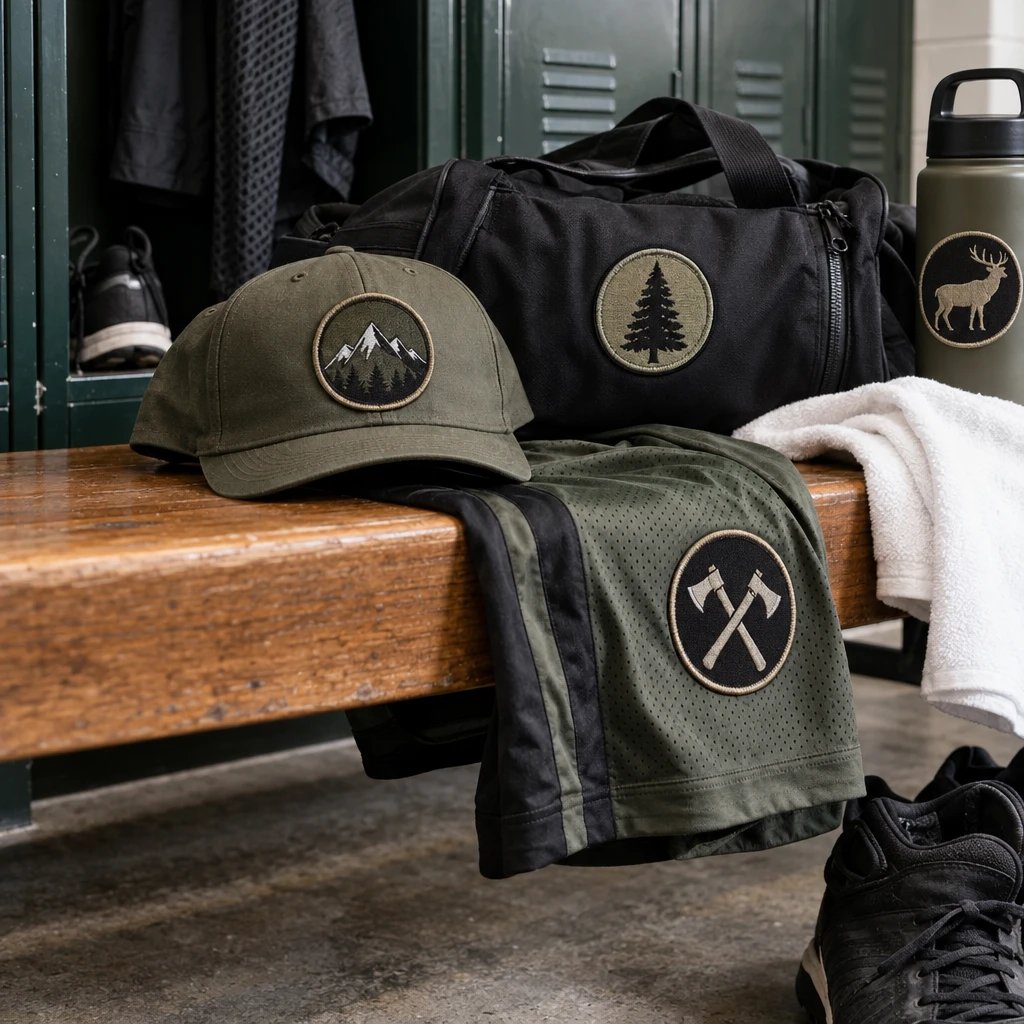
"Embroidered patches aren't worth ordering in small quantities" is partly true: setup costs matter, but unused inventory costs money too. For an embroidered patches small order, the practical answer is yes when you need matching patches for a defined group, the artwork stitches clearly, and the attachment method fits the garments.
The mistake is treating quantity as the whole decision. A simple club emblem on a work jacket can be a sensible small purchase, while the same budget spent squeezing a complicated crest onto a narrow cap front can buy a disappointing result. I would sort out the artwork and garment first. Then compare quantities.
When is an embroidered patches small order worth the setup?
A small embroidered run is worth considering when the patches have an immediate use and the design does not depend on very fine detail. Myth: "A small run always wastes money." Verdict: false.
Embroidery needs production preparation even when the order is small. The artwork must become stitch instructions, the size and border must work together, and the backing must match the intended application. Those tasks do not disappear because you need fewer pieces. That is the grain of truth behind the concern.
But a lower unit price is not automatically a better purchase. For example, say a neighborhood repair business needs 10 patches for current work shirts and replacement garments. Ordering a much larger batch simply to lower the price per patch ties up money in stock that may sit unused, especially if the business changes its logo or uniform.
USA Customized Patches has a 10-piece minimum. That gives a small group a workable starting point without requiring a large inventory commitment. I would buy for known garments and realistic replacements, not a hoped-for audience.
Why can fewer patches cost more per piece?
Smaller runs spread preparation and handling across fewer finished patches, so the unit price can be higher. Myth: "A higher small-order price means the manufacturer is overcharging." Verdict: partly true only if the quote includes unnecessary specifications or unclear charges.
Digitizing is the process that converts artwork into machine-readable embroidery instructions. It determines more than the outline: stitch direction, sequencing, underlay, and areas of coverage affect how the finished patch holds together and looks. A supplied image is not automatically a production-ready stitch file.
The useful comparison is between matching specifications. Ask for the same dimensions, quantity, thread coverage, border, backing, and destination on each quote. A plain sew-on patch and a patch with hook backing are not interchangeable line items, even when both show the same logo.
For example, a club might compare a 10-piece order with a 40-piece order. The larger run may offer a lower unit price, but it is only better value if the club expects to use the extra pieces. Request an itemized quote in US dollars and check what is included rather than assuming every supplier bundles setup, backing, and shipping the same way.
Will a smaller patch make the order less expensive?
Reducing the dimensions can reduce material and stitching requirements, but it can also make the design unreadable. Myth: "Just shrink the patch to save money." Verdict: partly true.
The border takes up physical space. So do the stitches forming a letter. When the whole design shrinks, the negative space inside small letters can close up, thin outlines can disappear, and neighboring details can merge. More thread does not solve that problem.
For example, imagine a 3-inch circular patch with a club name, a central bicycle, a founding year, and a small motto. Reducing that design to 2 inches may require removing the motto and simplifying the bicycle. Keeping everything unchanged would preserve the digital layout, not necessarily the finished readability.
I would cut secondary wording before cutting the primary emblem down too far. A patch needs to communicate on a moving person, not just look complete on a monitor. Print the proposed artwork at its actual dimensions and hold it against the intended jacket or cap. That inexpensive check catches proportion problems before production.
Which logo details actually work in embroidery?
Bold shapes, open lettering, and clear color separation are good candidates for embroidery. Myth: "Any logo can be embroidered without changes." Verdict: false.
Embroidered patches are fabric emblems that use stitched thread to build the visible design. Thread has width and texture. It cannot reproduce every effect that a screen can display, particularly soft gradients, tiny lettering, hairline outlines, and photographic shading.
For example, a local running club might have a skyline logo with thin window lines and a shaded sunset. On a small patch, a solid skyline and a few distinct color areas will generally communicate better than an attempt to stitch every window. That is an adaptation, not necessarily a downgrade.
In our production experience, the troublesome artwork is often the design that must preserve every tiny element at a fixed size. If the full wording is mandatory, either increase the patch size or consider another construction. Do not approve illegible lettering just to keep the word embroidery on the order.
You can request a free digital mockup through our embroidered patch options with the intended dimensions and garment noted. The useful question is not simply whether the logo looks good, but what needs to change to make it stitch clearly.
Should a small team choose woven or printed patches instead?
Choose the construction that preserves the important part of the artwork, not the one that sounds most substantial. Myth: "Embroidery is always the premium choice." Verdict: false.
Embroidery offers visible thread texture and a familiar uniform-patch appearance. That makes it a strong choice for bold business logos, club emblems, and jacket badges. The trade-off is that raised stitching is less forgiving of miniature details than a flatter construction.
| Construction | Best reason to choose it | Main trade-off | Example small-run use |
|---|---|---|---|
| Embroidered | Visible thread texture and bold shapes | Tiny text and fine lines may need simplification | A work-jacket emblem with a large business name |
| Woven | Flatter construction that can accommodate finer lettering and lines | Less of the raised stitched appearance associated with embroidery | A club badge with detailed line art |
| Printed | Artwork with gradients, shading, or photographic detail | A printed image rather than an embroidered surface | An event patch based on an illustrated poster |
For example, a small outdoor club may need a detailed trail map on its patch. I would review woven patches for fine detail before trying to force all those lines into raised embroidery. If the essential artwork is a full-color illustration with shading, printed patches for illustrated designs deserve a look.
Do not assume one construction is always less expensive. Dimensions, quantity, backing, and production requirements still matter. If a simpler embroidered version communicates the identity just as well, that simpler version may be enough. Paying to preserve detail nobody can read is not an upgrade.
See your artwork as a custom USA patch before you buy. Free digital mockup in 12 hours — 5-piece minimum per design. We do not produce until you approve.
GET A FREE MOCKUPDoes full thread coverage improve every patch?
Full thread coverage changes the surface appearance, but it is not automatically a quality improvement. Myth: "More stitches always mean a better patch." Verdict: false.
A twill background can be an intentional part of the design. Twill is a woven fabric that provides a stable base for the embroidery. Leaving selected background areas visible can create cleaner separation and avoid stitching a large field that contributes little to the logo.
For example, a white company name on a dark twill background may not need a fully stitched dark fill underneath it. The exposed fabric can do that visual work. If the brief calls for an all-thread surface, full coverage may be appropriate, but it should be a design decision rather than a reflex.
Excessive density can also make a patch less flexible and introduce production problems. The right stitch plan matters more than the largest stitch count. Ask what the coverage changes in appearance, feel, and cost. If the answer is only that it sounds more substantial, I would keep the simpler construction.
Is iron-on backing enough for work shirts and jackets?
Iron-on backing can suit compatible fabrics and suitable care routines, but it is not a universal attachment solution. Myth: "Iron-on means permanent on every garment." Verdict: false.
Iron-on backing is a heat-activated adhesive layer that bonds a patch to a compatible surface under specified application conditions. The garment must tolerate the required heat, and the adhesive needs appropriate temperature, pressure, and dwell time. A household iron does not always provide the same control as a suitable heat press.
For example, a cotton work shirt may be a more straightforward candidate than a coated rain shell. The shell can have a heat-sensitive finish or a fabric construction that makes adhesive attachment unsuitable. Sewing through a waterproof shell has its own drawback: needle holes may compromise weather protection.
For washable workwear that will see repeated use, I generally favor sew-on attachment when the garment allows it. That avoids relying only on adhesive. It does not mean every jacket should be stitched without checking its construction, lining, and care requirements.
Choose the backing before approving the order. A lower patch price can disappear into application labor if the selected backing does not suit the uniforms. For industrial laundering or protective apparel, get garment-specific guidance rather than treating ordinary home-laundry advice as sufficient.
Can one patch design fit caps, polos, and jackets?
One design can serve several garments, but one size and backing may not serve them equally well. Myth: "A patch is a patch, so the same specification works everywhere." Verdict: partly true.
Using a shared emblem helps a mixed uniform look coordinated. The complication is the mounting surface. A jacket back is broad and relatively flat; a cap front curves, and a lightweight polo moves and stretches. A patch that sits neatly on one can dominate or distort another.
For example, a 3-inch-wide emblem might look balanced on a jacket chest but crowd the usable panel area of a low-profile cap. A dense patch can also feel stiff on thin knit fabric. Measure the actual garments, including seams and pockets, instead of relying only on the clothing size label.
Cap attachment deserves a separate conversation because the crown shape, center seam, and available sewing or pressing equipment affect placement. I would not promise identical results across a structured cap, a mesh trucker cap, and a soft performance cap without reviewing them.
For a small budget, standardizing on one suitable garment location is often smarter than ordering several marginal compromises. If different patch sizes are necessary, ask how those variations affect the quote and minimum before counting them as one run.
Does a thick border make a patch last longer?
A suitable border finishes and protects the edge, but extra thickness is not a substitute for the right shape and construction. Myth: "The thickest border is always the strongest choice." Verdict: partly true.
A merrowed border is an overlocked thread edge that wraps around a patch perimeter. It gives many circles, rectangles, and other uncomplicated shapes a rounded, traditional finish. It also takes up visible space, which matters when the patch is small.
A cut edge can better follow some irregular outlines, subject to the material and production method. The trade-off is a different edge appearance, not an automatic loss of quality. Edge construction should follow the geometry and intended use.
For example, a shield-shaped club patch with broad corners may suit a merrowed edge, while a detailed silhouette with narrow projections needs a closer production review. Those projections can be awkward regardless of the border choice. Simplifying the outline may do more for practicality than adding more thread.
On a small order, a straightforward outline is usually where I would start. It leaves more room for readable artwork and makes attachment less fussy.
What does a digital mockup prove before production?
A digital mockup helps confirm the proposed layout and specifications, but it is not a physical sample. Myth: "The finished patch will look exactly like the screen preview." Verdict: partly true.
The mockup should let you check the wording, overall proportions, color assignments, border treatment, and placement of design elements. Dimensions and backing should also be confirmed in the order specifications. Those details matter more than a polished rendering without measurements.
Thread reflects light differently from screen pixels, and fabric has a texture that a digital image cannot fully demonstrate. A mockup also cannot establish how the patch will feel on your particular shirt. If tactile feel or a critical color match drives the decision, ask what physical verification options are available and how they affect timing and cost.
Ready to spec type, size, backing, and quantity? Open the quote form for a free 12-hour mockup and USA shipping after approval.
GET A FREE MOCKUPUSA Customized Patches provides a free digital mockup in about 12 hours. Production starts only after written approval. Use that approval step to settle the actual specification, not just reply that the picture looks good.
For example, if a club name appears correctly but the diameter is wrong, approving the artwork without addressing the size leaves an important issue unresolved. Review the image and written order details together. Names, dates, and acronyms deserve a second reader.
Will a small patch order arrive faster?
A smaller quantity does not automatically shorten the production queue, approval process, or shipping transit. Myth: "Only a few patches should take almost no time." Verdict: false.
Small runs still need artwork review, production preparation, manufacturing, finishing, and packing. An unresolved spelling correction can hold up a small order just as effectively as a large one. The fastest useful action is often a complete brief and prompt, careful approval.
Typical production time is 7–12 business days after approval; confirm the current schedule for your specifications before relying on an event date. Production time and delivery time are different. USA Customized Patches ships nationwide from Corona, CA, to all 50 states in the United States.
For example, a team ordering for a tournament should state the date the patches must be in hand, not only the tournament date. Someone still needs time to inspect and attach them. Orders delivered the night before departure may leave no workable application window.
USA Customized Patches is open 24 hours a day, 7 days a week for quotes. That does not turn production business days into calendar days. Review the shipping information and confirm destination-specific timing, particularly when the schedule is tight.
Should you buy extras or reorder later?
Buy extras for predictable replacements, not simply to reach an attractive unit price. Myth: "It is always smarter to place the smallest possible order." Verdict: partly true.
A minimum-size run makes sense when the design is untested, membership is uncertain, or the logo may change. A modest reserve makes more sense when the same patch will identify ongoing staff or club members. Both approaches can be economical under different conditions.
For example, a run club ordering 40 patches for confirmed members may also have a known list of incoming members. Including those confirmed needs is different from doubling the order because a larger quantity looks better on paper. Count actual uses first.
Reorders should reference the original approved specifications. Keep the dimensions, backing, border, thread color references, and approved artwork together. An old photograph is useful context, but it is not a reliable color specification.
Do not assume a future reorder will have the same price or a perfect visual match without checking. Availability, production conditions, and the requested quantity can change. If matching across garments is critical, review that requirement before deciding to split the purchase.
How we know this
This advice rests on the patch production process, the digital mockup step, and the written specifications needed to manufacture an order. It is not based on invented customer reviews or a universal durability ranking.
In our production experience, size, lettering, stitch coverage, edge construction, and garment compatibility interact. Changing one can force changes in another. That is why a useful recommendation starts with the actual artwork and intended clothing rather than a blanket statement that embroidery is always better.
The examples here illustrate production decisions; they are not reports of named customer jobs. Exact pricing, application requirements, and a dependable delivery commitment need an order-specific review. A digital mockup supports that review, but it does not replace physical testing when the use case requires it.
What should you send to get a usable small-order quote?
Send the design, intended dimensions, piece count, garment details, and required arrival date together. Myth: "A logo file is enough for an accurate quote." Verdict: partly true for an initial discussion, but not for a settled production specification.
- Attach the clearest artwork available. Identify any wording, colors, or symbols that cannot change, and say whether simplification is acceptable.
- Give the desired width and height in inches. If you have not chosen a size, provide the usable garment area rather than asking the production team to guess.
- State the quantity needed now and any known replacement needs. USA Customized Patches has a 10-piece minimum; ask how design or size variations affect the order.
- Name the garment and fabric when known. A cotton twill cap, polyester polo, denim jacket, and coated shell present different attachment questions.
- Choose a backing or explain how the patches will be attached. Identify who will sew or heat-apply them so application requirements can be reviewed before production.
- Provide the delivery ZIP code and required in-hand date. Allow time after delivery for inspection and attachment.
- Review the free digital mockup alongside the written dimensions, backing, border, quantity, and timing. Approve in writing only when those details agree.
If the size or backing is still uncertain, send those details with a free mockup request and identify the unresolved choice. A photo of the actual garment with a paper outline in position can make the discussion much more useful than a logo floating on a blank screen.