
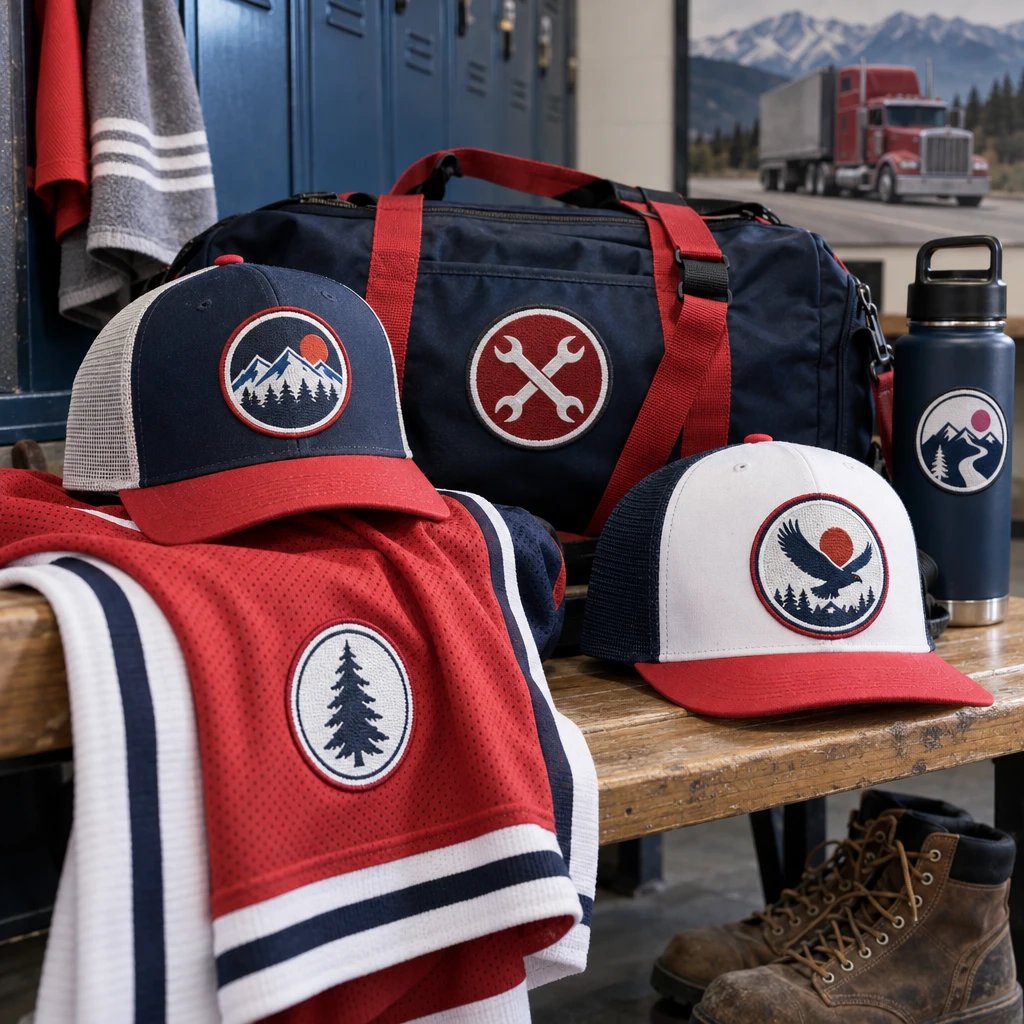
For embroidered bulk patches for trucking companies, stitched area is usually the biggest manufacturing cost driver when quantity and construction stay the same: bigger, more densely stitched designs take more machine time. The final quote also depends on backing, border, artwork preparation, order quantity, and the deadline. Keep the fleet name readable, then remove detail that adds sewing without helping someone identify the company.
What changes the quote for bulk patches for trucking companies?
A patch quote changes when the design requires more material, machine time, setup work, or handling. Quantity changes how those costs are shared across the order, so compare both the total in USD and the cost per patch.
There isn't a useful universal price for a trucking patch. A simple company-name patch on a work shirt is a different production job from a fully stitched truck illustration on the back of a canvas jacket. Even when the artwork looks similar on a screen, the finished dimensions and attachment method can move the quote.
| Factor | Effect on cost | How to keep it down |
|---|---|---|
| Finished size | Larger patches use more base material. With the same stitched layout scaled up, they generally require more stitches and production time. | Measure the garment placement before quoting. Use the smallest size that keeps the company name readable. |
| Stitch coverage and density | Filled backgrounds and dense illustrations increase machine time compared with artwork that leaves suitable base fabric exposed. | Use the base fabric as the background where the design permits. Remove shading that disappears at actual size. |
| Thread or artwork color count | Additional thread colors can add color changes and handling in embroidery. Printed color complexity is evaluated differently. | Keep colors that identify the brand. Ask whether removing minor accent colors changes the quote before altering the logo. |
| Border and shape | Standard shapes are generally simpler to finish. Tight corners, narrow extensions, and irregular outlines can require more finishing work. | Choose an oval, rectangle, or another straightforward shape unless the outline has a practical purpose. |
| Backing | Heat-seal layers, hook backing, and matching loop material add components compared with a plain sew-on patch. | Specify the attachment method the garment actually needs. Don't add hook backing to a uniform that will be permanently sewn. |
| Quantity per design | More identical patches generally spread preparation and setup across more pieces, lowering the unit cost while increasing the total spend. | Combine confirmed needs across terminals before ordering. Separate actual usage from speculative extras. |
| Design and name variations | Different logos, sizes, or employee names can create additional artwork, programming, sorting, and approval work. | Keep the company patch standard and handle individual names as a separate uniform element. |
| Rush timing | A compressed deadline can require production rescheduling and faster transportation. Availability and added charges depend on the job. | Approve usable artwork early and provide the delivery ZIP code with the first request. |
| Artwork preparation | Blurry files, missing lettering, and unsuitable detail can require more reconstruction or revision work before production. | Send clean source artwork, approved wording, color references, and finished dimensions together. |
Read those factors together. Shrinking a patch can reduce its stitched area, but not if the company name becomes unreadable and needs another round of artwork. Adding quantity can improve the unit figure, but buying more than the uniform program needs still increases the invoice. The sensible target is a repeatable patch that fits the garments already in service.
What size keeps a fleet logo readable without adding unnecessary stitching?
Choose the patch size from the usable garment space and the smallest important lettering, not from the logo's dimensions on a monitor. Larger embroidered patches generally cost more, but shrinking below a readable size is false economy.
Measure the actual work shirt, cap, or jacket. A shirt pocket, zipper, seam, reflective strip, or existing uniform-service label can limit placement. On a structured cap, the crown curve and center seam matter; on a fleece jacket, the surrounding fabric can make a heavy patch feel stiff.
Example: a fleet is comparing a 2.5-inch-wide patch with a 3.5-inch-wide patch for its driver shirts. The smaller version may work for a short company name and a simple road symbol. If the artwork also includes a city, phone number, truck illustration, and slogan, the first move should be editing the layout, not assuming that every detail must survive.
I'd skip a phone number on a small chest patch unless there's a clear reason to keep it. At normal viewing distance, the fleet name does more useful work. A phone number belongs on the vehicle or another surface large enough to read without leaning toward someone's shirt.
Print the proposed outline at actual size and place it on the garment. This simple check exposes problems a zoomed-in proof hides, particularly a patch that fits a jacket nicely but overwhelms a cap. If the same design cannot serve both garments well, quote separate sizes openly rather than treating them as one identical production run.
When do stitch coverage and color changes add cost?
Stitch coverage adds cost when more of the patch surface must be embroidered, while extra thread colors can add machine changes and handling. These are separate factors: a design with few colors can still take substantial sewing time if its entire background is filled.
Stitch coverage is the portion of a patch face that thread covers rather than leaving the base fabric visible. Stitch density is how closely stitches are placed within an embroidered area. Neither should be increased just to make a patch sound more substantial; the goal is clean coverage without an unnecessarily heavy, rigid result.
Polyester twill can provide the background color on an embroidered patch, with thread forming the company name and symbol. That exposed fabric isn't automatically a compromise. For a straightforward fleet mark, it can give a cleaner appearance than adding a stitched field behind every letter.
In our production experience, truck illustrations become expensive distractions when they contain tiny grille lines, wheel details, and layered shading that won't read on a uniform. Keep the recognizable silhouette. Remove detail that turns into texture rather than information.
Thread colors deserve the same scrutiny. A contrasting company name and an identifiable logo accent can be enough. But don't remove a required brand color to chase a saving that hasn't been quoted; color rules differ by construction, and the actual quote should tell you whether that change matters.
Small lettering may call for a different construction. Woven patches for detailed lettering use woven threads rather than embroidered stitches and can suit finer artwork. Printed patches can retain gradients or photographic detail. Neither is automatically less expensive, and both change the appearance compared with raised embroidery. Ask for a construction comparison using the same dimensions and quantity.
If the logo is still crowded, request a free digital mockup through the embroidered patch options and compare a simplified layout before approving production. The useful comparison is the same company name at the same finished size, not a large screen preview of each version.
Which border and backing make sense for driver uniforms?
A straightforward border and plain sew-on construction are often the right starting point for permanently attached work-shirt patches. Iron-on and hook backing have useful roles, but they should solve an attachment problem rather than appear on the order by default.
Keep the edge appropriate to the shape
A merrowed border is an overlocked thread edge that wraps around a patch's perimeter. It gives standard shapes a familiar finished rim, but it isn't the right treatment for every narrow corner or intricate outline. A cut edge can follow a more detailed silhouette, depending on the material and finishing method.
See your artwork as a custom USA patch before you buy. Free digital mockup in 12 hours — 5-piece minimum per design. We do not produce until you approve.
GET A FREE MOCKUPFor a company oval on a driver shirt, I'd usually keep the outline simple. A patch shaped around mirrors, exhaust stacks, and other narrow parts of a truck illustration introduces finishing complications without necessarily making the fleet name easier to recognize. Shape has a cost. Make it earn that cost.
Compare attachment cost, not just backing cost
A sew-on patch is a patch intended for attachment with stitching around its edge. Plain sew-on construction avoids paying for an adhesive layer or removable fastening system, but sewing labor still belongs in the uniform budget. The patch invoice and the installed cost are not the same number.
Iron-on backing is a heat-activated adhesive layer that bonds under appropriate heat, pressure, and dwell time. It isn't a universal shortcut. Coated jackets, heat-sensitive synthetic fabrics, and curved cap panels need an application check before you commit. Confirm the garment care instructions and the application method.
Hook backing is the hook side of a hook-and-loop fastening system that attaches to a compatible loop surface. It makes sense for garments designed for removable identification. If the jacket doesn't already have a loop panel, include the matching loop material and its installation when comparing costs.
For high-visibility or protective workwear, check the garment manufacturer's placement and attachment guidance. Don't cover reflective tape, required labels, or important garment features. A patch should identify the driver without interfering with the clothing's intended function.
How should a trucking company calculate its order quantity?
Count patches by garments receiving them, then add a deliberate allowance for replacements and confirmed hiring. More identical pieces generally lower the unit cost, but separate designs and sizes can reduce the benefit of combining everything into one purchase.
USA Customized Patches has a 10-piece minimum. For a fleet program, the more important purchasing question is often how many identical pieces belong in the same run. A company logo, a safety-department logo, and individually named driver patches are not interchangeable units just because they appear on one purchase order.
Example: a trucking company outfits 40 drivers with three patched shirts each. That means 120 shirt patches before replacement garments, jackets, or new hires are considered. If the jacket uses a larger version, keep that count separate so the quote reflects the correct dimensions and production setup.
Ask terminal managers for confirmed garment counts rather than employee headcount alone. Some drivers may need replacement shirts; others may already have usable uniforms. An order based only on the payroll roster can leave the shop short of patches while still paying for extras in the wrong size.
I'd keep individual driver names separate from the standard fleet emblem. That lets the company patch remain useful when assignments change, and it avoids tying leftover inventory to specific employees. If terminal identification matters, compare a separate terminal strip against creating a completely different company patch for every location.
What artwork preparation prevents quote changes?
Clean artwork and complete specifications reduce reconstruction work and prevent revisions caused by missing information. A logo file alone doesn't tell production the finished size, border, backing, or garment placement.
Embroidery digitizing is the process that converts artwork into stitch instructions for an embroidery machine. A vector logo helps define shapes cleanly, but it isn't itself an embroidery program. Lettering, stitch direction, underlay, and sewing sequence still need production decisions.
Send the original logo file when available, along with approved spelling and useful color references. A sharp image is better than a screenshot copied from a social media profile. If the only usable source is an older uniform patch, say so at the beginning and ask what reconstruction is needed.
- State finished width and height in inches, or identify which dimension controls the fit.
- Name the garment and placement, such as a polyester work-shirt chest, canvas jacket sleeve, or structured cap front.
- List the quantity for each design and size, not just the combined order total.
- Specify sew-on, iron-on, or hook backing and identify any matching loop material needed.
- Provide the delivery ZIP code and the actual date the patches must be in hand.
- Identify one person who can approve company wording, colors, border, and attachment specifications.
The free digital mockup is generally provided in about 12 hours. It should make the proposed layout, proportions, wording, and specified construction clear enough to review. A digital proof is not a physical sample, though, and screen colors should not be treated as an exact representation of thread under every light.
Ask whether artwork preparation, digitizing, and requested revisions are included in the written quote. Don't assume a separate fee, and don't assume every reconstruction task is included. The important thing is knowing what the quoted scope covers before changing the file.
What timeline should you allow before a uniform rollout?
Typical production timing is 7–12 business days, with production starting only after written approval. Allow additional time for artwork review and shipping, and confirm the schedule against the actual delivery address before promising a rollout date.
USA Customized Patches is open 24 hours a day, 7 days a week for quotes. That quote availability doesn't turn weekends into production business days or remove shipping transit. Keep the stages separate when you plan.
Ready to spec type, size, backing, and quantity? Open the quote form for a free 12-hour mockup and USA shipping after approval.
GET A FREE MOCKUP- Submit the artwork, dimensions, quantity, backing, delivery ZIP code, and required in-hand date together so the initial quote has a usable scope.
- Review the free digital mockup, generally available in about 12 hours, and collect internal changes before sending one clear revision request.
- Give written approval only after the wording, dimensions, colors, border, backing, and quantity are correct. Production begins after that approval.
- Confirm the applicable production schedule. Typical production takes 7–12 business days, but the actual order specifications and current scheduling determine the commitment.
- Add shipping transit to the approved schedule and leave time for receiving, checking, and attaching the patches before uniforms are issued.
The most avoidable delay is often an unanswered proof. If dispatch wants one version, operations wants another, and a terminal manager adds a slogan after approval, the deadline becomes harder to meet. Put one person in charge of consolidating feedback.
Rush production and faster shipping solve different problems. Expedited transportation cannot recover time spent waiting for artwork approval, and moving production earlier doesn't make a distant destination local. Ask which stage is limiting the schedule before paying to speed up the wrong one.
USA Customized Patches ships from Corona, CA, to all 50 states in the United States. Review the shipping information for patch orders and confirm transit for the destination ZIP code, particularly when the rollout depends on arrival at a specific terminal rather than a central office.
How can purchasing compare patch quotes fairly?
Compare quotes against the same written specification and separate the patch cost from application and delivery costs. A lower unit figure is only useful when the finished patch, included services, and delivery commitment are comparable.
This is where vague descriptions cause trouble. “Company patch with backing” doesn't tell you whether the price covers a plain sew-on piece, a heat-seal layer, or hook material with matching loop. Likewise, “embroidered logo” doesn't establish the amount of exposed base fabric or the finished dimensions.
- Match the construction. Compare embroidery with embroidery unless a woven or printed alternative has been specifically requested.
- Match width, height, shape, and artwork. A smaller patch or simplified logo can legitimately cost less, but it is a different specification.
- Match the border and backing. Ask what is included and whether removable attachment requires a separate loop component.
- Match the quantity per design. A combined total may conceal smaller runs of different artwork or sizes.
- Check artwork preparation and approval terms. Record what the mockup covers and when production is authorized.
- Compare the total in USD, including stated delivery charges and any application work being purchased separately.
- Compare confirmed timing. Distinguish proof preparation, production business days, shipping transit, and the required in-hand date.
Keep any proposed savings visible. If leaving twill exposed lowers the quote, show that version next to the fully stitched version and decide on appearance and cost together. Don't approve one appearance while expecting the price of another.
A simpler patch is often enough for a work-shirt program. The company name, recognizable mark, and sound attachment matter more than decorative stitching that disappears at arm's length. Spend on detail only where the finished garment lets people see it.
What should the uniform shop check when patches arrive?
Check the delivered patches against the approved specifications before attaching them to uniforms. Confirm the artwork, dimensions, backing, and counts, then verify the chosen attachment method on the actual garment.
Keep sizes and designs separated during receiving. A shirt patch and a cap patch with the same logo can look similar in a bag, especially when the difference is easier to see against the garment than on a packing table. Mark internal storage by design, finished size, and intended placement.
For heat application, use the supplied application guidance and the garment manufacturer's restrictions. For sewing, check that the placement doesn't close a usable pocket or cross an unsuitable seam. A correct patch attached in the wrong spot is still a uniform problem.
Save the approved artwork and order specifications with the purchasing record. Reorders are easier to review when the company can identify the exact size, border, backing, and design version instead of requesting “the patches from last time.”
What is this cost advice based on?
This advice is based on the patch production process, the digital mockup review, and the specifications used to prepare an order. Cost direction follows material use, sewing time, finishing work, setup, and handling; it is not a substitute for a written quote.
In our production experience, the useful decisions happen before approval: fit the actual garment, simplify details that won't reproduce clearly, and choose backing for the attachment method. The free mockup helps resolve the layout, while the written order specifications establish what will be produced. USA Customized Patches produces only after written approval.
For a workable starting point, send the logo, garment description, proposed dimensions in inches, quantity, and delivery ZIP code through the patch quote and mockup request. Request the free digital mockup and have the uniform installer check the placement before approving it.