
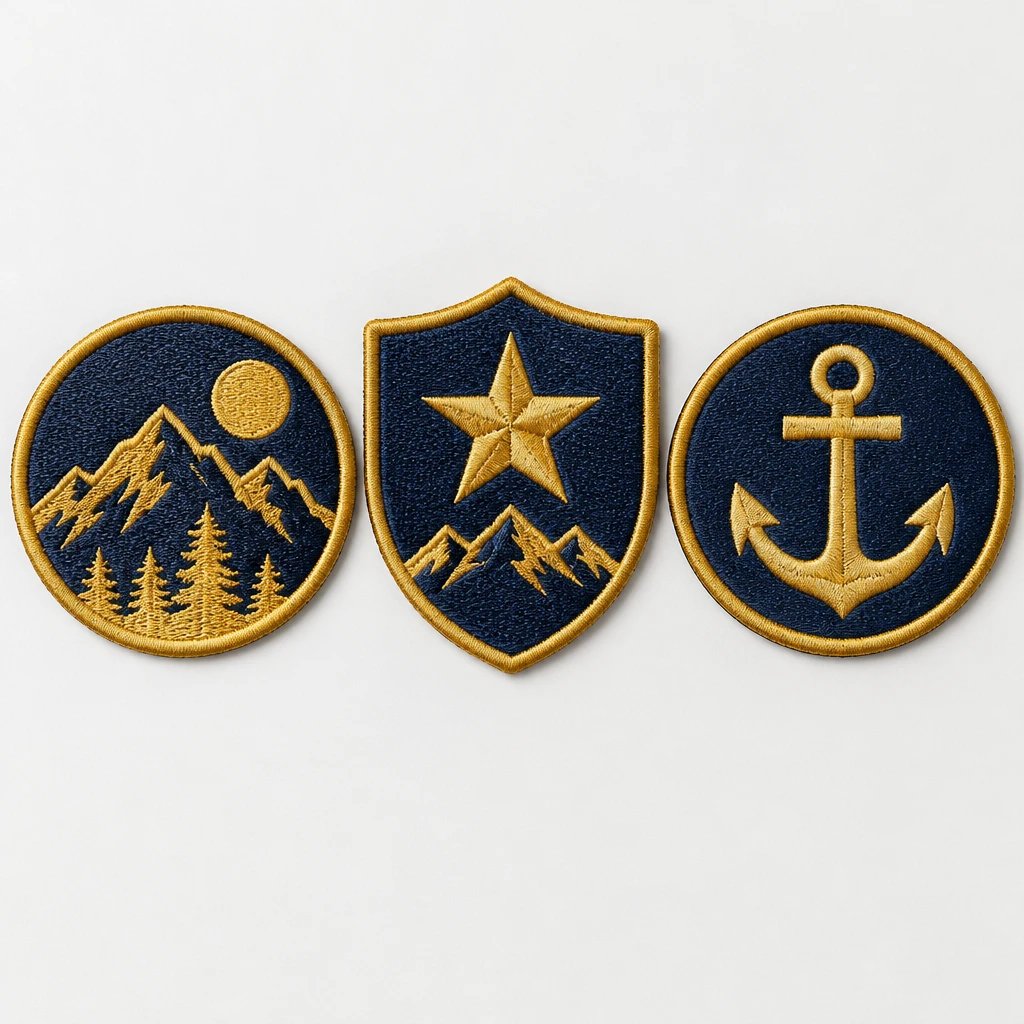
Embroidered patches are the best starting point among custom patch types Texas teams and businesses can order, unless fine lettering, photographic artwork, or wipe-clean construction matters more than stitched texture. Woven, printed, and polyvinyl chloride (PVC) patches solve those specific problems better. Here's how the materials compare on actual caps, work shirts, team bags, and jackets, including where the simpler option saves money without sacrificing the job.
Compare custom patch types Texas teams and businesses use
Choose the patch material around the artwork first, then check the garment and attachment method. A material that reproduces the logo beautifully can still be the wrong choice for a thin performance shirt or a cap panel that won't sit flat.
The useful comparison isn't premium versus basic. It's raised thread versus fine detail, molded construction versus fabric flexibility, and decorative texture versus easy care. In our production experience, buyers avoid more problems by checking those trade-offs early than by choosing the most elaborate patch on the quote.
| Patch type | Detail level | Durability and care trade-off | Main cost drivers | Typical uses | Attachment or border consideration |
|---|---|---|---|---|---|
| Embroidered | Strong for bold lettering and separated shapes; tiny text can close up | Good everyday service when correctly attached; exposed thread can snag | Size, stitch coverage, design complexity, quantity, and backing | Work shirts, team caps, club jackets, equipment bags | Sew-on for washable garments; merrowed borders suit simple outlines |
| Woven | Fine yarn construction supports smaller lettering and cleaner narrow lines | Low-profile fabric face; edge finish and garment care still matter | Size, color layout, edge finishing, quantity, and backing | Detailed cap badges, shirt patches, sponsor designs | Sewn edges or suitable finished borders; less raised texture than embroidery |
| Printed | Best suited to gradients, photographic artwork, and continuous color changes | Surface appearance depends on fabric, print process, abrasion, and care | Size, substrate, print process, finishing, quantity, and backing | Event artwork, illustrated merchandise, detailed promotional badges | Check edge treatment and actual-size readability before approval |
| PVC | Good for clean molded shapes and separated color areas; not a photo substitute | Material resists water and wipes clean; attachment and garment can still fail | Mold setup, dimensions, raised levels, color layout, quantity, and backing | Outdoor bags, removable gear identifiers, structured cap badges | Sewing channel or hook backing; check weight and flexibility |
| Chenille | Best for large letters and broad symbols, not fine text | Looped yarn can catch or flatten; garment-specific care is important | Letter size, layered construction, embroidered accents, and quantity | Letterman jackets, oversized team initials, awards | Usually sewn to a substantial garment; avoid undersized text-heavy designs |
| Leather or faux leather | Works well for simplified marks; tiny lettering depends on material and marking method | Water, heat, and cleaning affect genuine and synthetic materials differently | Material specification, thickness, shape, marking method, and quantity | Branded caps, denim jackets, canvas bags | Confirm material identity and care before choosing attachment |
| 3D embroidered | Raised foam-backed stitching favors thick letters and simple shapes | Prominent stitching is more exposed to crushing and snagging | Foam construction, stitch coverage, artwork suitability, and quantity | Bold cap logos and selected team merchandise | Confirm that raised construction works as a patch on the intended cap |
None of these materials wins every row. A woven badge may look less dimensional than embroidery yet reproduce the actual logo more faithfully. A molded PVC patch may be easier to wipe down but feel unnecessarily heavy on a lightweight uniform. Those are useful differences, not defects.
Choose embroidered or woven patches for a team logo?
Choose embroidery for a bold logo that benefits from visible stitching. Choose woven construction when lettering and narrow lines need more room than embroidery can give them at the finished size.
Choose embroidered patches if texture and bold shapes matter
An embroidered patch is a fabric badge that builds its design with stitched thread over a base material. That raised surface suits a contractor's chest logo, a softball team's block initials, or a club emblem on a denim jacket. It looks like a patch. Sometimes that's exactly the point.
Keep the important elements broad enough to survive stitching. For example, a Houston service business might compare a 3-inch-wide shirt patch with its full logo against a version containing just the company name and main symbol. The second layout may read better from across a counter, even though it contains less information.
I'd skip full thread coverage when a visible fabric background already gives the logo the right contrast. More stitching changes the surface and can add stiffness and cost; it doesn't automatically make a work-shirt badge better. Leave the background exposed if it supports the design and the approved construction.
If embroidery looks like the right starting point, request a free digital mockup through our embroidered patch options with the garment and finished dimensions included. Seeing the border and lettering together is more useful than comparing thread colors in isolation.
Choose woven patches if smaller details must stay
A woven patch is a fabric badge that forms its design with interlaced fine yarns rather than raised embroidery stitches. Its flatter construction usually gives small lettering and thin shapes better definition at the same patch size, although it cannot make genuinely undersized text readable.
For example, an Austin run club could need a neighborhood name, a narrow skyline, and a club symbol on a 2.5-inch badge. Woven construction deserves a look before the artwork gets enlarged beyond the available cap panel. Remove unnecessary details first, then compare materials.
The trade-off is texture. Buyers who want the raised feel of a traditional uniform patch sometimes find woven construction too flat, even when its lettering is cleaner. Review the woven patch construction options if keeping the full design is more important than a pronounced stitched surface.
Choose PVC or embroidery for outdoor work gear?
Choose PVC for a flexible molded badge that needs a wipe-clean face. Choose embroidery for ordinary work uniforms when a fabric patch, sewn securely, meets the actual care and wear requirements.
Choose PVC if surface cleaning and molded relief matter
A PVC patch is a flexible molded badge that uses polyvinyl chloride to create defined shapes and raised or recessed areas. It suits gear bags, hook-and-loop panels, and some structured caps. The material doesn't absorb water like a textile face, but that doesn't make the entire assembly waterproof.
For example, a Fort Worth field crew might use removable identifiers on equipment bags that regularly pick up dust and mud. PVC with hook backing could be sensible if each bag already has a compatible loop panel. Without that panel, the attachment plan needs another step.
Don't buy PVC solely because the order is headed to Texas. Heat, sun, abrasion, chemicals, and laundering are different exposures. Material specifications matter, and no patch choice should come with an invented promise about years of outdoor service. Compare PVC patches for outdoor gear against the actual environment and cleaning routine.
Choose embroidery if washable uniforms are the main job
A sewn embroidered patch is often enough for a cotton-blend work shirt, canvas apron, or ordinary shop jacket. It's familiar, flexible enough for many uniform placements, and doesn't require a molded construction just to display a business name.
This is one place the simpler option is the right call. If the badge spends its working life on a shirt rather than a muddy gear case, paying for raised molded levels may buy little practical benefit. Put that attention into readable lettering, a suitable border, and attachment that matches the laundry routine.
See your artwork as a custom USA patch before you buy. Free digital mockup in 12 hours — 5-piece minimum per design. We do not produce until you approve.
GET A FREE MOCKUPWhen are printed, chenille, leather, or 3D patches worth choosing?
Choose these materials when the artwork or merchandise concept specifically needs their strengths. They aren't automatic upgrades from embroidery, and each creates limits elsewhere.
Choose printed patches for artwork that needs continuous color
A printed patch is a fabric badge that carries an image applied by a printing process instead of forming every design element with thread. It is the practical choice for photographs, soft shadows, and gradients that would otherwise need a substantial redraw.
For example, a San Antonio event organizer might have an illustrated skyline fading into a sunset. Printing preserves that color transition more directly than embroidery. I'd skip a complicated stitched imitation if the illustration itself is the reason people want the patch. The trade-off is a flatter surface, not a lack of usefulness.
Choose chenille for large team letters
A chenille patch is a textured badge that uses looped yarn to create a plush face, often supported by a felt base. It's right at home on letterman jackets and oversized school initials. It isn't the right tool for a small badge filled with sponsor names.
For example, a Dallas school organization could use a large chenille initial on a substantial jacket and a separate embroidered identifier for a smaller club name. That split respects both materials. Trying to squeeze the entire design into chenille usually makes the text, rather than the texture, the problem.
Choose leather for a restrained brand mark
Leather patches suit simple marks on caps, denim, and canvas when the material surface is part of the look. Genuine leather and faux leather are different specifications, not interchangeable descriptions. Ask which material is quoted and how the design will be marked.
A tonal logo can look appropriate on retail headwear but disappear on a busy work shirt. I'd skip leather for a multicolor team crest that depends on clear color separation. Also check the intended cleaning method before putting either genuine or synthetic leather on a garment that receives frequent washing.
Choose 3D embroidery for thick letters with room to rise
3D embroidery is raised stitching that uses foam beneath suitable design areas to create extra height. Thick initials and simple symbols are better candidates than small text or closely spaced details. On a patch, the combined base, foam, stitching, and backing also need to suit the cap's shape.
More height isn't always more readable. For example, a team cap might benefit from raised block initials while keeping a smaller place name flat. Ask about the entire construction rather than assuming a design developed for direct cap embroidery can be transferred unchanged to a separate patch.
Which backing works on caps, work shirts, and jackets?
Sew-on is the practical starting point for permanent attachment to many washable garments. Iron-on requires a heat-compatible surface, while hook-and-loop works best when the patch needs to be removable.
Backing is an attachment decision, not a patch material. An attractive face won't rescue an adhesive that doesn't suit the fabric. Before quoting, name the exact garment: cotton twill cap, polyester performance polo, denim jacket, coated rain shell, or canvas tool bag.
- Caps: Check usable panel space, the center seam, curvature, and access for sewing. Structured fronts and soft unstructured crowns respond differently to a stiff patch.
- Work shirts: Sewing often suits repeated wear and laundering. Check industrial laundry conditions separately rather than assuming household-care guidance covers them.
- Performance polos: Lightweight polyester can distort under a heavy badge. Heat can also mark or damage unsuitable fabric, so confirm compatibility before choosing iron-on.
- Denim and canvas jackets: These substantial fabrics usually offer a more forgiving sewing surface, but check for linings, pockets, and concealed construction behind the placement.
- Coated rain shells: Heat and needle holes can compromise fabric or weather protection. Follow the garment manufacturer's attachment guidance before committing to either method.
- Gear bags with loop panels: Specify hook backing for the patch and confirm the receiving panel dimensions. Hook backing alone does not attach directly to an ordinary smooth fabric surface.
Iron-on isn't a universal shortcut. A patch needs the correct application conditions for its adhesive and the garment, and those conditions must not damage the fabric. For a permanently worn uniform patch, I'd consider sewing rather than treating an adhesive bond as maintenance-free.
Adhesive sticker backing is a separate category again. It can suit temporary placement or selected non-garment surfaces, but it should not be presented as a washable substitute for sewing. State the intended service life before selecting it.
How should you size the artwork and choose a border?
Measure the usable garment area before choosing patch dimensions, then judge the artwork at that finished size. Border width and edge construction consume space that small lettering may already need.
A merrowed border is a wrapped stitched edge that finishes the perimeter of a patch. It gives circles, rectangles, and other suitable outlines a familiar raised rim. A cut edge follows the silhouette more closely and can suit shapes that a bulky wrapped border would simplify or obscure.
Don't make the outline complicated just because the artwork file allows it. Small protrusions can be awkward to finish and attach. For a washable business uniform, a straightforward shape with adequate space around the lettering is often a better buy than a finely cut outline that adds little to recognition.
- Measure the usable placement in inches, including clearance from cap seams, shirt pockets, zippers, and jacket panels.
- Make a paper outline at the proposed size. For example, compare a 3-inch-wide cap badge with a narrower version on the actual cap rather than relying on a flat product photograph.
- Separate essential artwork from optional copy. The organization name may need to stay; a tagline, date, and web address may not.
- Review lettering, gaps, border thickness, and overall proportions on the digital mockup at actual size.
- Confirm material, backing, finished width and height, quantity, and garment compatibility in the written order specifications before approving production.
Ready to spec type, size, backing, and quantity? Open the quote form for a free 12-hour mockup and USA shipping after approval.
GET A FREE MOCKUPThere isn't one honest minimum letter height that applies to every font, material, and construction. A wide block letter behaves differently from a thin script letter. In our production experience, inspecting the actual characters catches problems that a blanket size rule misses.
What changes the price, and when is the simpler patch enough?
Patch prices depend on dimensions, construction, artwork complexity, backing, and order quantity. The cheaper option is the right call when it meets the readability, attachment, and care requirements without an added feature the garment doesn't need.
Compare quotes in US dollars using the same specifications. A larger embroidered patch with dense coverage isn't directly comparable to a smaller woven badge, even if both display the same logo. Ask what the quoted amount includes, including finishing, backing, shipping, and any applicable setup charges.
Material names don't establish a fixed price ladder. A complex embroidered design can involve more production work than a simpler design in another construction, while PVC mold setup can weigh more heavily on a small run. Quantity can spread setup work across more pieces, but ordering unwanted extras is not a saving.
- Use standard embroidery when bold lettering and ordinary uniform wear are the requirements. Raised molded levels or foam aren't necessary just to identify a staff member's employer.
- Choose a visible fabric background when it gives sufficient contrast. Full stitch coverage should serve the appearance, not an assumption that more thread always means better.
- Simplify a busy outline if it makes finishing and sewing easier without losing the recognizable logo.
- Choose woven construction when it preserves necessary small details. Paying for a larger embroidered patch that no longer fits the garment solves the wrong problem.
- Use printed construction when continuous-color artwork is essential. A laborious conversion to thread isn't automatically a better representation of the original.
- Keep a small test order relevant to the eventual garment. A patch approved on a canvas bag does not establish how the same construction will behave on a thin polo.
For example, a Texas business ordering 40 staff patches could compare a simple sewn embroidered badge with a molded version using the same finished dimensions. If nobody needs a wipe-clean face or removable gear identification, the embroidered version may be the more economical fit. Let the actual quote establish the price difference.
What should a Texas buyer confirm before production?
Confirm the material, dimensions, border, backing, quantity, artwork, and delivery requirements before approving an order. USA Customized Patches produces patches only after written approval.
USA Customized Patches has a 10-piece minimum. A free digital mockup is provided before production, generally in about 12 hours. Typical production is 7–12 business days after approval, subject to the confirmed order specifications; shipping transit is separate.
Orders ship from Corona, CA, to all 50 states in the United States, including Texas. Quote requests are open 24 hours a day, 7 days a week. Shipping origin does not, by itself, establish where every material or production operation originates.
For an event deadline, give the needed-in-hand date, not just the event name. Time for artwork revisions, written approval, production, transit, and local garment attachment all belong in the schedule. Check the nationwide shipping information and have the timing confirmed for the actual destination.
A digital mockup should settle the visible layout and record the intended specifications. It does not prove how an adhesive will bond to an unknown fabric, reproduce the exact feel of chenille, or show every color under every lighting condition. Keep those physical questions separate from artwork approval.
What this advice is based on
These recommendations rest on patch production methods, the digital mockup review, and the written order specifications. They are practical selection guidance, not laboratory durability rankings or claims that one material survives every Texas environment.
Where we refer to production experience, the point is how thread, woven yarn, printing, molded PVC, and edge finishing affect a proposed design. Final suitability still depends on the actual garment, attachment, cleaning routine, and approved construction. A screen preview cannot replace a physical compatibility check when the application demands one.
Which patch type should you order?
My verdict: start with sewn embroidery for a bold team or business logo on ordinary workwear, caps, or jackets. Change materials only when a specific requirement gives you a reason.
That reason might be smaller lettering for woven construction, gradients for printing, a wipe-clean molded face for PVC, large plush initials for chenille, or a restrained tonal mark for leather. If standard embroidery already does the job, keep it simple and spend the review time on placement and readability.
For a second look before committing, send the logo, garment description, quantity, and proposed dimensions through the patch artwork and quote form for a free digital mockup. Include a photo of the actual placement area if a seam, pocket, or curved cap front could affect the fit.