
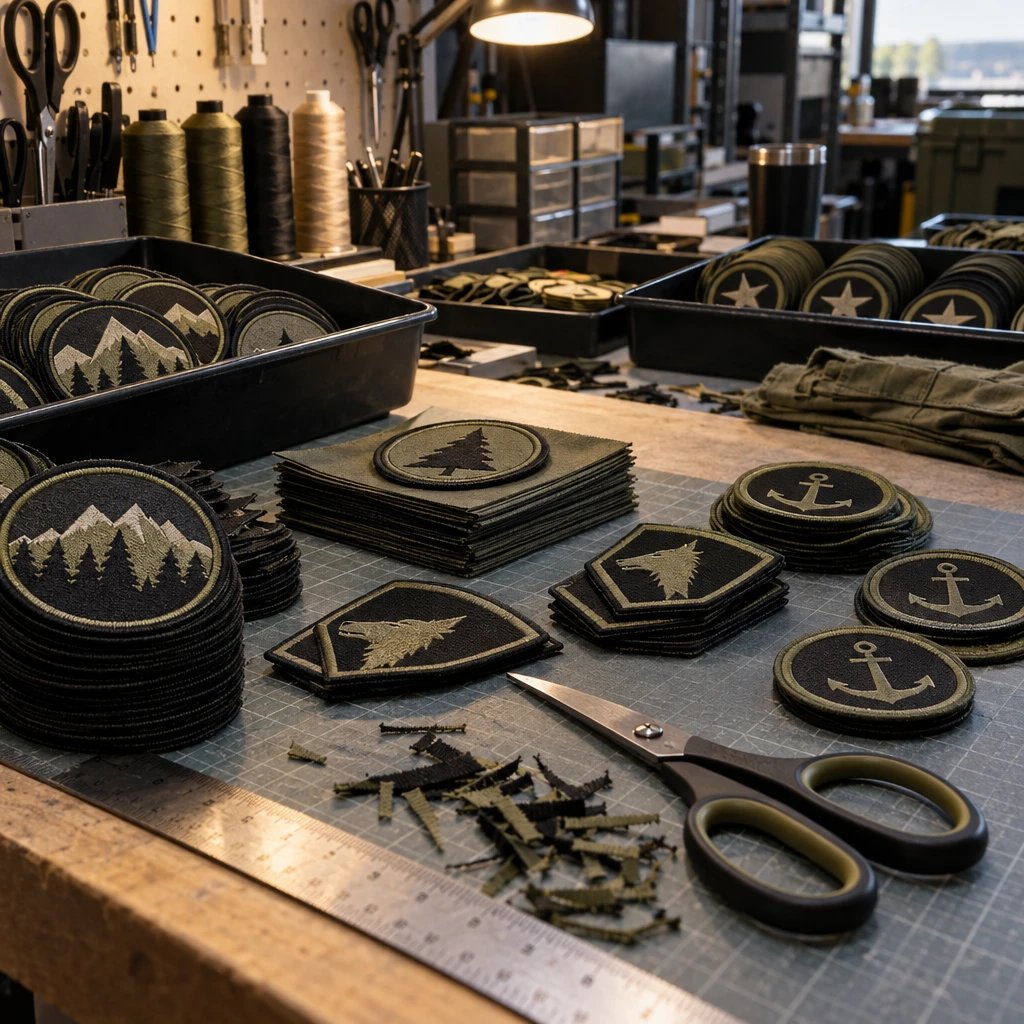
Order quantity is the biggest driver of the total bill for bulk patches for security companies because it determines how many finished pieces must be produced. The cost of each piece then depends on size, stitch density, colors, border, backing, artwork preparation, and deadline. A useful quote separates those specifications from shipping and any work needed to attach the patches to uniforms.
Start with the garment count, not the employee count. Security officers may rotate through polos, woven uniform shirts, fleece layers, and outerwear, and those garments do not necessarily take the same patch. Buying a larger run of the wrong shoulder emblem does not save money. It creates a box of inventory that cannot go onto the next uniform issue.
What changes the price of bulk patches for security companies?
The quote changes when the production workload, material requirements, or schedule changes. For embroidered security patches, larger stitched areas and denser coverage generally increase unit cost, while a larger quantity of an identical design can spread setup work across more pieces.
Keep total cost and unit cost separate. A larger order can have a lower price per patch and still require a larger total payment. That distinction matters when purchasing compares a replacement order with a full uniform rollout. Neither quote is meaningful without the quantity and specifications beside it.
| Quote factor | Effect on cost | How to keep it down without hurting the uniform |
|---|---|---|
| Order quantity | More pieces increase the total bill. A larger identical run can reduce unit cost by spreading setup work. | Count garments, replacements, and approved spare stock before ordering. Combine matching departmental requirements when the design is truly identical. |
| Finished dimensions | A larger patch uses more material and usually requires more stitching. | Measure the actual sleeve or chest position. Do not enlarge a patch just to preserve decorative detail that could be removed. |
| Stitch density and coverage | More stitched area and dense fills increase embroidery work and can make the patch stiffer. | Use an exposed fabric background where it supports the design. Keep a fully stitched background only when the appearance requires it. |
| Thread or material colors | Additional colors can add setup, thread changes, or material requirements. Their effect depends on the construction method. | Use approved uniform colors and remove nearly identical shades that do not improve recognition. |
| Border and outline | A conventional outline is generally simpler to finish than a shape with narrow points, small notches, or tight inside corners. | Choose a rounded rectangle, oval, or straightforward shield when the uniform specification allows it. |
| Backing | Iron-on adhesive, hook backing, and supplied mating material add different materials and finishing requirements. | Choose the attachment that matches the garment. Do not pay for heat adhesive when the patch will be sewn on and does not need it. |
| Artwork preparation | Rebuilding unclear artwork and resolving small details adds preparation work. Any separate charge depends on the quote. | Supply the original artwork, exact wording, dimensions, and color references together. |
| Rush timing | A compressed schedule can require production changes or expedited transit, if available. | Approve the design early and give the actual in-hand date rather than requesting an unspecified rush. |
| Design variations | Different wording, dimensions, borders, or backing combinations can create separate production requirements. | Standardize the main company emblem and separate only the role identifiers that genuinely need to change. |
There is no responsible flat dollar estimate without those details. Ask for a quote in US dollars that identifies the quantity, patch construction, dimensions, backing, and delivery scope. If a supplier gives only a unit price, check what is included before treating it as the purchasing total.
How should you count patches for a security uniform order?
Count patch positions on issued garments, then add a deliberate allowance for replacements and planned hiring. An officer count alone misses spare shirts, seasonal jackets, and garments that need matching shoulder patches.
For example, a security company might issue several uniform shirts to each officer but only one duty jacket. The shirts may carry company emblems on both sleeves, while the jacket uses a removable chest identifier. Those are separate needs, even when all the artwork comes from the same brand file.
- List each garment by model and fabric, including short-sleeve shirts, long-sleeve shirts, polos, fleece, and outerwear.
- Record every patch position. Note left and right placement if the artwork or orientation differs.
- Separate permanent emblems from removable role labels, supervisor identifiers, and assignment-specific pieces.
- Add replacement stock based on your own uniform replacement habits and confirmed hiring plans, not an arbitrary percentage.
- Group only the pieces that share artwork, dimensions, colors, border, and backing.
USA Customized Patches has a 10-piece minimum. That makes a smaller replacement run possible without buying a full rollout again, although the unit price still depends on the specifications and quantity. Ask how different versions will be grouped in the quote rather than assuming that every variation receives the same bulk pricing.
I'd standardize the company shoulder emblem before chasing a quantity discount. If every property gets a slightly different shape or color scheme, purchasing loses flexibility and the uniform room has more versions to track. A common company emblem with a separate assignment identifier is often the more practical arrangement.
Which size and embroidery details are worth paying for?
Pay for enough size to keep the company name and required identifier readable on the actual garment. Decorative density is less valuable than clear lettering, a stable outline, and a patch that sits flat.
Stitch density is the concentration of embroidery stitches within an area that affects coverage, texture, and stiffness. It is not the same as patch size. A small emblem with a solid stitched background and layered details can require more work than its dimensions suggest.
In our production experience, a fabric background can do useful work. If the approved uniform design calls for a dark field behind light lettering, an exposed twill ground may provide that field without filling the entire surface with thread. Fully stitched coverage has its place, but it should earn its place in the specification.
For example, a 3-inch shoulder patch might fit a uniform sleeve well but leave a long company name crowded around a narrow shield. Enlarging the whole emblem is one solution. Shortening approved wording, opening the text arc, or removing fine decorative lines may solve the problem without making the patch wider.
Small lettering is where buyers sometimes spend in the wrong direction. More stitches do not automatically make tiny text readable. Thread has physical width, and tight letter openings can close up. A clean abbreviation approved by the company is preferable to a full name that turns into a textured stripe.
A free digital mockup of the embroidered security patch option can help settle the dimensions, text layout, and background coverage before you commit to production. Include the garment position so the discussion starts with fit, not just the logo.
When does woven construction make more sense than embroidery?
Woven construction is worth comparing when fine lettering or compact linework is essential. Embroidery is the right call when the design benefits from raised thread texture and the details have enough room.
A woven patch is a fabric emblem that forms its design with interlaced threads rather than embroidered stitches placed over a base fabric. Its flatter surface can suit a detailed crest or a longer company name. Compare the same finished dimensions and backing so the construction difference is not mixed up with other changes.
Do not assume that one method is always less expensive. The quote depends on the design and order specifications. I would compare woven patches for detailed uniform emblems if the embroidered version needs repeated compromises just to keep required text visible.
Keep the uniform set consistent, too. A flat woven shoulder emblem beside a heavily textured embroidered chest piece may be intentional, but it can also look like unrelated purchasing decisions. Decide which visual differences are acceptable before approving separate components.
Do extra colors and custom borders justify their cost?
Extra colors and complicated borders are worth keeping when they serve an approved identity requirement or improve recognition. Otherwise, simpler color separation and a straightforward outline are usually easier to produce and repeat.
See your artwork as a custom USA patch before you buy. Free digital mockup in 12 hours — 5-piece minimum per design. We do not produce until you approve.
GET A FREE MOCKUPColor count and stitch count are different cost inputs. Adding another shade may require a thread change, but filling a large background with a single color can still involve substantial stitching. Ask which part of the design is driving the quote instead of cutting colors at random.
For security uniforms, contrast deserves priority over subtle shading. A light company name on a dark ground is more useful than several close shades outlining a small building or eagle. I'd skip gradient-style shading in an embroidered shoulder emblem unless the artwork genuinely depends on it.
A merrowed border is a wrapped thread edge that finishes a patch with a raised perimeter. It works well on shapes that accommodate that finishing process. A cut edge follows the design outline more closely and may suit shapes that cannot take a conventional wrapped border cleanly.
Neither border is automatically the right answer for every shield. Narrow tips and tight inside corners need review. If those features are merely decorative, simplifying the outline can make both production and sewing onto a sleeve more manageable. If the outline is fixed by an approved uniform specification, keep it and price the appropriate finish.
Should security patches use sew-on, iron-on, or hook backing?
Sew-on is usually the practical choice for permanent uniform emblems, while hook backing suits garments built with matching loop panels. Iron-on backing needs a compatible fabric and an application process that the garment can tolerate.
Sew-on for permanent sleeve and chest emblems
A sew-on patch is an emblem attached to a garment with stitching around its edge or another specified sewing path. It avoids relying on heat adhesive for attachment. For a woven uniform shirt that will keep the same company emblem throughout its service life, this is often enough.
The patch quote is not necessarily the finished-uniform cost. Someone still needs to place and sew each piece, and that labor belongs in the purchasing plan. Confirm whether garments are being decorated before issue or collected from officers later. Retrofitting issued uniforms can add handling and scheduling work.
Iron-on for compatible garments and controlled application
Iron-on backing is a heat-activated adhesive layer that bonds a patch to a compatible surface under the required application conditions. It is not a universal shortcut. Coated shells, heat-sensitive fabrics, surface treatments, and garment construction can make heat application unsuitable.
Check the garment maker's instructions before choosing it. On a structured cap, a curved surface and limited access can make uniform pressure difficult. On an outer shell, excessive heat can damage the fabric or finish. Buying adhesive backing without checking the garment can leave you paying for a feature you cannot use.
Hook backing for removable identifiers
Hook backing is the gripping side of a hook-and-loop fastening system that attaches to a compatible loop surface. It makes sense for removable chest identifiers, approved role labels, and jackets already equipped with loop panels.
Specify whether the garment already has the loop side. Supplying mating loop material changes the order, and attaching that material to the garment is another task. Check the panel dimensions as well. A patch that overhangs its loop panel can catch at the edges and sit poorly.
What artwork preparation can change the quote?
Artwork preparation changes when the supplied file needs reconstruction, simplification, or conversion into production instructions. Clear source art reduces uncertainty, but even a clean logo must be checked at the intended patch size.
Digitizing is the process of converting artwork into embroidery instructions that control stitch placement, direction, and sequence. It is not simply saving an image in another file format. A layout designed for a website may need different spacing and fewer fine lines when it becomes a sleeve emblem.
Send the original vector artwork when available. If all you have is a photograph of an old patch, photograph it straight on and include a separate measurement. The visible wear, thread texture, and camera angle should not become accidental instructions for the new order.
- Provide exact company wording, including punctuation and approved abbreviations.
- State finished width and height in inches, not just a description such as standard shoulder size.
- Identify required colors and distinguish approved references from approximate screen colors.
- Name the garment and placement, including any pocket, seam, or loop-panel restrictions.
- Mark which details are mandatory and which can be simplified for production.
- Ask whether any artwork preparation or setup charge is separate or included in the quoted total.
USA Customized Patches provides a free digital mockup in about 12 hours. The mockup should be reviewed for spelling, proportions, dimensions, colors, border, and backing notes. It shows the intended specification; it is not a physical sample, a heat-application test, or a guarantee that every screen displays thread colors identically.
How long should a security patch rollout allow?
Typical production takes 7-12 business days after written approval, and shipping requires separate planning. Artwork revisions, garment attachment, and internal distribution also need room in the schedule.
Ready to spec type, size, backing, and quantity? Open the quote form for a free 12-hour mockup and USA shipping after approval.
GET A FREE MOCKUPProduction starts only after written approval. That protects the order from moving ahead with unresolved spelling, dimensions, or backing choices. It also means a quote request is not the start of manufacturing, and an unapproved mockup does not reserve a completed delivery date.
- Set the date when patched uniforms must be ready for issue, not merely the date when a carton can arrive.
- Allow time for sewing, application checks, sorting, and distribution to individual sites.
- Confirm shipping expectations for the destination and order before relying on a delivery date.
- Work backward through the confirmed production schedule to establish an approval deadline.
- Assign a final approver who can resolve wording, dimensions, and uniform-specification questions without another review cycle.
USA Customized Patches ships from Corona, CA, to all 50 states in the United States. Transit varies with destination and service. Review the nationwide patch shipping information and confirm the shipment plan for the actual receiving address, especially when uniforms must then travel to separate branches.
Rush production and expedited shipping are different things. Faster transportation cannot recover time spent waiting for artwork approval, and faster manufacturing does not eliminate transit. Ask which stage can realistically be shortened and what that changes in the quote.
For example, if a company needs uniforms ready for a new property assignment, the useful deadline is the uniform issue date before officers report to the site. Receiving loose patches that morning is not a workable plan. Give the production desk the operational deadline and explain what still has to happen after delivery.
Where can you reduce cost without weakening the uniform?
Reduce unnecessary production work before cutting readability or attachment quality. Standardized artwork, sensible dimensions, a simpler background, and a realistic schedule are better places to start than removing required wording.
First, question the full background fill. Then question ornamental lines, tiny text, and redundant colors. Those changes should be reviewed together because removing a dark stitched field may require a different base fabric color to preserve contrast.
Next, match the backing to the job. A permanent sleeve emblem does not need removable hook backing just because the jacket patch uses it. Conversely, sewing a removable assignment label permanently onto outerwear defeats the reason for having separate identifiers.
Keep reorder specifications on file. Approved artwork, finished dimensions, color references, border, and backing give the next buyer a usable starting point. Reordering from a casual description invites differences that may become obvious only when new officers stand beside the existing team.
Avoid buying excess inventory solely to reach a lower unit price. Company names, uniform colors, and property requirements can change. The less expensive option is the one that meets a realistic need, not necessarily the quote with the smallest number in the unit-price column.
What is this cost advice based on?
This advice rests on the patch production process, the digital mockup review, and the specifications required to quote an order. Cost directions describe production workload, not a published price schedule or a promise that every design will price the same way.
In our production experience, the most useful comparisons hold the design and dimensions steady while changing a specific feature, such as backing or background coverage. Changing size, quantity, construction, and deadline at the same time may produce a different price, but it will not tell purchasing which change actually helped.
What should go into a quote request?
A useful request includes the artwork, quantity by version, dimensions, garment, backing, destination, and required in-hand date. Add any approved uniform specification so the quote does not depend on assumptions.
USA Customized Patches is open 24 hours a day, 7 days a week for quotes. That availability does not replace the approval step or shorten a confirmed manufacturing schedule. Keep the purchasing contact and design approver aligned so questions can be answered without restarting the review.
You can send the uniform specifications for a free digital mockup with a photo of the intended placement. If the backing is undecided, identify the garment fabric and say whether the patch needs to come off. That is more useful than choosing an attachment by name before checking the uniform.
Before approving, put the mockup beside the garment measurements and read every word aloud. Then confirm the quantity for each version and the delivery address in the same written approval. Those details are easier to fix on a screen than on a finished carton of patches.