
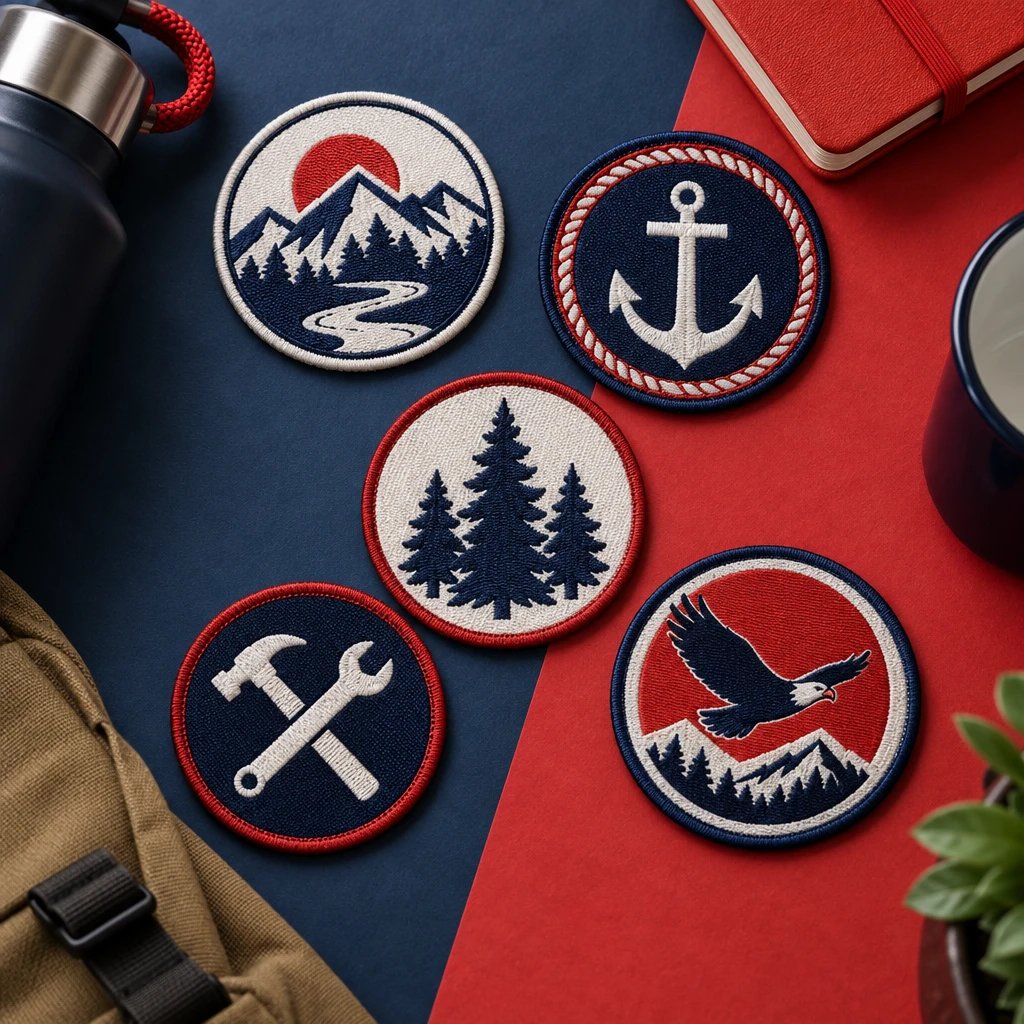
For embroidered bulk patches for corporate teams, the biggest production-cost driver is stitching workload: larger designs and denser coverage take more machine time. Your final quote also depends on quantity, thread colors, border, backing, artwork preparation, and the delivery deadline. Keep those specifications consistent when comparing quotes, or the lower price may simply buy a different patch.
Start with the garment. A patch for a structured cotton twill cap has different limits from one going on a nylon windbreaker or a heavy canvas work jacket. Paying for a backing that cannot be applied safely to the garment is wasted money, even when the patch itself looks right.
What changes the quote for bulk patches for corporate teams?
The quote changes when the production work, materials, order quantity, or scheduling requirements change. Ask for a written specification alongside the dollar amount so purchasing can compare the same product rather than two loosely similar descriptions.
In our production experience, artwork labeled “simple” can still be expensive to stitch. A solid rectangular background takes substantial coverage, while a more detailed-looking outline may leave most of the base fabric exposed. Color count alone does not tell you how much work the embroidery machine must do.
| Quote factor | Effect on cost | How to keep it down without creating a problem |
|---|---|---|
| Finished size | A larger patch generally uses more material and, with the same coverage pattern, more stitches. | Choose the smallest size that keeps the approved logo readable on the actual garment. |
| Stitch count and coverage | Dense fills and large stitched backgrounds increase machine time and thread use. | Let a suitable twill base provide the background instead of stitching every exposed area. |
| Thread or design color count | Additional thread colors can add color changes and handling. The effect depends on the construction and design. | Remove decorative colors that do not support brand recognition; keep required brand colors. |
| Patch construction | Embroidery, weaving, printing, and molded constructions use different processes, so identical artwork can produce different quotes. | Use the construction that reproduces the artwork cleanly rather than forcing unsuitable detail into embroidery. |
| Border and outline | Tight curves, internal cutouts, and irregular edges can require more cutting or finishing work. | Use a straightforward outline and ask which border suits that shape. |
| Backing | Adhesive layers or hook-and-loop components add material and processing compared with a basic sew-on specification. | Match the backing to the installation method. Skip removable hardware on permanently sewn uniforms. |
| Quantity | A larger identical run generally spreads setup work over more pieces, lowering the per-piece cost while increasing total spend. | Consolidate matching departmental orders, but do not buy surplus solely to reach a lower unit quote. |
| Artwork preparation | Redrawing unclear artwork, resolving small lettering, and preparing a stitch file add work. Any associated charge depends on the quote. | Provide clean source artwork, readable text, color references, and a final size at the start. |
| Rush timing | Compressed production or expedited shipping can add cost, subject to available capacity and carrier service. | Set an internal approval deadline and leave time for shipping and garment attachment. |
| Packing and delivery requirements | Separate department packs, special labels, or multiple destinations can add handling and freight costs. | Request one delivery location and straightforward packing when your internal distribution process allows it. |
Ask for the total in US dollars, the quantity it covers, and what is included. Artwork work, backing, freight, and rush service should not remain assumptions. A useful quote also identifies anything that would trigger a revision, such as enlarging the patch after the mockup is approved.
Which size and stitch coverage are worth paying for?
Pay for enough size to keep the design readable, then remove stitching that contributes little to the finished result. Shrinking a crowded logo until it fits the budget is usually a worse compromise than simplifying its least important detail.
Stitch coverage is the portion of the patch face covered by embroidery rather than exposed base fabric. A polyester or cotton twill base can serve as the background color, so an embroidered logo does not automatically need a fully stitched field.
For example, consider a corporate warehouse team choosing between a 3-inch chest patch and a 4-inch version of the same design. The larger version offers more room for a department name, but it also needs more material and stitching when the design is scaled proportionally. Those measurements are examples, not a universal sizing recommendation.
I'd keep the larger patch if the smaller version makes the company name difficult to read. I'd skip the fully stitched background if a matching twill does the job. Those are different decisions: one protects function, while the other removes production work that may not improve the result.
The garment sets the ceiling. A cap front has a curved surface and may have a center seam; a jacket back offers a broad panel but can introduce lining or seam-access issues. Print the proposed outline at actual size and place it on the garment before choosing dimensions.
If the company mark is mostly solid lettering and a clear symbol, embroidered patches for uniforms and team gear are a sensible starting point. Fine legal text, gradients, and tiny internal lines need a different conversation before anyone promises an embroidered result.
When do extra colors or a different patch material change the price?
Extra thread colors can increase embroidery work, but the relationship is not a simple charge for every color in every order. Construction matters: woven detail, printed gradients, and embroidered fills create cost in different ways.
A flat brand color is straightforward to discuss. A shadow fading behind that color is not another ordinary thread shade; it may require redesign or a different process. Flag gradients, photographic elements, and very thin outlines during quoting rather than treating them as details to solve after approval.
Woven patches use interlaced threads to form the design rather than raised embroidery stitches over a base. For small lettering and fine linework, woven patches for detailed logos may preserve information that embroidery would need to simplify. That does not make woven automatically less expensive. Compare the actual specifications.
Printing is worth considering when a corporate illustration depends on shading or continuous color. Embroidery is the right call when the approved mark has clear shapes and the team wants visible thread texture. I'd choose the process around the logo, not around a blanket claim that one construction is always the budget option.
Color decisions also affect consistency across garments. A navy thread can read differently against white twill than against a dark jacket sleeve. The mockup records the intended color arrangement, but a screen is not a physical thread sample and should not be treated as a color-calibrated proof.
Which border and backing keep the order practical?
Use the simplest border that suits the outline, then choose the backing around attachment and removal. The least expensive workable specification is better than paying for a feature the garment cannot use.
Borders: decide from the outline
A merrowed border is an overlocked thread edge that wraps around a patch perimeter. It suits many straightforward shapes and gives the patch a raised frame. A cut edge follows the outline more closely and can accommodate details that are awkward for a wrapped border.
See your artwork as a custom USA patch before you buy. Free digital mockup in 12 hours — 5-piece minimum per design. We do not produce until you approve.
GET A FREE MOCKUPNeither border is universally the cheaper choice. Shape, material, edge finish, and production method determine the quote. An intricate outline around every letter may look interesting on screen but creates more edge to manage and more opportunities for a snag on workwear.
For a corporate jacket emblem, I'd normally prefer a clean outer shape over a collection of narrow points. Keep the distinctive logo inside that outline. It is easier to position, easier to sew, and less likely to make the installer fight the design.
Backings: count installation work too
A sew-on patch is a patch attached with stitching through its edge and the garment. For permanent canvas work jackets and washable uniforms, it is a practical baseline. The patch quote may be lower without an adhesive or removable backing, but your budget still needs to cover sewing.
Iron-on backing is a heat-activated adhesive layer that bonds a patch to a compatible fabric under suitable application conditions. It adds convenience only when the garment can tolerate the required heat and pressure. Check the garment care label and the application guidance before specifying it for nylon shells, coated fabrics, or stretch performance shirts.
Hook-and-loop backing makes sense when staff remove or swap an identifier. Confirm whether the quote includes the hook side alone or a matching loop component, and check whether the garment already has a loop panel. I'd skip it for a permanent office-team emblem unless removal serves a real purpose.
A structured cap is a good example of why patch cost is only part of the decision. Its curved front can make even pressure difficult during heat application. A qualified cap decorator should confirm the attachment method before the purchasing team orders adhesive-backed patches for the entire cap run.
When does ordering more actually lower the budget?
Ordering more identical patches generally lowers the per-piece cost, but it does not necessarily lower the amount you spend. The useful quantity is the number you can assign or reasonably keep for replacements, not the largest run with an attractive unit price.
Setup work is shared across a matching run. If departments use different artwork, sizes, or constructions, they may not behave like one consolidated order for pricing purposes. Ask how the quote groups designs rather than assuming all pieces in the purchase order receive the same treatment.
For example, a company might need 80 identical patches for jackets and 20 for caps. If the same size fits both garments, a shared design may simplify the order. If the cap version needs smaller lettering and a different outline, quote it as a distinct specification and ask how that affects pricing.
Department names are another trap. Changing “Operations” to “Facilities” changes the artwork, even if the corporate symbol stays the same. Before splitting a run, decide whether department identification belongs on the patch or can live on a name badge, garment color, or another existing uniform element.
USA Customized Patches has a 10-piece minimum. For a mixed-design project, ask how that minimum applies to the proposed order. Do not assume a large company-wide total removes the need to check individual design quantities.
Keep a reorder specification with the final artwork, dimensions, colors, border, and backing. A reorder still needs a current quote and schedule confirmation. Having the approved specification ready prevents a replacement batch from becoming a fresh design discussion.
What artwork preparation can you avoid paying for?
You can reduce avoidable preparation by supplying clean artwork and settling the important design decisions before quoting. A usable logo file does not eliminate production preparation, but it removes guesswork about edges, lettering, and intended colors.
Digitizing is the process of translating artwork into stitch instructions for an embroidery machine. A vector logo is useful source material, not a finished embroidery file. Stitch direction, sequencing, and support stitches still need decisions that account for the chosen size and fabric.
- Send the original logo file when available, not a screenshot taken from a presentation slide.
- State the finished width and height in inches, or provide the garment placement limits if you need sizing advice.
- Identify lettering that must remain and details that may be simplified.
- Provide brand color references and flag any color that requires special review.
- Name the garment fabric and intended attachment method.
- Identify the person authorized to approve artwork so conflicting comments do not produce repeated revisions.
Ask whether preparation and revisions are included in the quoted total. Do not assume every redraw is free, and do not assume every file requires an extra charge. The scope of work should be stated before it becomes a purchasing issue.
You can request a free digital mockup with your garment type and proposed size to see which details need simplifying before production. Include the deadline at the same time; artwork decisions and scheduling belong in the same conversation.
How long should corporate teams allow for approval and delivery?
Allow for artwork preparation, internal approval, production, shipping, and garment attachment as separate steps. USA Customized Patches provides a free digital mockup in about 12 hours, starts production only after written approval, and has typical timing of 7-12 business days; confirm the schedule for your specific order.
Ready to spec type, size, backing, and quantity? Open the quote form for a free 12-hour mockup and USA shipping after approval.
GET A FREE MOCKUPDo not treat a typical timing statement as a guaranteed arrival date. Ask whether the quoted window covers production, shipping, or the complete approved-order schedule. Then give the actual date the patches must be available to the person sewing or applying them.
- Set the in-hand date. For an event uniform, use the decorator's required receipt date rather than the day employees wear the garment.
- Submit a complete specification. Include quantity, dimensions, artwork, border, backing, destination, and any separate packing requests.
- Review the free digital mockup. Check spelling, proportions, color placement, and the listed specifications rather than approving from a small phone preview.
- Collect internal comments in one place. Resolve brand, purchasing, and uniform-placement questions before the authorized approver responds.
- Give written approval. Production begins only after approval, so an unanswered proof keeps the order out of production.
- Confirm the production and shipping plan. Check the destination address, delivery requirements, and any time needed for garment attachment.
USA Customized Patches is open 24 hours a day, 7 days a week for quotes. That makes it possible to submit a request outside office hours; it does not turn business-day production estimates into a promise of continuous manufacturing or carrier movement.
Orders ship from Corona, CA, across the United States to all 50 states. Shipping from California is not, by itself, a statement about where every manufacturing step takes place. If country of origin is part of your corporate procurement requirements, request confirmation for the specific product.
Check the shipping information for United States orders when planning delivery, and have the quoted service confirmed for the destination. Alaska, Hawaii, a staffed receiving dock, and an office mailroom can involve different delivery considerations. A complete address matters as much as the calendar.
What does a rush request change?
A rush request can change production scheduling, shipping service, or both, and any added cost depends on the order. It cannot recover time spent waiting for unresolved artwork approval.
Tell the production desk the real deadline and ask what is feasible before choosing specifications. A simpler outline or a more suitable construction may help, but do not remove essential lettering or choose an unsafe attachment method merely to move faster.
The first thing I'd shorten is the internal approval chain. Assign one person to return a consolidated decision. A rush freight upgrade does nothing while the mockup is still sitting in separate inboxes waiting for contradictory comments.
Also separate “patches delivered” from “uniforms ready.” Loose patches still need sorting, attachment, inspection, and distribution. If another shop is decorating the jackets, get its receiving deadline and application capacity confirmed before paying for an accelerated patch schedule.
How should purchasing compare quotes without missing hidden work?
Compare the delivered patch specification and the installed-use requirement, not just the unit price. A lower patch quote can create a higher finished-uniform cost if it omits the backing, freight, or attachment work your team expected.
For example, two quotes for 100 company-logo patches are not equivalent if one includes hook-and-loop components and the other supplies plain sew-on patches. Nor are they equivalent if one uses exposed twill and the other stitches the entire background. Both could be reasonable products. They simply solve different specifications.
- Match the finished dimensions, construction, and artwork version.
- Check whether the background is exposed base material or stitched coverage.
- Compare border and backing descriptions, including any mating loop component.
- Confirm the quantity assigned to each design rather than just the combined total.
- Identify preparation, freight, rush, packing, and other quoted charges.
- Check approval requirements and whether the schedule ends at dispatch or delivery.
The right cost reduction usually removes unnecessary work without changing the patch's job. Exposed twill can be enough for a uniform emblem. A permanent sew-on backing can be enough for a canvas jacket. Smaller lettering that no one can read is not a saving worth taking.
What this advice is based on
This advice rests on the patch production process, the digital mockup step, and the specifications that determine an order. In our production experience, cost problems often begin when artwork, attachment, and delivery assumptions are left unresolved until after quoting.
A digital mockup records the proposed appearance and allows the team to review details before production. It is not a physical sample and does not prove garment adhesion, exact screen-to-thread color, or the feel of a finished edge. Those questions need the relevant material and application checks.
For a free digital mockup tied to your actual order, send the logo, garment fabric, quantity, proposed dimensions, backing preference, and required arrival date through the patch specification and quote contact page. Include the decorator's deadline if someone else is attaching the patches.