
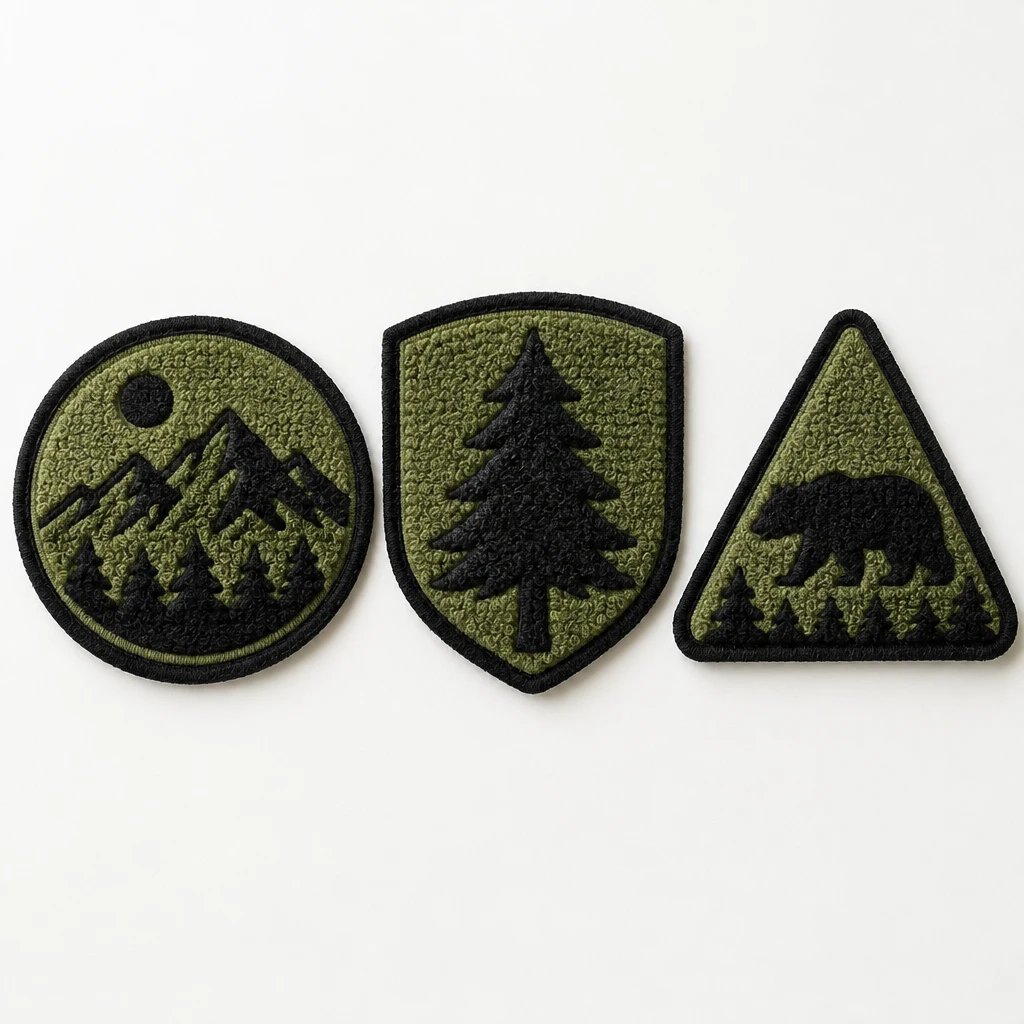
Choose chenille for fuzzy varsity lettering and PVC for wipe-clean gear badges, but don't assume either is the cheaper small-order option. The chenille vs PVC patches cost decision depends on size, setup, artwork, backing, and attachment. Here's why those details matter more than a low price per patch.
Compare chenille vs PVC patches cost at the same quantity
Neither chenille nor PVC has a dependable price advantage without matching specifications. A useful comparison holds the quantity, finished dimensions, artwork, and attachment requirements steady, then explains any construction changes needed for each material.
Small orders expose setup costs. Artwork preparation and production setup still have to happen when the order contains fewer pieces, so those costs are distributed across a smaller run. PVC generally involves mold tooling. Chenille requires its own machine-ready artwork and construction planning, especially when the design combines fuzzy fill, embroidered outlines, and a shaped felt foundation.
For example, say a club needs 40 patches, each 3 inches wide, for member jackets. A chenille quote with a felt edge and sew-on attachment isn't directly comparable to a PVC quote with sculpted layers and hook-and-loop backing. Those aren't just different materials. They're different builds, with different installation costs and different ways of being worn.
Ask for the total in USD as well as the price per piece. Separate any setup or tooling charge, backing charge, shipping, and garment attachment. If setup is included rather than itemized, have that stated. A quote should make the purchase easier to understand, not make you reverse-engineer it.
| Buying criterion | Chenille patches | PVC patches | Small-order implication |
|---|---|---|---|
| Surface and feel | Raised yarn creates a fuzzy surface, commonly supported by a felt foundation. | Flexible polyvinyl chloride creates a smooth or textured molded surface. | Pay for the texture your garment actually needs; the two finishes are not interchangeable. |
| Durability | Works well on varsity garments but exposed yarn can snag, flatten, or collect lint. | Tolerates surface dirt and moisture well, although edges and attachment can still fail. | Match durability to the wear location rather than treating one material as indestructible. |
| Detail level | Best for broad lettering and open shapes; fine details may need embroidery. | Supports defined color areas and relief, but tiny lettering and narrow gaps still have molding limits. | Simplifying artwork can improve readability in either material. |
| Cost drivers | Finished area, felt layers, chenille coverage, embroidered detail, outline complexity, and backing. | Tooling, finished area, thickness, color layout, relief levels, shape, and backing. | Request comparable construction instead of assuming material alone determines price. |
| Typical uses | Varsity letters, school jackets, club sweatshirts, and fashion pieces built around texture. | Outdoor club badges, backpack patches, work gear, and removable morale patches. | The garment and wear conditions should decide the shortlist. |
| Attachment | Sew-on is a practical choice for many jackets; adhesive compatibility depends on the garment. | Sew-on construction or hook-and-loop backing is common, depending on the intended surface. | Include installation and any matching loop panel in the purchasing plan. |
| Cleaning | Requires attention to yarn, felt, backing, and the garment's care instructions. | The patch face can often be wiped clean, but the backing and garment need separate care consideration. | A wipe-clean patch does not make the complete garment machine-washable or waterproof. |
| Repeat orders | Reorders depend on retained artwork, available materials, and matching the original specifications. | Reorders may benefit from usable retained tooling, subject to the supplier's storage and reuse terms. | Confirm reorder terms before assigning future savings to today's purchase. |
Choose chenille if the patch needs varsity texture
Choose chenille when the fuzzy surface is part of the design, not just an optional finish. Large initials, block lettering, and broad mascots on varsity jackets are strong uses because they give the yarn enough room to read clearly.
A chenille patch is a yarn-based emblem that uses raised loops or pile to create a soft, textured face. Many constructions combine that yarn with a felt foundation and embroidered accents. The felt can create a visible outline, while conventional embroidery can handle details that would disappear in the fuzzy fill.
That combination matters on a school letter. The main letter might be chenille, while a small year or club name needs a tighter stitched treatment. Asking every element to be fuzzy usually hurts the design. In our production experience, broad shapes with room between them are more reliable than trying to preserve every detail of a compact logo.
For example, a 4-inch block initial on a wool varsity jacket gives chenille a clear job: create the raised letter people expect to see and feel. Put that same initial on a lightweight running shell and the bulk becomes harder to justify. The material hasn't become worse. The placement has changed.
I'd keep chenille on substantial garments that can support its visual and physical weight. Think letterman jackets, heavyweight fleece, or a fashion overshirt with a deliberate chest emblem. Review chenille patch construction when deciding how much of the design should be fuzzy and how much should remain embroidered.
Skip chenille when fuzz works against the job
A badge positioned under a backpack strap is a poor place to buy texture. Repeated rubbing can compress the surface, and exposed yarn can catch on rough hardware. For dirty work gear, I would also skip a pale, fuzzy design if the buyer expects a quick wipe to remove grime. That expectation fits PVC better.
Choose PVC if the patch will face dirt and repeated handling
Choose PVC for a molded badge that needs defined shapes, a wipe-clean face, or removable attachment to compatible gear. It is a practical fit for backpacks, outdoor club equipment, and workwear placements that get handled often.
A polyvinyl chloride (PVC) patch is a flexible molded emblem that forms artwork through colored material and raised or recessed surfaces. It doesn't imitate thread. Its strength is the molded construction, which can separate a logo from its background without relying on fuzzy yarn or stitch direction.
For example, a hiking club could use a PVC mountain badge on packs with existing loop panels. Hook backing lets members remove the badge before cleaning the pack or move it to another compatible surface. That is a real functional reason to choose PVC. Adding several raised levels just because they are available is not.
Keep the relief useful. A simple raised logo against a recessed background may communicate more clearly than a crowded sculpted treatment. Narrow channels can trap dirt, and a thick badge may feel awkward on a soft garment. The best drawing isn't always the one with the most depth.
See PVC patch options for the material side of the decision, but judge them against the actual jacket, cap, or bag. A smooth shell fabric and a stiff pack panel ask different things of the patch. PVC's resistance to water at the face does not seal needle holes or waterproof the item underneath.
Skip PVC when it adds weight without a benefit
I'd skip a thick molded badge on a thin performance shirt. It can pull at the fabric, change the drape, and feel out of place against the rest of the garment. PVC also isn't the right substitute when the buyer specifically wants a traditional fuzzy varsity letter. Matching the outline won't reproduce the feel.
See your artwork as a custom USA patch before you buy. Free digital mockup in 12 hours — 5-piece minimum per design. We do not produce until you approve.
GET A FREE MOCKUPWhich artwork changes protect quality on a small patch?
Protect the main symbol first, then remove or enlarge details that won't survive the chosen construction. Chenille needs generous shapes, while PVC needs enough room for molded walls, color separation, and readable lettering.
Don't judge a patch only from an enlarged screen preview. A tiny slogan can look readable when the mockup fills a monitor and disappear at the finished size. Print the artwork at its intended dimensions, cut it out, and place it on the garment. It's a simple check. It catches surprisingly basic placement problems.
For example, a 3-inch cap badge containing a mascot, a curved organization name, a founding year, and a tagline may need editing in either material. With chenille, the mascot's interior features may require embroidered accents. With PVC, small counters inside letters and closely spaced color areas may need more room.
- Keep the primary name or symbol readable before preserving secondary wording.
- Show the finished width and height on the approval drawing, not just a large rendering.
- Identify which chenille areas are yarn, felt, and conventional embroidery.
- Identify which PVC areas are raised, recessed, or level with the background.
- Check the border and narrow protrusions for both appearance and attachment practicality.
- Treat screen colors as references, then confirm the intended material color selections.
A digital mockup confirms layout and specifications; it cannot reproduce actual softness, thickness, or how a jacket hangs. If those physical qualities determine acceptance, ask about a physical sample and its separate cost and timing before committing. Don't use a flat picture as evidence of a material property it cannot show.
Match the backing to the jacket, cap, or gear panel
Choose the attachment around the garment and intended use, not around whichever backing sounds easiest. Sew-on attachment is a practical starting point for permanent jacket patches, while hook-and-loop is useful for removable badges on compatible panels.
Backing is not a minor finishing choice. It changes thickness, installation, removal, and sometimes the total project cost. A hook-backed patch needs a loop receiving surface. If the jacket doesn't already have one, somebody has to supply and attach it. Include that work before comparing the finished cost with a sew-on patch.
Varsity jackets and lined outerwear
For a wool varsity body, sew-on chenille is often the sensible starting point. The installer still needs to consider the lining, nearby pockets, and whether stitches will be visible inside. Leather sleeves require different handling from the wool body. Tell the person quoting the patch exactly where it will sit.
Structured caps and trucker hats
A cap front curves, and a center seam can interrupt contact. For example, a 3-inch-wide badge may fit across the panel on paper but resist sitting flat if it is too tall, thick, or stiff. Chenille pile adds height; PVC thickness adds its own resistance to bending. Check the cap profile before finalizing the outline.
Shell jackets and removable gear badges
Heat-sensitive nylon and coated fabrics deserve caution. Don't assume an iron-on option is compatible merely because the patch supplier offers adhesive backing. Sewing can also puncture weather-resistant layers. For gear designed with a loop panel, a matching hook-backed badge avoids inventing an attachment method on a finished shell.
For sew-on PVC, discuss a suitable sewing channel or stitch area in the design. For chenille, confirm that the attachment path leaves the intended felt outline visible and avoids crushing the main yarn surface. Those details belong in the specification, not in instructions passed along after the patches arrive.
When is a simpler embroidered patch the right call?
Choose a conventional embroidered patch when the order needs a recognizable stitched logo but doesn't need chenille pile or molded PVC relief. If that simpler construction meets the wear requirements and comes back at a lower total cost, it is the right purchase.
For example, a volunteer club ordering 20 jacket badges may only need a block name, a simple emblem, and a clean border. Paying for fuzzy fill won't automatically make that badge more readable. Paying for a mold won't automatically make it more appropriate for occasional indoor events.
Embroidery isn't automatically the lowest quote, either. Dense stitching, large dimensions, and complex edges still require work. The honest comparison is a simplified embroidered version against chenille and PVC versions that preserve the same essential message. Remove decorative complexity before shrinking the whole design into something nobody can read.
If the material choice is still open, request a free digital mockup through the embroidered patch hub and note that you want a simpler stitched alternative considered. That gives you a useful baseline before paying for texture or molded depth.
Don't buy more pieces just to make the unit price look better. A lower per-piece figure on a larger order can still mean spending more dollars overall. Extra inventory makes sense when there is a realistic use for it, not merely because the quote has an attractive quantity break.
Ready to spec type, size, backing, and quantity? Open the quote form for a free 12-hour mockup and USA shipping after approval.
GET A FREE MOCKUPCheck these specifications before approving a small order
Approve a written build specification alongside the artwork. The drawing should show what the patch looks like, and the order details should state how it will be made, attached, counted, and shipped.
USA Customized Patches has a 10-piece minimum. A free digital mockup is provided in about 12 hours, before production. Production starts only after written approval. Quotes are available 24 hours a day, 7 days a week.
- Name the garment and placement. Include the jacket material, cap style, or gear panel rather than writing only 'for apparel.'
- Set the finished dimensions in inches. Confirm both width and height, including any visible felt or molded border.
- Confirm the count and design versions. Ask how separate artwork, names, or construction changes affect the minimum and setup.
- Approve the material construction. Identify chenille fill and embroidered accents, or PVC thickness and relief treatment.
- Specify the backing and attachment plan. State who supplies a loop panel, performs sewing, or checks heat compatibility.
- Review the actual-size artwork. Check spelling, open spaces, edge shape, colors, and the position of every secondary detail.
- Confirm the complete USD total. Identify setup, tooling, backing, shipping, and any garment application outside the patch quote.
- Approve the schedule in writing. Keep production time separate from transit and any installation work after delivery.
For a straightforward comparison, send the artwork, garment photo, desired dimensions, and piece count through the patch quote contact page for a free digital mockup. Note the deadline and whether the badge must be removable. Those details prevent a visually correct design from becoming an inconvenient patch.
Plan production and shipping around the actual event date
Typical production takes 7–12 business days after approval, and transit must be planned separately. USA Customized Patches ships from Corona, CA, to all 50 states across the United States.
The approval step controls the start of production. Time spent revising artwork happens before that start, not inside a finished production window. If a school committee needs several people to approve colors and placement, build that decision time into the schedule instead of treating the first quote request as the start date.
Installation adds another handoff. A box delivered before a club event isn't enough if the patches still need to be sewn onto jackets. Ask the installer about access through linings, cap handling, and scheduling while the artwork is being reviewed. Waiting until delivery can leave good patches sitting beside unfinished garments.
Review the nationwide shipping information and confirm the destination-specific transit estimate with the quote. Shipping from Corona identifies the dispatch location; it does not, by itself, establish where every material or production operation originated. Ask separately if sourcing documentation is a purchasing requirement.
What this advice is based on
This comparison rests on patch construction, artwork review, the digital mockup step, and the written order specifications. It is production guidance, not a laboratory durability ranking or a claim that one material always costs less.
In our production experience, small-order problems often begin with a mismatch: detailed artwork assigned to a coarse texture, a thick patch assigned to thin fabric, or a backing selected without checking the receiving surface. Reviewing those points before approval is more useful than promising a universal lifespan.
Actual wear depends on friction, cleaning, sunlight, placement, and attachment quality. Actual cost depends on the approved build and quantity. A digital mockup helps resolve design and specification questions, but physical testing or a sample is the better tool when hand feel or garment performance is the deciding issue.
Make the final choice by the feature you actually need
The verdict is chenille for a traditional fuzzy statement, PVC for a molded gear badge, and simpler embroidery when neither specialty feature earns its cost. For a small order, paying for the correct construction matters more than paying for the more elaborate one.
I'd choose chenille for a broad varsity initial on a substantial jacket. I'd choose PVC for a removable club emblem on a pack with a loop panel. For a basic stitched name badge worn occasionally, I'd start with embroidery and spend the remaining budget on proper attachment.
Before requesting the final price, write one sentence stating the patch's job: the garment, the placement, the wear conditions, and whether it must come off. Send that sentence with the artwork. It tells the production desk more than a request for the 'best quality' ever will.