
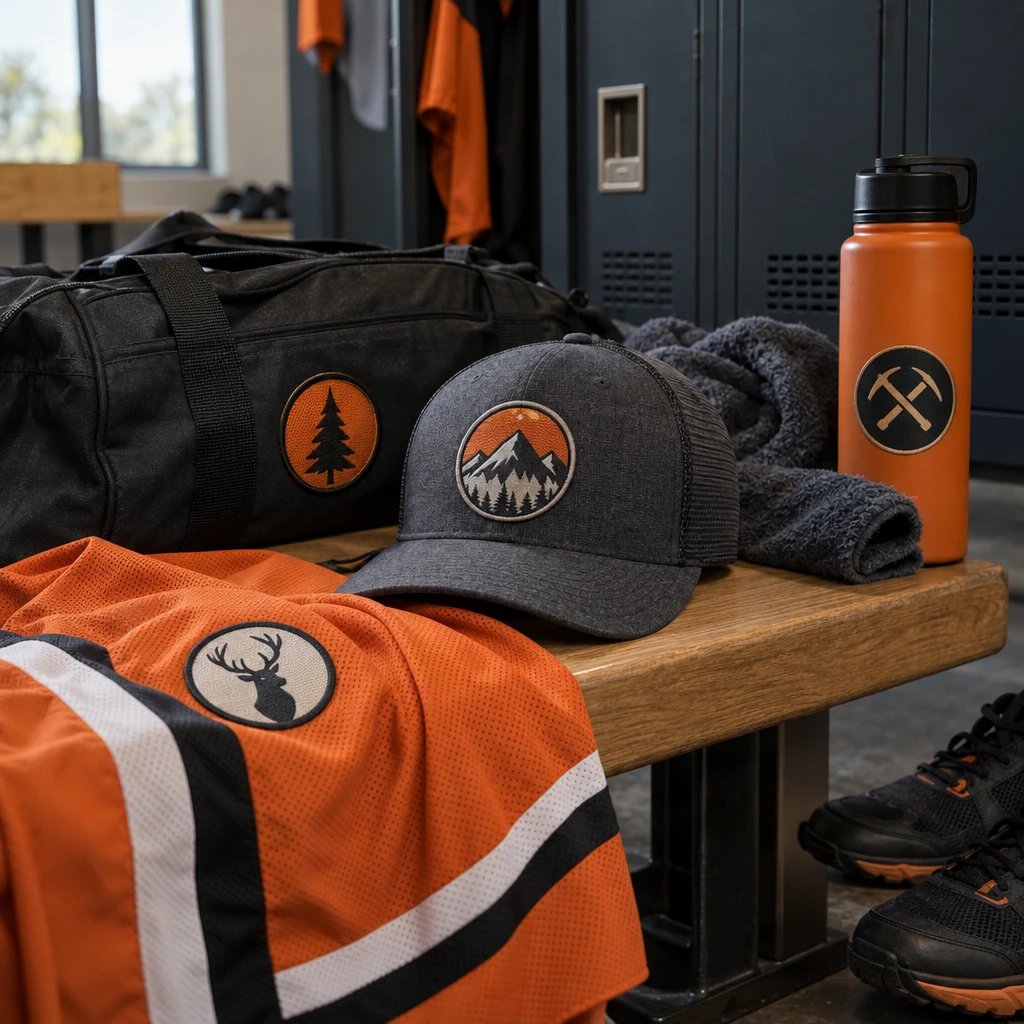
Example, not a customer story: a small cap brand has 24 business days before a Saturday pop-up and needs patches for 40 launch hats. For custom patch ideas hat and cap brands can actually use, start with a readable badge, match its material to the artwork, and check its size on the intended cap before choosing the backing. In this hypothetical order, a 2.5-inch-wide embroidered badge sewn onto a structured cotton-twill cap is the starting specification, subject to the mockup and an attachment check.
The organizer also wants four finished hats held back for exchanges and four loose patches for repairs or replacement stock. That makes 48 patches, all carrying one design, with 44 destined for caps. No fictional sales results or customer feedback are attached to this example. The decisions below are a practical order plan, not a claim about a completed job.
How do you turn custom patch ideas hat and cap brands use into stitchable art?
Choose one primary symbol and one readable line of lettering, then remove anything that depends on close inspection. For this example, a simple sunrise above a short brand name is a better front-cap design than a miniature version of the brand's full promotional artwork.
The hypothetical brand starts with a website logo containing a sunrise, narrow rays, a small tagline, and a shaded background. That file can look fine on a monitor and still be a poor embroidery plan. Thread occupies physical space. Closely spaced rays can merge, and the open centers of small letters can tighten as the design is translated into stitches.
I'd keep the sunrise and brand name. Drop the tagline. Replace the shaded sky with a solid background, and reduce the rays to a few clear shapes. The example uses three thread colors: cream lettering, orange sun details, and dark navy outlines. These are design choices for this hypothetical run, not a limit on available colors.
The patch idea also needs to suit the brand's selling format. A shield can work for an outdoor outfitter, a horizontal wordmark suits a workwear cap, and a round emblem can give a club hat a familiar badge layout. But adding a new shape just to look different often creates a small-text problem. Here, a rounded rectangle gives the short name more useful width than a circle would.
- Send the cleanest available artwork and identify the exact wording that must remain.
- Separate required elements from optional details, such as a tagline, date, or tiny registration symbol.
- State the intended patch dimensions and cap color so the design is judged in its actual use case.
- Check the digital mockup for spelling, proportions, thread-color assignments, border shape, and the smallest gaps between elements.
- Request revisions before approving the design for production.
USA Customized Patches provides a free digital mockup in about 12 hours. Production starts only after written approval. A digital mockup is an artwork proof that shows the proposed design and layout before manufacturing; it is not a physical test of thread texture, cap curvature, or attachment strength.
If the artwork still has fine rays or cramped lettering, request a free mockup through the embroidered patch page with the intended cap dimensions. Seeing the simplified version at the proposed size usually makes the trade-off easier to judge.
The lesson: preserve the recognizable mark before preserving every detail.
Which patch material fits a branded cotton-twill cap?
Embroidery is the right call for this example because the simplified badge uses broad shapes and benefits from visible thread texture. Woven construction becomes the stronger option when retaining finer lettering matters more than a raised surface.
An embroidered patch is a fabric badge that forms its design with stitched thread. A woven patch is a fabric badge that forms its design with interlaced threads, producing a flatter surface that can accommodate finer detail. Those differences matter more than calling either material premium.
| Material | Best fit for a hat design | Trade-off to check | Decision for this example |
|---|---|---|---|
| Embroidered | Bold lettering, simple symbols, and visible thread texture | Fine gaps and small lettering may need simplification | Choose it for the simplified sunrise badge |
| Woven | Detailed linework and smaller lettering with a flatter finish | Less raised texture than embroidery | Choose it instead if the small tagline must stay |
| Printed | Gradients, illustrations, and artwork that depends on continuous color | The image does not have embroidered thread relief | Use it if the shaded sky is essential to the identity |
| Leather | Simple marks and wordmarks with a material-led appearance | Fine detail, contrast, and care depend on the leather and marking process | Skip it for this multicolor sunrise design |
In our production experience, material decisions go sideways when the buyer selects a surface first and only then asks it to reproduce unsuitable artwork. A tiny multiline slogan does not become easier to stitch because the cap is expensive. If the tagline is nonnegotiable, compare woven patches for detailed hat artwork before enlarging the entire badge.
Printed construction is not a fallback for a bad embroidery file. It is a different way to carry an image. For a cap brand built around illustrated landscapes or photographic artwork, printed patches for full-color designs may preserve the design more faithfully than converting every color change into thread.
Cost needs the same practical treatment. Bigger patches, more involved construction, and added finishing generally push the quote upward, but material names alone do not establish a dependable price order. Ask for an itemized quote in dollars using the same dimensions and quantity. If a simpler, lower-cost version keeps the brand mark readable, it may be enough.
For our 48-patch example, adding raised specialty lettering or changing to a decorative material would complicate a design that already works in ordinary embroidery. I'd spend the attention on clean lettering and a suitable cap blank instead.
The lesson: choose the material that carries the artwork, not the material with the most elaborate description.
How do you size a front patch around a cap's seams?
Measure the usable front area on the actual cap and test a full-size paper outline before approving patch dimensions. The example starts at 2.5 inches wide by 1.5 inches tall, but those dimensions are a proposal for this cap, not a universal hat-patch standard.
See your artwork as a custom USA patch before you buy. Free digital mockup in 12 hours — 5-piece minimum per design. We do not produce until you approve.
GET A FREE MOCKUPA structured six-panel cotton-twill cap has a center seam and a supported crown. An unstructured low-profile cap has a different shape and may collapse around a stiff badge. A five-panel cap can provide an uninterrupted front panel, but its available height still depends on the blank. The product photo rarely tells you enough.
For the hypothetical order, the organizer obtains the selected blank before approving the patch. The paper rectangle goes on the front while the cap is worn or supported in its normal shape. Flattening the crown on a desk makes almost any badge look easier to fit than it will be in use.
- Cut a paper outline measuring 2.5 inches by 1.5 inches, including the intended border.
- Place it on the cap without forcing the crown flat.
- Check the space above the bill and below the upper crown seams.
- Look at the cap straight on and from both sides to see whether the outline appears oversized.
- Ask the person attaching the patches to confirm access around the proposed perimeter.
The rounded rectangle also suits a merrowed border. A merrowed border is a wrapped thread edge that finishes a patch perimeter with a raised rim. That rim becomes part of the visual design, so the artwork needs breathing room inside it. A narrow letter pushed against the border can look crowded even when it technically fits.
A shaped patch with deep notches or sharp internal corners may need a different edge treatment. For this launch, I'd skip the complicated outline. A straightforward border is easier to assess, and the sunrise already provides the identity.
Don't solve every legibility issue by making the badge taller. On a low crown, that can trade a lettering problem for a fit problem. Simplifying a line of text is often the more useful revision.
The lesson: size the finished patch around the cap, including its border and sewing space.
What backing works for caps that will be worn regularly?
Choose sew-on attachment for this example, with the backing specified for the planned sewing process. It avoids heat activation and gives the attachment shop a mechanical connection around the patch edge, provided the shop can access the cap correctly.
Sew-on is not the same as effortless. A finished cap has a sweatband, curved panels, and sometimes internal reinforcement where the needle needs to travel. The organizer should confirm that the shop has suitable equipment and can keep the sweatband clear. Sewing through the wrong internal layer may make a cap uncomfortable or distort its shape.
Iron-on backing is a heat-activated adhesive layer that bonds a patch to a compatible surface under suitable heat, pressure, and dwell time. A curved crown makes consistent pressure harder to achieve with a household iron. The cap's fabric, treatments, internal support, and care instructions also affect whether heat application is appropriate.
I'd skip household iron-on application for these 44 finished launch caps. Not because heat attachment can never work, but because it introduces a process the organizer has not tested. An experienced decorator with appropriate cap equipment may reach a different decision after evaluating the exact blank and adhesive.
Hook-and-loop backing makes sense when a cap is designed for interchangeable badges. It needs a compatible receiving area on the hat. Adding that area to an ordinary cap creates another construction task, so it is unnecessary for a fixed brand logo. Peel-and-stick adhesive is also not the attachment I'd specify for a regularly worn retail cap.
Before the full batch is attached, have the shop complete one cap and inspect it. Check whether the patch lies evenly, whether its center follows the intended placement, and whether the sweatband remains usable. This is an attachment check after patch delivery, not a substitute for approving the patch artwork beforehand.
The lesson: select the backing with the garment and attachment equipment in mind.
How many patches should a small cap launch order?
Order against the number of finished caps you need, then add a deliberate reserve rather than guessing. This hypothetical launch calls for 48 identical patches: 40 for sale hats, four for exchange-stock hats, and four kept loose.
USA Customized Patches has a 10-piece minimum. The example clears that minimum without adding extra artwork versions. If an order contains several designs, confirm how each version is counted in the quote rather than assuming a combined total answers every minimum-quantity question.
One patch design can still support more than one cap color. Here, the brand plans 22 navy caps and 22 tan caps, using the same cream, orange, and dark navy badge on both. The artwork should be reviewed against both backgrounds. A border that looks distinct on tan can visually disappear against navy.
Keeping the badge unchanged reduces the number of specifications to manage. Switching to a different thread palette for each cap color creates separate variants that must be clearly quoted, proofed, counted, and labeled. That may be worth doing later. For a first launch under a deadline, I'd keep one approved patch and let the blank colors provide the assortment.
Ready to spec type, size, backing, and quantity? Open the quote form for a free 12-hour mockup and USA shipping after approval.
GET A FREE MOCKUPAsk for patch manufacturing, shipping, and any separately arranged attachment work to be accounted for in the budget. A loose-patch quote should not be treated as the cost of a finished decorated cap. Blank hats and sewing can be separate purchases with their own scheduling requirements.
There's no useful reason to invent a price for this example. Dimensions, design complexity, material, backing, quantity, and delivery requirements belong in the quote. If budget pressure appears, compare a simpler specification before deleting the reserve pieces that have an actual purpose.
The lesson: count sale stock, exchange stock, and loose spares separately.
How should you schedule patches before a cap launch?
Work backward from finished-cap readiness, not just the date the patch package needs to arrive. Typical timing is 7–12 business days, but the quote must clarify the applicable schedule and shipping assumptions before that range is used to plan an event.
USA Customized Patches ships from Corona, CA, to all 50 states in the United States. Shipping to a destination and arriving before a particular event are different commitments. Confirm the service, destination, and estimated arrival window through the shipping information and the order discussion.
The example has 24 business days available before the pop-up. Its organizer does not spend all of them on manufacturing and transit. Sewing, checking, and packing 44 caps must fit after the patches arrive. The attachment shop's availability matters as much as the patch schedule.
- Business day 1: submit the artwork, cap information, proposed 2.5-inch by 1.5-inch size, sew-on requirement, and 48-piece quantity.
- Business days 2–3: review the free digital mockup, resolve any revisions, confirm the quoted timing, and provide written approval.
- Business days 4–15: reserve a hypothetical 12-business-day production window, subject to the actual order confirmation.
- By business day 20: target patch receipt only if the quoted shipping plan supports it; do not assume five business days covers every destination or service.
- Business days 21–22: complete the first attachment check and then sew the remaining patches onto the caps.
- Business day 23: inspect, count, and pack the finished hats, keeping the four loose patches separate.
- Business day 24: retain a final buffer before the Saturday pop-up.
These are planning allocations for the hypothetical order, not a promised production or transit schedule. If approval slips, the organizer must recheck the remaining window rather than assuming the original arrival target still holds. A revised logo, new backing, or quantity change can also require a revised confirmation.
USA Customized Patches is open 24 hours a day, 7 days a week for quotes. Quote availability does not mean weekends count as production business days. Likewise, a free mockup in about 12 hours is an artwork step, not a statement that the finished patches will leave the facility that day.
With a fixed event date, send the required arrival date and attachment plan through the patch order contact page when requesting the free digital mockup. That gives the team something concrete to assess before the artwork is approved.
The lesson: protect time after delivery, because loose patches are not finished hats.
What is this advice based on?
This advice rests on the patch-production process, the digital mockup step, and the specifications used to quote and manufacture an order. The cap launch is explicitly hypothetical; its dimensions, quantities, color choices, and planning dates illustrate decisions rather than document a customer result.
In our production experience, small lettering, edge spacing, crown shape, and attachment access are recurring constraints worth resolving before approval. The exact outcome still depends on the supplied artwork, selected construction, and actual cap. A digital proof can establish layout and wording, but it cannot physically demonstrate how a particular crown behaves under sewing or heat.
For the example order, the final approval record should identify one rounded rectangular embroidered design, a 2.5-inch by 1.5-inch finished size, three specified thread colors, a merrowed border, sew-on construction, and 48 pieces. It should also preserve the approved artwork revision and confirmed schedule.
The lesson: keep the approval record specific enough that the next reorder does not depend on someone remembering which navy, which border, or which file was used.