
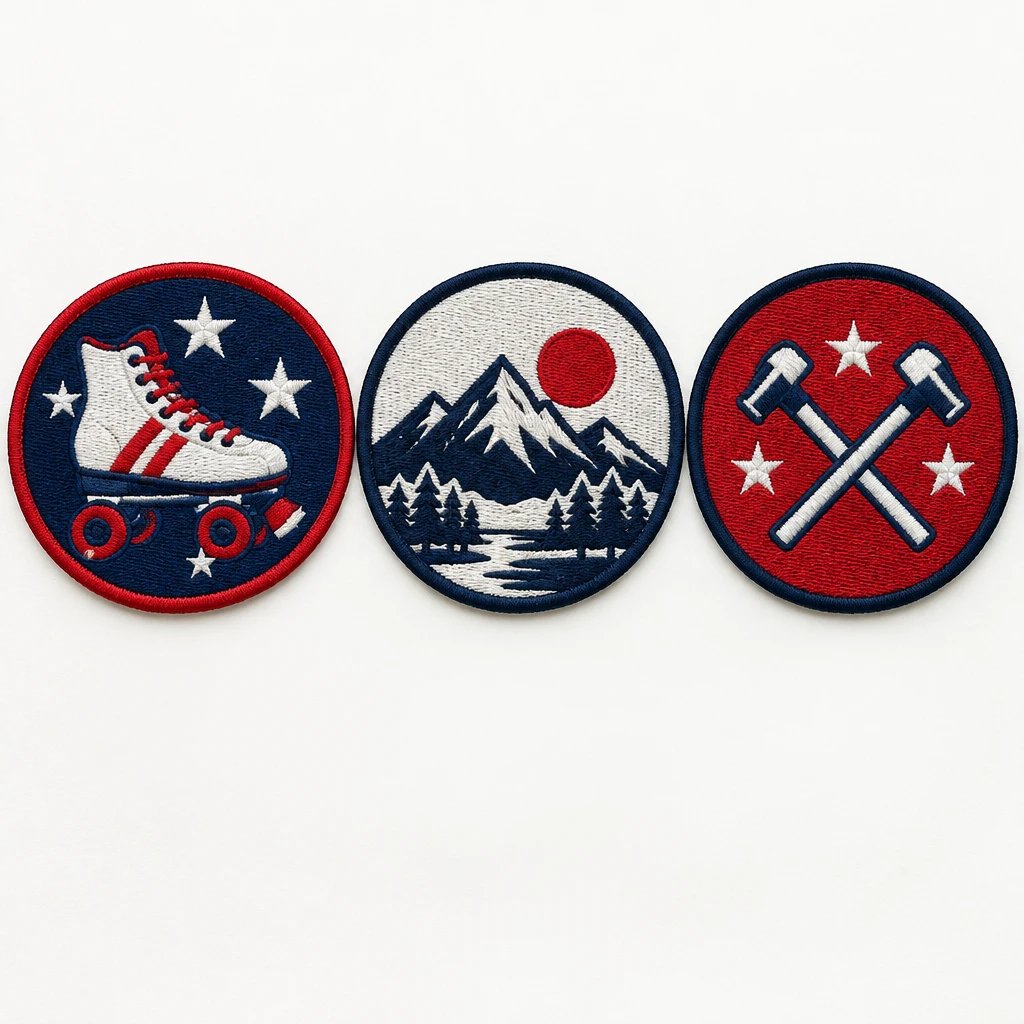
The biggest design-driven cost factor for an embroidered team patch is the area that needs stitching: larger, denser artwork takes more thread and machine time at the same order quantity. For custom patch ideas roller derby and rec leagues can use without stretching the budget, start with a shared crest, readable team name, and backing suited to the actual jacket, cap, or bag.
Don't start with the fanciest finish. Start with where the patch will live. A derby jacket back can carry a large mascot and an arched league name, while a rec softball cap needs a compact mark that clears the crown seams. Trying to force the same full layout onto both usually creates either unreadable lettering or unnecessary production work.
What changes the quote for a league patch?
Size, stitch coverage or color requirements, border, backing, quantity, rush timing, and artwork preparation all affect a custom patch quote. Their importance changes with the construction: embroidery is sensitive to stitch work, while printed artwork handles color and shading differently.
There isn't a useful universal dollar price without those specifications. Ask for a quote in USD that identifies the patch construction, finished dimensions in inches, quantity per design, backing, and shipping arrangement. A lower total means little if one version includes an attachment backing and another arrives ready for sewing.
| Cost factor | Effect on cost | How to keep it down |
|---|---|---|
| Finished size | A larger patch generally uses more material and, for embroidery, requires more stitching when coverage stays similar. | Measure the garment's usable placement area before choosing dimensions. Remove minor details instead of automatically enlarging the patch. |
| Stitch count and coverage | Dense fills, layered details, and large stitched backgrounds generally increase embroidery time. | Use exposed twill where it suits the design and keep decorative background stitching out of areas that do not need it. |
| Thread or artwork colors | Additional thread colors can add setup and production handling. Printed color complexity does not follow the same stitch-based cost pattern. | Keep embroidered artwork to intentional team colors and ask whether removing an accent actually changes the quote. |
| Patch construction | Embroidered, woven, and printed versions use different production methods, so identical artwork can quote differently. | Choose the construction that reproduces the essential detail without extra size or unnecessary texture. |
| Border and outline | Irregular outlines, narrow projections, and detailed edge finishing can add production work. | Use a circle, oval, shield, or rounded rectangle when the team identity does not require a custom silhouette. |
| Backing | Iron-on adhesive, hook-and-loop components, and other added backing materials can increase patch cost. | Use sew-on construction when the garment allows it, but include the separate cost of attaching the patches. |
| Quantity and design versions | More identical pieces can spread setup work across the order. Separate names or layouts introduce additional handling. | Consolidate the roster around a shared design and request a quantity comparison before adding speculative inventory. |
| Rush timing | Compressed production and expedited shipping can add cost, and availability depends on the specifications and schedule. | Approve artwork early and work backward from the date the finished garments must be ready. |
| Artwork preparation | Redrawing unclear art, rebuilding lettering, or resolving multiple layouts can add preparation work and affect the schedule or quote. | Provide the clearest original artwork available, exact wording, and one agreed team brief. |
| Individual personalization | Different player names, numbers, or roles create variations that require separate checking and production handling. | Keep the main crest identical and place personal information on a separate garment decoration or name tab. |
In our production experience, the least useful budget question is simply, “Can you make it smaller?” Sometimes yes. Sometimes that change forces the lettering into a size that thread cannot reproduce cleanly. Simplifying the artwork first gives you a better chance of reducing cost without ordering a patch nobody can read.
Compare custom patch ideas roller derby and rec leagues can use on a budget
A shared team crest usually gives a league the most flexibility because the same approved artwork can serve players, coaches, volunteers, and supporters. Role badges, season awards, and individual name patches make sense when their extra versions serve a clear purpose.
A shared crest for jackets and equipment bags
A crest is a team emblem that combines the primary symbol and name into one repeatable design. For example, a roller derby league might use a skate wheel, its league name, and a simple shield outline on denim jackets and canvas equipment bags. I'd keep the mascot's expression bold and leave the founding story off the patch. The story belongs elsewhere; the crest needs to read across the bench.
This is where ordinary embroidery often earns its place. The raised thread gives a block-letter wordmark enough character without requiring a special dimensional effect. If a twill background already matches the team's dark color, stitching that entire background may add work without adding much visual value.
Season badges that do not require a new layout
For example, a rec kickball league could keep the same circular badge and change only the season wording for each new order. That still requires a fresh proof and quote, but it avoids redesigning the whole identity. A season badge works well on a gear bag, where there is room to collect them without crowding the playing jersey.
I'd skip a different patch shape for every season unless collecting those shapes is part of the program. A consistent outline makes placement easier and keeps the visual system recognizable. Changing a small label is usually a more restrained design decision than rebuilding the mascot, border, and text arrangement together.
Volunteer, official, and captain identifiers
Role patches should prioritize the role word, not miniature artwork. For example, a derby event could use a clearly lettered VOLUNTEER patch on an approved staff vest. If roles rotate, removable hook-and-loop attachment may justify its added material cost. If the vest stays assigned to the same job, a sewn patch may be enough.
Keep identification separate from required uniform markings. Check the league's current uniform rules before deciding that a captain patch, player number, or nickname belongs on the playing garment. A decorative patch should not obscure an identifier or occupy a location reserved by the team's rules.
Awards with one readable message
A milestone patch works best when the achievement is obvious. For example, a rec basketball program could use a sportsmanship badge with a simple ball symbol and clear award wording. Trying to add the recipient's name, full season dates, sponsor list, and venue creates several personalized layouts where one shared award design would do.
For a shared team crest, you can request a free digital mockup through the embroidered patch options. Include the intended garment and finished size so the proof starts with a usable layout rather than a logo floating on an empty page.
How do you choose patch size without paying for unused space?
Choose the smallest finished size that preserves the essential lettering and fits the garment cleanly. Measure the usable panel, not the overall garment, and leave room for seams, pockets, closures, and movement.
For example, a proposed 3-inch round patch may fit a canvas bag panel but feel crowded on the front of a particular cap. Cut a paper circle at that size and place it on both items. That simple check catches placement problems a large on-screen logo can hide.
A jacket back offers space, but you do not have to fill all of it. Large lettering may be worth the extra stitching when recognition from a distance matters. Decorative rays, tiny stars, and a fully stitched background are easier places to reduce work. Protect the team name before protecting the ornament.
See your artwork as a custom USA patch before you buy. Free digital mockup in 12 hours — 5-piece minimum per design. We do not produce until you approve.
GET A FREE MOCKUPCap orders deserve their own layout check. Crown curvature and center seams can affect how a finished patch sits and how it can be attached. An oversized patch may look fine laid flat and still be awkward on the cap. Send a photo of the actual cap style rather than describing it only as a baseball hat.
When should a team choose embroidery, woven, or printed patches?
Choose embroidery for bold lettering and visible thread texture, woven construction for finer linework, and printed construction for artwork built around shading or photographic detail. The lowest-cost workable choice depends on the actual art and dimensions, not a blanket ranking of materials.
An embroidered patch is a fabric patch that uses stitched thread to build the design over a base material, often twill. It suits a derby jacket crest with thick outlines and a compact color palette. Larger fills and denser coverage generally require more work, so a simple mascot can be more economical than an equally sized illustrated scene.
A woven patch is a textile patch that forms the design through woven threads rather than raised embroidery stitches. For a league emblem with fine lettering or closely spaced lines, woven patch construction is worth comparing before increasing the patch size. The trade-off is a flatter surface rather than the familiar raised embroidered finish.
Printed construction deserves consideration when a design relies on gradients, shaded flames, or an illustrated rink scene. Converting every shade into thread can change the artwork substantially. I'd skip that conversion if the shaded illustration is the whole point. Get the printed version quoted instead, while checking the available material and backing for the intended garment.
Color count needs context. Removing an embroidered accent color may simplify production, but removing a color from printed artwork does not necessarily create a comparable saving. Ask what changes the specific quote. Don't strip the team's identity out of the design based on a pricing rule from a different process.
Which border keeps a team patch simple to produce?
A straightforward outline with a compatible edge finish usually keeps production simpler than a shape full of narrow points and deep recesses. The border should support the artwork rather than turn every mascot detail into a cutting requirement.
A merrowed border is an overlocked thread edge that wraps around a patch's perimeter. It is a familiar choice for many circles, ovals, and uncomplicated badge shapes. A cut edge follows a trimmed outline and can suit shapes that do not work well with a wrapped border, subject to the patch material and design.
For example, a derby logo featuring a skate with trailing flames does not need each flame cut out separately. Put the illustration inside a shield and the identity stays intact. I'd choose the simpler outline for a team equipment bag, where a thin projecting detail is more likely to catch on surrounding gear.
A custom silhouette can still be the right call when the outline is the recognizable part of the logo. Just price that choice honestly. Compare the same artwork in a contained badge and a contour shape, then decide whether the difference matters enough to the team to keep it.
Should derby jackets and rec jerseys use the same backing?
Not automatically. Denim, canvas, cap fabric, and stretch performance jerseys have different attachment requirements, so the backing should follow the garment rather than the team logo.
Sew-on construction is often the practical choice for a permanent patch on a denim jacket or accessible canvas bag panel. It avoids an added adhesive backing when that adhesive is not needed. Sewing still has a cost, though. If an alterations shop or uniform decorator will attach the patches, include that labor in the comparison.
Iron-on backing is a heat-activated adhesive layer that bonds a patch to compatible fabric under the specified application conditions. It can be convenient, but a polyester performance jersey is not automatically heat-safe. Check the garment care instructions and the patch application requirements before making iron-on the default for the whole roster.
Stretch changes the decision too. A firm patch attached across a stretchy section may restrict that area or pull differently from the surrounding fabric. For playing jerseys, discuss placement and attachment with the decorator. A warm-up jacket or equipment bag may be a better home for a decorative league crest.
Hook-and-loop backing is a removable fastening system that joins a hook surface to a matching loop surface. It is useful for rotating role labels or gear that already has a loop panel. Confirm whether the quote includes just the patch-side hook or both mating pieces. A hook-backed patch does not attach properly to an ordinary jersey by itself.
How can roster planning reduce the cost per patch?
Combining identical patches into one planned order can spread setup work across more pieces. Separate player names, numbers, shapes, or layouts create variations, so a larger total count does not necessarily behave like one repeated design.
USA Customized Patches has a 10-piece minimum. If the order includes multiple versions, identify the quantity for each version and confirm how the minimum applies before collecting money from players. Do not assume that an assortment of unrelated designs will be quoted as one shared run.
For example, a run club ordering 40 identical crest patches has a different specification from a club ordering 40 patches with individual names. The shared crest repeats one approved layout. Individual names introduce different word lengths, additional proof checking, and more opportunities for an ordering mistake.
I'd keep the main league mark common and handle personal names separately when the budget is tight. That also makes spare patches useful for new members. A patch carrying a departed player's nickname is not much help when someone joins halfway through the season.
Ready to spec type, size, backing, and quantity? Open the quote form for a free 12-hour mockup and USA shipping after approval.
GET A FREE MOCKUPCount coaches, officials, volunteers, supporters, and replacement needs before requesting the quote, but do not buy a large speculative pile solely to chase a lower unit cost. More pieces can reduce the price per piece while increasing the total spend. Ask for quantity alternatives tied to a believable roster plan.
What artwork preparation prevents expensive revisions?
Clear source artwork, final wording, and one designated approver reduce avoidable preparation and revision work. A free digital mockup helps check the specification, but it does not turn unclear art into an agreed team decision.
Provide the original artwork file when available. A clean image can also be useful; a screenshot of a social profile picture is less helpful because small lettering and outlines may already be blurred. Include exact spelling, capitalization, team colors, and any elements that must remain unchanged.
For embroidery, digitizing is the preparation of a stitch plan that tells the embroidery equipment how to build the design. It is different from simply resizing a picture. Ask the quote to identify any applicable artwork or setup charges rather than assuming they are included or assuming every redraw carries a separate fee.
USA Customized Patches provides a free digital mockup before production, generally in about 12 hours. Production starts only after written approval. Check the dimensions, wording, thread color references, border, backing specification, and quantities during that approval step. A digital proof shows the proposed layout; it is not a physical sample of texture or garment attachment.
If the roster has competing layouts, send the agreed version and intended garment through the patch quote contact page for a free digital mockup. Settle the mascot choice first. The proof is more useful when it resolves production details rather than reopening the team's entire identity.
How do you avoid paying for a last-minute patch order?
Work backward from the date the patched garments must be ready, not just the date the package must arrive. Artwork approval, production, shipping, and attachment each need room in the schedule.
Typical production takes 7-12 business days after written approval. That is not a promise of delivery within the same window. Rush feasibility and any added cost depend on the design, quantity, production availability, and destination, so confirm the full schedule before announcing a distribution date.
USA Customized Patches ships from Corona, California, to all 50 states across the United States. Review the patch shipping information and confirm the delivery arrangement for the order. Shipping origin does not by itself establish where every material or production step originates.
Quote requests are open 24 hours a day, 7 days a week. That access is useful for volunteer organizers working after practice, but it does not remove approval or production time. If a tournament deadline is close, provide the required arrival date immediately and ask what can actually be completed.
Leave time for attachment. A box of sew-on patches arriving before the first bout is not the same as finished jackets ready for distribution. The person doing the sewing needs access to the garments, and cap application may require equipment or handling different from a flat bag panel.
Build a quote brief the whole team can approve
A useful quote brief names the garment, essential artwork, dimensions, construction, edge, backing, quantity, and deadline. Keeping those details together makes alternate quotes comparable and prevents a budget decision from quietly changing the finished product.
- Name the use case and garment. Specify derby denim jackets, rec softball caps, staff vests, or canvas equipment bags. Include a photo and the garment's fiber information when attachment compatibility matters.
- Measure the placement area in inches. Note nearby seams, pockets, closures, and curved surfaces. If dimensions are provisional, label them as provisional rather than letting everyone assume they are final.
- Identify the essential artwork. Separate the team name and primary symbol from optional dates, small slogans, background fills, and decorative accents that can be removed if the quote needs adjustment.
- Request the appropriate construction. Start with embroidery for a bold crest, but ask about woven or printed alternatives when fine detail or shading would otherwise force a larger size.
- Specify the border and backing. If those choices are undecided, request clearly labeled alternatives rather than comparing an unbacked sew-on patch with a hook-and-loop version as if they were identical.
- List the quantity for each design version. Mark player-specific names and numbers separately. Include confirmed spare requirements without treating every possible future recruit as a committed order.
- Give the required arrival date and attachment plan. Explain when the patched garments must be ready and who will apply the patches. Name one person to collect feedback and issue written approval.
What this advice is based on
This advice rests on patch production requirements, the digital mockup review, and the specifications that determine an order's quote. In our production experience, garment compatibility, readable artwork, and clearly separated design versions matter more than choosing the most elaborate finish.
The examples describe possible league orders, not customer stories or fixed pricing. For a useful next comparison, keep the quantity and delivery requirements unchanged and ask what happens when only one feature changes, such as patch size, background coverage, or backing. That isolates the cost decision instead of making you compare two different products.