
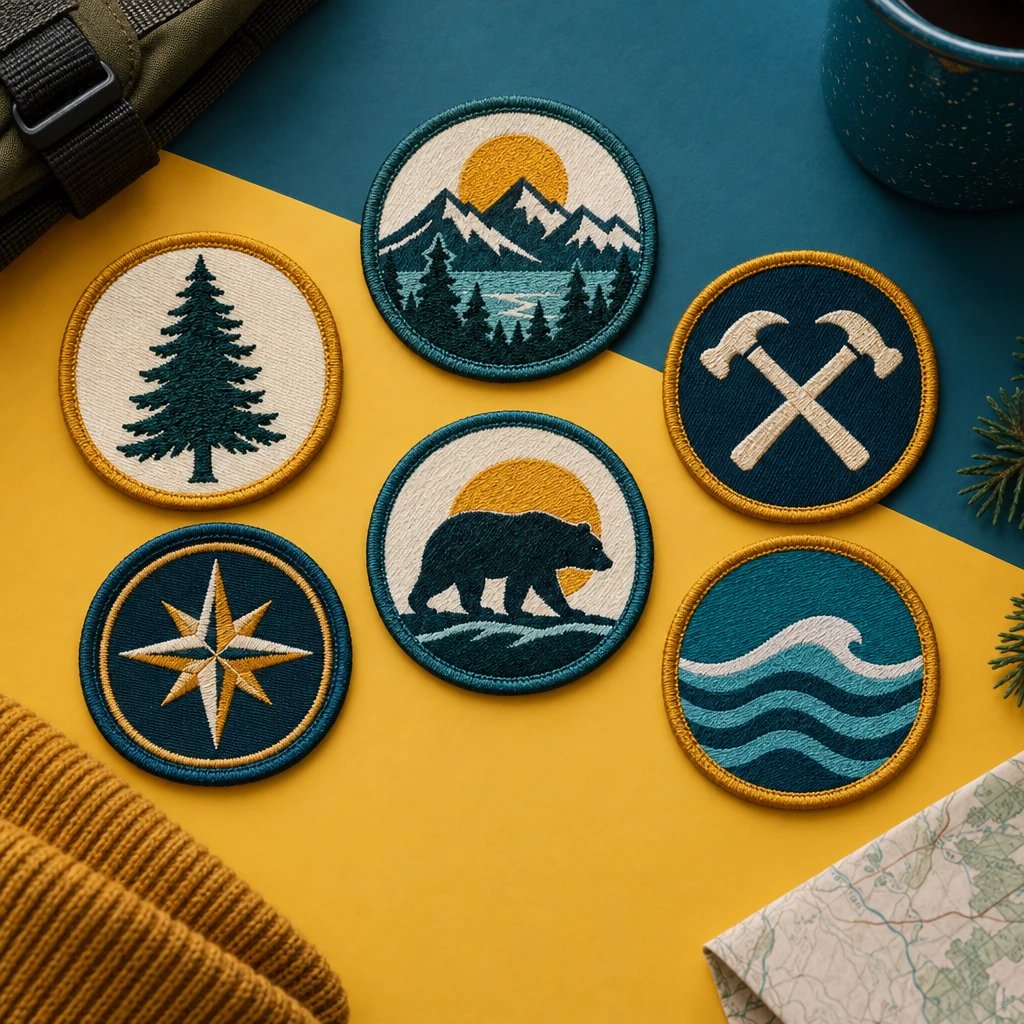
To order custom patches for Charlotte businesses that fit your uniforms and read clearly, choose the garment, attachment method, and finished dimensions before refining the artwork. The first mistake is approving a logo on screen without checking the space where the patch will actually sit. USA Customized Patches offers a 10-piece minimum, a free digital mockup before production, and shipping to all 50 states.
Start custom patches for Charlotte businesses with a garment brief
Build your order around the item you will decorate, not just the logo file. A structured cap, a lightweight restaurant shirt, and a team warm-up jacket put different limits on patch size, stiffness, and attachment.
Your brief should name the garment model if you know it, fabric composition, placement, intended use, quantity, and date the finished garments must be ready. Say whether you are handing out loose patches or supplying finished apparel. Those are different jobs. A box arriving in Charlotte does not mean your local decorator has time reserved to sew every patch onto a sleeve.
Example: say a Charlotte run club orders 40 patches for woven nylon jackets. You would send the jacket care label, a photo of the proposed chest placement, and a note that the garments need to flex during running. That information matters more at the quote stage than a photograph of a patch you liked on a heavy denim vest.
Use this sequence to keep the decisions in order. Each step produces a specification you can pass to the next person, including a designer, purchasing manager, or Charlotte embroidery shop.
- Decide the use and garment. Specify the fabric, garment model, placement, washing routine, and whether you need loose patches or application. The reason is practical: the garment determines which patch constructions and attachment methods are appropriate.
- Decide the finished dimensions. Specify width and height in inches, plus orientation and the usable space between seams. Check a paper cutout at actual size because a screen preview hides scale and cannot show how a patch occupies a curved cap panel.
- Decide the patch material. Specify embroidered thread, woven fabric, printed fabric, or molded polyvinyl chloride (PVC), along with the design features you must preserve. Material choice determines texture, detail retention, flexibility, and the kind of artwork revision needed.
- Decide the backing and border. Specify sew-on, heat-activated iron-on, or hook-and-loop attachment, then identify the edge finish. This prevents ordering an attachment that conflicts with the garment or a border that crowds the lettering.
- Decide the production artwork. Specify wording, colors, line hierarchy, simplified details, and the approved logo file. Small details need deliberate treatment because increasing stitch density cannot make every tiny feature readable.
- Decide the approved order scope. Confirm the piece count, dimensions, material, backing, border, delivery address, and final digital mockup in writing. Production starts only after approval, so the approved specification must describe the whole order rather than the artwork alone.
- Decide the delivery and application schedule. Specify the in-hand date, transit allowance, receiving contact, and any separate sewing or pressing appointment. Shipping, attachment, and garment distribution need time after patch production is complete.
Measure the placement before you choose a patch size
Measure the usable garment area and test the proposed patch outline at actual size. Record both width and height in inches; a single measurement leaves too much room for interpretation.
A pocket is not always a usable mounting panel. Sewing through it can close the pocket, and a patch that overlaps the opening can interfere with normal use. On a work shirt, check the distance between the placket and the sleeve seam. For a cap, look at the front-panel height, center seam, crown curve, and the decorator's access to the underside.
Example: a proposed patch might measure 3 inches wide by 2 inches high for a staff shirt. Cut that rectangle from paper, place it on the actual shirt, and check it while someone wears the garment. Those dimensions are an example, not a universal chest-patch recommendation. A narrow shirt panel or a large logo border may push you toward a different shape.
Read it from normal conversation distance. Can you identify the company name without leaning in? I'd remove a secondary tagline before shrinking every line to preserve the full business-card layout. You are designing a garment identifier, not a miniature brochure.
For mixed apparel, keep the artwork related without assuming every item needs the same patch. A jacket back has room for a club name and emblem. A cap may need only the emblem. Separate sizes or constructions can affect the quote and order setup, so identify those variations before requesting pricing.
Choose the material that keeps your design readable
Choose embroidered patches for visible thread texture and straightforward logos, woven patches for finer fabric detail, printed patches for tonal artwork, and PVC for a molded surface. The right choice preserves the information people actually need to recognize.
An embroidered patch is a fabric emblem that uses stitched thread to build a raised design. That texture suits work shirts, club jackets, and many cap logos, but it also takes space. In our production experience, the hardest embroidery files are often ordinary logos with too many small elements packed into a narrow finished width.
| Material | Use case to consider | Specification to settle | Trade-off |
|---|---|---|---|
| Embroidered thread on fabric | Staff shirts, team jackets, bold cap logos | Finished size, thread colors, fill coverage, and edge finish | Raised texture gives the design depth, but fine lettering and close gaps may need simplification. |
| Woven fabric | Club badges or uniform emblems with fine lines | Smallest lettering, line spacing, and background color | A flatter surface can retain finer detail, but you lose the raised thread texture of embroidery. |
| Printed fabric | Merchandise artwork with gradients or photographic elements | Image resolution at finished size and the required edge treatment | Printed color can preserve tonal transitions, but it does not create stitched relief. |
| Molded polyvinyl chloride (PVC) | Gear bags, outdoor team equipment, and removable identifiers | Thickness, raised areas, color separations, and attachment | The molded surface suits a different look and feel, but added stiffness may be wrong for a lightweight shirt. |
I'd start with embroidery for a Charlotte service company's bold name-and-symbol logo on a woven work shirt. For a badge containing fine lettering that cannot be removed, I'd compare woven construction instead of forcing the same design into more stitches. Neither material wins every job.
If stitched texture is the direction you want, you can request a free digital mockup through the embroidered patch ordering page using your garment photo and proposed dimensions. The useful question is not just whether the logo looks good, but whether it remains readable at the size you intend to wear.
Check woven patches for fine-detail logos when the artwork has tight linework. A simpler construction may be enough for a basic staff identifier; you do not need molded layers or decorative texture just to make a company name visible. Ask for the cost difference using the same finished size and quantity so the comparison means something.
See your artwork as a custom USA patch before you buy. Free digital mockup in 12 hours — 5-piece minimum per design. We do not produce until you approve.
GET A FREE MOCKUPMatch the backing and border to the garment
Choose the backing from the garment's fabric, care instructions, and need for removal. Choose the border from the patch shape and the amount of room available around the design.
Sew-on backing is the right starting point for many uniforms that will be worn and washed repeatedly. It does not rely on a heat-activated adhesive bond, and the attachment can be inspected along the perimeter. The trade-off is application labor. You also need access behind the panel, especially around pockets, jacket linings, and structured caps.
Iron-on backing is a heat-activated adhesive layer that bonds a patch to compatible fabric under controlled heat and pressure. It is not permission to press every garment. Check the fabric label and the patch supplier's application instructions, then test on a spare garment when possible. Heat-sensitive synthetic fabrics, coatings, and curved surfaces deserve particular care.
I'd skip an untested iron-on application for expensive performance jackets. A damaged finish costs more than the application shortcut saves. If pressing is suitable, ask the applicator to document the settings used for that patch and garment combination rather than borrowing settings from a different transfer product.
Hook-and-loop backing is a two-part fastening system that lets you remove or exchange a patch. Specify whether your order needs the hook side alone or both mating sides. A hook-backed patch cannot attach securely to an ordinary shirt without a compatible loop field. For team bags or role identifiers, removability may justify the added thickness.
A merrowed border is a wrapped thread edge that finishes a patch perimeter. It works well with many simple outlines, while narrow points and deep inward cuts may call for a cut edge instead. Leave visual space between the border and lettering. Otherwise, even correctly spelled text can feel crowded after the edge is finished.
Prepare artwork and quantities for an accurate quote
Send the clearest artwork available alongside a written specification and a counted quantity. Pricing depends on the combination of size, construction, detail, backing, border, and order volume, not simply on the fact that it is a logo patch.
An editable vector file is useful when you have one because shapes and lettering can be evaluated cleanly. A clear image can also start the conversation, but a screenshot may conceal rough edges or missing detail. Include the exact wording separately. That gives you another way to catch a dropped letter, outdated team name, or incorrect punctuation.
State which parts of the logo may change. Can the tagline disappear? Can a thin outline become thicker? Does a gradient need to remain, or can it become solid color? These decisions should come from the person responsible for the brand, not from a last-minute guess made while approving the proof.
Color references help, but a monitor is not a physical thread sample. Thread sheen, fabric texture, and lighting can change the apparent color. If a close match to existing Charlotte staff uniforms matters, say that before approval and ask what physical comparison options are available. A digital mockup confirms the proposed color arrangement, not every aspect of material appearance.
USA Customized Patches has a 10-piece minimum. Count patches by garments and placements, not just by people. Example: if a business outfits 20 employees with two shirts each and one patch per shirt, the base need is 40 patches. Any spares should reflect your actual replacement needs rather than an arbitrary allowance.
Request the quote in USD and ask which services it includes. Patch manufacture, garment application, shipping, and any requested physical sample should not be treated as interchangeable line items. Bigger or denser designs generally require more material or production work, but simplifying a small logo may be more useful than reducing its dimensions until the name is difficult to read.
Review the digital mockup and approve the full order
Approve both the artwork and the written specifications before production. USA Customized Patches provides a free digital mockup in about 12 hours and produces your patches only after written approval.
A digital mockup is a visual proof that shows the proposed patch layout before manufacturing. Review the wording, proportions, colors, outline, border, and stated dimensions. Backing details may need confirmation in the accompanying order notes because you cannot reliably infer a backing from a front-view image.
Print the mockup at actual size if your software allows it, then check the printed dimensions with a ruler. Printer scaling can quietly change the result. Compare the proof with the paper placement test you made earlier. If the design has grown to preserve lettering, confirm that the larger outline still fits the garment.
Ready to spec type, size, backing, and quantity? Open the quote form for a free 12-hour mockup and USA shipping after approval.
GET A FREE MOCKUPUse one approval owner. Team captains, office managers, and brand staff can all review, but one person should send a consolidated revision list. Conflicting instructions about a border color or nickname create uncertainty that no production file should carry.
If the backing or artwork still needs a decision, send the open questions with your garment details through the patch specification contact page and ask for the free digital mockup to reflect the final choice. Settle those questions before approving rather than attaching a correction to an already released order.
Keep the approved proof and specification together. Your record should identify the finished width and height, material, colors, border, backing, quantity, shipping address, and approval date. A later reorder is much easier to quote accurately when you can point to a complete approved version.
Schedule shipping to Charlotte and garment application
Work backward from the day the decorated garments must be ready, allowing separate time for production, transit, and application. Typical production takes 7–12 business days after approval; confirm the schedule for your specific order before committing to an event.
USA Customized Patches ships from Corona, CA, to all 50 states in the United States. Charlotte delivery is part of that nationwide service, not a local pickup arrangement. Use the shipping information to prepare your delivery questions, and confirm transit expectations for your address and requested service.
Put the actual receiving address on the order. A business suite, apartment number, loading entrance instruction, or receiving contact can matter more than the neighborhood name. For apparel going to a Charlotte decorator first, decide whether the patches should ship directly there or come to you for inspection.
Quotes are available 24 hours a day, 7 days a week. That availability does not mean production and transit run on the same schedule. Keep business-day production estimates separate from calendar dates, and leave room for your own artwork review rather than treating approval as automatic.
Reserve the application appointment separately. Ask the decorator to inspect the patches and mount one on the intended garment before completing the batch. Confirm position, orientation, garment access, and stitch placement or approved pressing method. It is far easier to adjust one test application than to repair a full rack of uniforms.
Check what usually goes wrong before application
Most avoidable problems come from a mismatch between the approved patch, the actual garment, and the application plan. Inspect those three things together before the entire batch is attached.
- The patch looks smaller than expected. Compare the delivered dimensions with the approved dimensions, then check the original placement test. A correctly sized patch can still feel too small if nobody tested its visual scale on the garment.
- The lettering is difficult to read. Check whether the approved proof retained too much small text. Enlarging a design on a phone during review can hide a readability problem at finished size.
- The backing does not match the plan. Confirm that sew-on, iron-on, or hook-and-loop instructions reached the person doing application. A front-view mockup alone does not communicate the attachment method.
- The garments are late even though the patches arrived. Review the separate application booking and distribution date. Patch delivery is only one milestone when a team needs finished apparel.
What this is based on
This advice rests on the patch-production process, the digital mockup review, and the specifications that control an order. Recommendations about detail, placement, and attachment reflect general production realities rather than invented customer results or claims about a particular Charlotte organization.
Your garment remains the final check. Before releasing the whole batch for application, put the approved specification beside one patch and one actual garment, then verify the fit and attachment method together.