
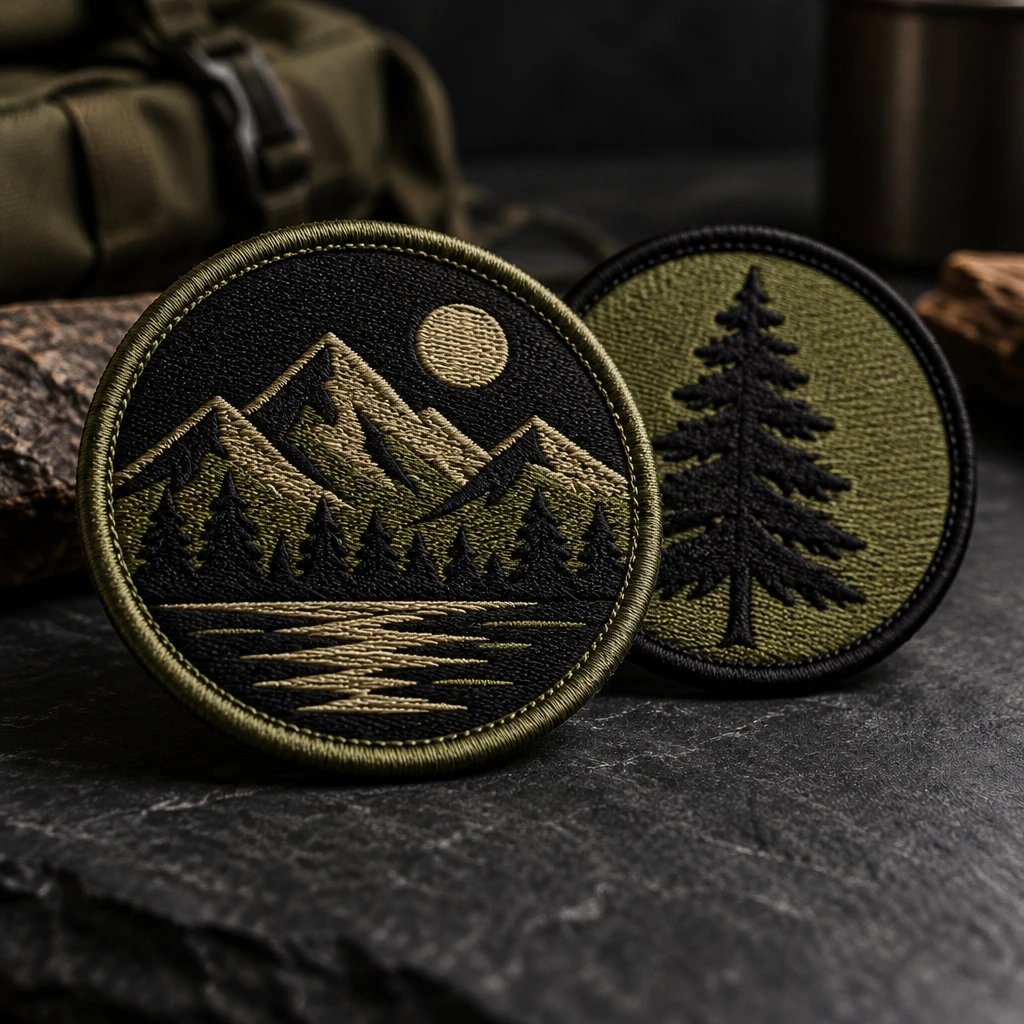
To order custom patches Georgia teams can wear and reorder, match the size and backing to the actual garment before approving your artwork. Most people get that order backward: they perfect the logo first, then discover the patch crosses a cap seam or needs heat a jacket cannot tolerate. USA Customized Patches provides a free digital mockup before production, has a 10-piece minimum, and ships from Corona, California, to all 50 states.
Plan custom patches Georgia teams can actually wear
Build your order around the garment, its usable attachment area, and your required arrival date. A Georgia destination affects shipping planning, but the fabric and daily use determine most production choices.
Put a real cap, shirt, jacket, or bag on the desk. A product photo rarely tells you enough about a curved front panel, a pocket opening, or a lining that a sewing needle would catch. Measure the placement while the garment sits in its normal shape, not stretched flat just to make the patch fit.
For example, say an Athens run club orders 40 patches for lightweight running caps and equipment bags. One design might work for both, but one backing may not. The cap can have a thin, curved panel while the bag has a flat loop field. Decide whether to split the attachment specification before asking for a single combined quote.
Use this sequence as your order checklist. Each step settles a decision that the next step depends on.
- Decide the use case. Specify the garment model or fabric, placement, expected washing, and whether the patch stays permanently attached. This prevents choosing a patch that looks right in isolation but fights the garment.
- Decide the finished footprint. Specify width and height in inches, orientation, shape, and clearance from seams or closures. Those measurements control fit and determine how much lettering the design can carry.
- Decide the construction. Specify embroidered thread, woven construction, printed fabric, or molded polyvinyl chloride, plus the border treatment. The material must reproduce your artwork without adding unnecessary bulk or sacrificing readable detail.
- Decide the backing. Specify sew-on, heat-seal, or hook backing and identify the receiving surface. Attachment needs to suit the garment's heat tolerance, available sewing access, and any existing loop panel.
- Decide what the artwork must preserve. Supply your best logo file, exact wording, color references, and any nonnegotiable details. Clear priorities let the mockup solve production limits without quietly changing the identity of the design.
- Decide the order quantity and distribution. Specify the total piece count, design variations, backing splits, delivery ZIP code, and required arrival date. USA Customized Patches has a 10-piece minimum; an itemized request makes the quote and shipping plan easier to check.
- Decide whether the proof is ready to release. Verify dimensions, spelling, colors, border, backing, quantity, and destination, then give written approval. Production starts only after approval, so unresolved questions belong before that release.
- Decide how you will receive and attach the patches. Confirm the shipping service, receiving contact, garment compatibility, and installation method. Inspect the delivered pieces before distributing them or attaching the entire batch.
Measure the placement and set the finished patch size
Set both finished dimensions in inches, then check a paper cutout on the garment. The usable placement area matters more than a patch size that looks familiar on a screen.
For example, a 3-inch-wide rectangle may sit comfortably on a flat bag panel but look crowded on a low-profile cap. Height matters just as much. A tall design can run into the crown's curve even when its width fits between the side seams. Tape the cutout in place and look at the cap from the front and side.
On a work shirt, check whether the patch will sit above a pocket or directly on it. Sewing through the pocket face and the shirt body can close the pocket. On a lined jacket, confirm that whoever installs the patch can reach the attachment area without trapping the lining or creating an uncomfortable seam inside.
Small text needs room. In our production experience, crowded lettering is often a layout problem before it is a material problem. Remove a secondary tagline, enlarge the main name, or move a date out of a narrow ring. Shrinking every element together usually makes the least important wording just as hard to read as the club name.
State whether dimensions include the finished border. They should describe the complete patch you expect to receive, not just the artwork inside it. For an irregular shape, identify the widest and tallest points so the person quoting and the person approving are measuring the same object.
Choose the material and border for your artwork
Choose construction according to the smallest important detail and the garment's tolerance for thickness. Embroidery is a good starting point for bold identities, but it isn't the right answer for every logo.
An embroidered patch is a fabric emblem that uses stitched thread to form its design. A woven patch is a textile emblem that forms the design through interlaced yarns rather than raised embroidery stitches. That construction difference matters when your artwork combines a small name, thin outlines, and a compact finished size.
| Construction | Choose it for | Main trade-off | Garment or use-case check |
|---|---|---|---|
| Embroidered thread on fabric | Bold lettering, simple mascots, work-shirt logos, and club jacket emblems | Raised texture has character, but tiny text and closely spaced lines need simplification | Check density and stiffness on thin caps or lightweight shirts |
| Woven textile | Compact lettering, fine linework, and flatter cap or uniform patches | Cleaner small detail, but less raised texture than embroidery | Confirm that the lettering remains readable at the approved finished size |
| Printed fabric | Gradients, photographic artwork, and designs that depend on smooth color transitions | Preserves image detail without the stitched surface of embroidery | Ask about the specific print construction and care requirements for your garment |
| Molded polyvinyl chloride (PVC) | Raised gear badges, equipment bags, and removable patches on loop panels | Wipe-clean surface and molded relief, but more bulk than a thin textile patch | Check flexibility, thickness, and backing against the receiving panel |
For a straightforward business logo on a cotton work shirt, I'd start with embroidered patches. You get a clear stitched identity without needing the layout to imitate a printed photograph. If the design relies on fine lettering that cannot be removed, compare woven patch construction before enlarging the patch beyond the shirt's usable space.
Choose PVC patches for equipment and gear when a molded surface serves the job, not just because the material sounds tougher. PVC itself handles surface moisture differently from thread, but that does not make every backing, seam, or attached garment waterproof. I'd skip a thick molded badge on a thin running cap unless the cap construction clearly supports it.
Next, settle the edge. A merrowed border is an overlocked thread edge that wraps around the patch perimeter. It gives simple shapes a defined rim, but it also takes space and adds thickness. A cut edge follows the outline without the same wrapped rim, making it useful when points, tight corners, or an irregular silhouette would be awkward to overlock.
Don't request an intricate outline by habit. For example, a circular badge with a simple border may communicate the same club identity as a shield with several small notches, while being easier to place and sew consistently. Ask for the simpler option if it does the job; extra edge detail isn't automatically worth its cost or handling.
Match the backing to the cap, jacket, or bag
Use sew-on attachment for a permanent patch when you can safely access the fabric, heat-seal backing only on compatible garments, and hook backing for a matching loop panel. Backing is an installation decision, not a finishing detail.
See your artwork as a custom USA patch before you buy. Free digital mockup in 12 hours — 5-piece minimum per design. We do not produce until you approve.
GET A FREE MOCKUPSew-on is the right call for many club jackets and regularly washed work shirts. It avoids relying solely on an adhesive bond, although the stitch line still needs suitable fabric underneath. Check access first. A bulky bag panel, waterproof shell, or insulated jacket may need an installer who understands what the needle will penetrate.
Heat-seal backing is an adhesive layer that bonds under specified heat, pressure, and application time. Those settings are not universal. A household iron and a commercial heat press do not apply pressure equally, and a cap's curved panel adds another complication. Get instructions for the actual backing rather than borrowing settings from an unrelated patch.
Read the garment care label before choosing heat. Coated nylon, stretch performance fabric, and heat-sensitive finishes deserve particular attention. For a lightweight polyester team shirt, I would not assume that iron-on is safe just because another polyester garment accepted it. Fabric construction, coatings, and decoration already on the shirt can change the result.
Hook backing is the rough fastening surface that grips a compatible loop panel. Specify whether you need the patch's hook side only or also need a separate loop piece for the garment. A hook-backed patch won't attach properly to an ordinary smooth jacket just because both surfaces are fabric.
For example, an Atlanta facilities team might want sew-on patches for uniform shirts and hook-backed versions for equipment bags. List those quantities separately. If an adhesive attachment is being considered as a lower-cost shortcut, compare the cost of preparing and installing it correctly, not just the backing charge.
Prepare artwork that the mockup can resolve
Send your clearest artwork with exact text, color references, and the finished dimensions already decided. The mockup should resolve production choices, not leave the supplier guessing which parts of the logo matter.
A vector file is useful when you have one because its shapes can be resized without becoming pixelated. A clear raster image can still communicate the design. Don't turn a small screenshot into a blurry large file and assume it now contains more information. If the original artwork is missing, say so and identify the text separately.
List the wording exactly, including punctuation and capitalization. Georgia place names, chapter names, sponsor lines, and founding dates all deserve a deliberate check. A production-ready layout can still contain a spelling error copied perfectly from the source file. The person who knows the organization should review the text, not just the person handling payment.
Color references help, but a screen is not thread. Thread sheen, fabric texture, lighting, and the surrounding colors affect what you see. Identify which colors carry brand meaning and which can move to a close available material color. If exact matching is critical, ask what physical verification options are available before approving the digital proof.
USA Customized Patches provides a free digital mockup in about 12 hours. You can send the artwork, placement photo, and measurements through the patch artwork and quote contact and ask to see the proposed layout before committing it to production.
The proof should make the proposed shape, lettering, color arrangement, and border visible, with dimensions and backing recorded in the proof or accompanying order specifications. It is not a physical sample. You cannot judge actual stiffness, thread feel, or heat adhesion from a digital image, however convincing the rendering looks.
Request a quote with quantities and a Georgia delivery date
Request a written quote in USD that identifies the construction, finished size, backing, quantity, and shipping destination. Add the required arrival date, not just the event date, so you have time to inspect and install the patches.
USA Customized Patches has a 10-piece minimum. If you want several designs, sizes, or backing combinations, ask how the minimum applies to those variations rather than assuming every version can be combined into one run. A logo change can require a different production setup even when the patches go to the same organization.
Size, construction, stitch coverage, border complexity, backing, and quantity all affect the quote. Bigger and denser generally costs more. A simpler embroidered design may be enough for a clear work-shirt emblem, while fine woven detail can be worth the difference when removing small wording is not acceptable. Compare the same specifications before deciding which quote costs less.
Ask what is included in the total. Shipping charges, applicable taxes, attachment services, and any separately quoted options should not be left to assumption. Ordering finished patches is not automatically the same as ordering decorated garments. If you need patches sewn onto caps, identify who supplies the caps and who performs the installation.
For example, a Savannah club preparing for a weekend event should allow time between patch delivery and jacket distribution. That interval covers counting, checking, and sewing. A delivery on the morning of the event may technically meet the calendar date while still leaving you with unattached patches.
Typical timing is 7–12 business days. Confirm what that window includes on your specific quote and whether transit time is additional. USA Customized Patches is open 24 hours a day, 7 days a week for quotes; round-the-clock quote availability does not mean production and carriers operate on the same schedule.
Approve the final proof and release production
Approve only when the proof and written order specifications agree. USA Customized Patches starts production only after written approval, so use that checkpoint to close every outstanding question.
Ready to spec type, size, backing, and quantity? Open the quote form for a free 12-hour mockup and USA shipping after approval.
GET A FREE MOCKUPCheck the proof at its intended physical size, not only zoomed in on a monitor. For example, print a 3-inch-wide proof at 3 inches wide rather than using a page setting that enlarges it. This does not reproduce thread texture, but it quickly exposes lettering that looked readable only because the screen image was oversized.
- Artwork: Confirm the exact wording, logo orientation, important linework, and any approved simplifications.
- Dimensions: Confirm finished width and height in inches, including the border.
- Construction: Confirm the material, border type, color references, and backing.
- Quantity: Confirm the total pieces and every design or backing split.
- Delivery: Confirm the recipient, complete Georgia address, receiving contact, and required arrival date.
- Version: Identify the final proof in your written approval so an older layout cannot be mistaken for the released version.
Assign one person to send the approval. Team chats are useful for gathering opinions, but conflicting instructions from several organizers can leave the final specification unclear. Collect the comments, settle the design, then send one consolidated response that identifies what is approved.
Still deciding between a tighter embroidered layout and a flatter woven version? Ask for the free digital mockup to resolve that choice before approving production. It is easier to move lettering on a proof than to compensate for unreadable lettering after the run is finished.
Confirm shipping from Corona, California, to your Georgia address
Orders ship from Corona, California, to Georgia and all 50 states. Confirm the service, destination details, and transit allowance separately from the artwork and production schedule.
USA Customized Patches serves customers across the United States. Georgia service does not mean the order is produced locally in Atlanta or available for pickup in Savannah. Likewise, a California shipping origin does not establish the manufacturing origin of every component. If origin documentation matters to your purchasing department, request it directly.
Use a delivery address where someone can actually receive the package. A school office, gated business park, event venue, and residential porch each create different receiving conditions. Include the organization name, suite or building information, and a reachable contact. For an Augusta tournament, confirm that the venue accepts deliveries under your team's name before using its address.
Check the nationwide patch shipping information when organizing your schedule, then have the quoted service confirmed for your ZIP code. Don't treat a general transit estimate as a fixed arrival promise. Approval delays, holidays, and carrier exceptions can affect the date, and faster shipping cannot recover time spent waiting for final artwork decisions.
When the package arrives, count the patches before handing them out. Compare the shape, dimensions, backing, and wording with the approved specification. Photograph any concern and contact the supplier before sewing or heat-applying the affected pieces. Keep the order reference with the proof so a later reorder starts from an identified design rather than someone's memory.
What usually goes wrong before patches reach the garment
Most preventable problems come from approving artwork without checking the attachment surface or delivery plan. In our production experience, those omissions create more avoidable rework than a lack of decorative options.
- The patch fits the drawing but not the cap. Test a paper cutout on the actual panel, including the crown curve and center seam.
- Small lettering survives the mockup but loses clarity in construction. Review it at finished size and simplify or change material before approval.
- Heat-seal backing is chosen for a heat-sensitive garment. Verify the garment restrictions and the backing's application instructions first.
- Hook backing arrives without a receiving loop panel. Specify both sides of the attachment system when the garment does not already have one.
- The event date is mistaken for the installation deadline. Plan receipt early enough for inspection, attachment, and distribution.
- A revised design is discussed but never formally approved. Release one identified final proof with a matching written specification.
What this advice is based on
This guidance rests on the patch production process, the digital mockup checkpoint, and the specifications needed to quote and release an order. Material and attachment recommendations reflect general production realities, not invented customer stories or a claim that one construction suits every garment.
Your approved proof establishes the artwork; the written order records establish dimensions, material, backing, quantity, and delivery details. Garment care instructions and the supplied application instructions govern installation. Before distributing a full run, test the chosen attachment on a compatible spare garment or fabric area and inspect the result.