
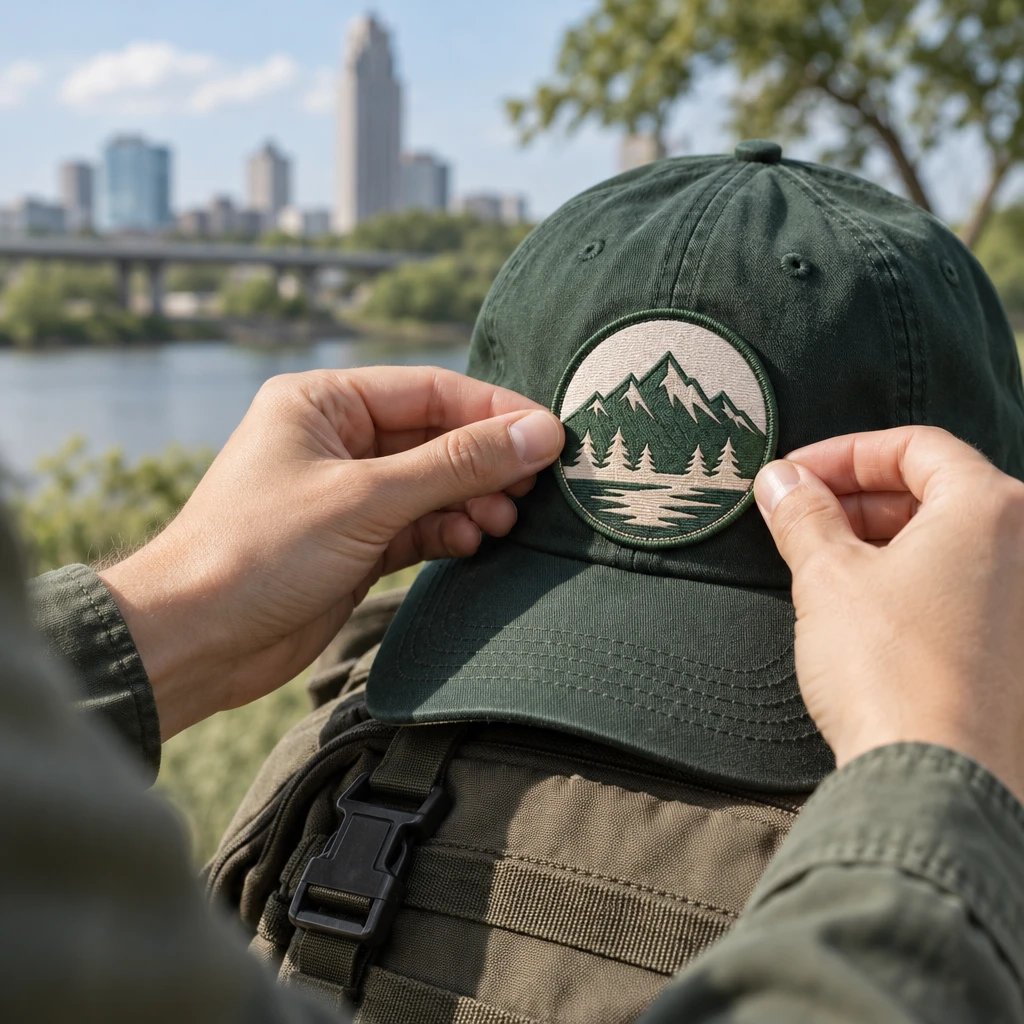
For custom patches Omaha turnaround, plan on a free digital mockup in about 12 hours, typical production of 7–12 business days after written approval, and additional shipping time rather than expecting next-day finished patches. The safest choice for a firm deadline is the design and construction that can be approved without rework; here are the material trade-offs and scheduling checks behind that verdict.
What does custom patches Omaha turnaround actually include?
Turnaround includes artwork review, your approval, manufacturing, and delivery to Omaha. If the patches must be attached to jackets or caps, that installation time belongs on the calendar too.
A digital mockup is an artwork proof that shows the proposed patch layout before manufacturing. It is not a finished patch, a photograph of a production sample, or confirmation that the order has shipped. That distinction matters when someone sees a proof arrive quickly and assumes the rest of the order will move at the same pace.
USA Customized Patches has a 10-piece minimum. A free digital mockup is provided in about 12 hours, and production starts only after written approval. Typical production takes 7–12 business days. Confirm how those dates apply to the quoted construction, quantity, and current schedule before treating them as your event plan.
Orders ship from Corona, California, across the United States to all 50 states. An Omaha delivery address does not mean the patches are sitting in local inventory or available for local pickup. Custom manufacturing and the shipment to Nebraska are separate parts of the job.
Should you choose embroidered or printed patches for a deadline?
Choose embroidered patches for bold lettering and visible thread texture; choose printed patches when preserving fine detail matters more than stitched texture. Neither construction is automatically faster, so compare the actual approval requirements and quoted production dates.
An embroidered patch is a fabric emblem that uses stitched thread to build the design. A printed patch is a fabric emblem that reproduces artwork with ink rather than using stitches to form every graphic element. Both can suit an Omaha team order, but they solve different artwork problems.
| Buying criterion | Embroidered patches | Printed patches | What it means for your deadline |
|---|---|---|---|
| Durability | Thread holds up well in many workwear applications, although raised stitches can snag or abrade. | Printed detail avoids raised design stitches; surface wear and color retention depend on the print system and care. | Match construction to use rather than assuming the fastest quote will also suit repeated wear. |
| Detail level | Best with bold letters, clear spaces, and shapes that translate cleanly into stitches. | Better suited to gradients, fine lines, and artwork that would become crowded in thread. | Artwork that fits the process usually needs fewer compromises during approval. |
| Cost drivers | Size, stitch coverage, stitch count, border, backing, and quantity affect the quote. | Size, print process, fabric, border, backing, and quantity affect the quote. | Request equivalent specifications; printing is not always cheaper, and embroidery is not always more expensive. |
| Typical uses | Work shirts, club jackets, equipment bags, and caps with bold logos. | Illustrated event graphics, detailed brand artwork, and designs with color transitions. | Start with the garment and artwork, not an assumed speed advantage. |
| Common proof changes | Small lettering, narrow gaps, and crowded borders may need adjustment. | Low-resolution artwork, unclear edges, and color expectations may need adjustment. | Fix the actual artwork problem before approving, rather than hoping production will resolve it. |
| Attachment considerations | Sew-on, iron-on, or hook-and-loop choices must suit the garment and use. | Backing suitability still depends on the garment, patch construction, and available attachment method. | Backing and installation can affect the finished-garment date even when patch production is on schedule. |
In our production experience, artwork compatibility is a more useful early scheduling question than asking which material is universally fastest. A bold logo may move through an embroidery proof with little adjustment. A detailed illustration may need substantial simplification for embroidery while remaining much closer to the supplied artwork in print.
Choose embroidered patches if the design is bold and texture matters
Embroidery is the right call for a recognizable club emblem, a business name on a work jacket, or a cap logo that needs visible thread. Keep the information hierarchy simple. The main name should read first, with secondary wording added only when the available space supports it.
For example, a maintenance team ordering a 3-inch patch with a company name and a simple wrench symbol has a sensible embroidery starting point. Adding a street address, a slogan, and a detailed skyline changes the job. I'd remove the extra wording before making the patch larger than the shirt pocket can comfortably hold.
If that sounds like your design, a free mockup for embroidered patches is a useful way to check lettering, border spacing, and overall proportions before production.
Choose printed patches if preserving the artwork avoids a redesign
Printing is the right call when gradients, fine illustration, or closely spaced graphic elements are part of the identity. I'd skip embroidery for a photographic image unless the buyer specifically wants an interpreted, simplified version rather than a close reproduction.
A printed patch construction can preserve more of that original graphic, but it cannot repair a blurry source file. It also gives a different surface from embroidery. If the patch is meant to look stitched from across a room, choosing print solely to avoid artwork work may solve the wrong problem.
When is the simpler or lower-cost patch the right call?
Choose the simpler option when extra texture, coverage, or backing features do not improve how the patch will be used. Spend on readable artwork and secure attachment before spending on construction details nobody needs.
For example, a run club ordering 40 patches as participation keepsakes may not need removable hook-and-loop backing. A sew-on patch can be enough if members will attach it themselves or keep it as a collectible. Confirm the intended use first; a lower patch quote is less helpful if everyone expected immediate iron-on application.
Leaving suitable areas of base fabric visible can reduce embroidery coverage compared with stitching the entire background. That may lower the quote, depending on the complete specifications. It is a sensible choice when the exposed fabric supports the design, not a compromise that automatically makes the patch look unfinished.
See your artwork as a custom USA patch before you buy. Free digital mockup in 12 hours — 5-piece minimum per design. We do not produce until you approve.
GET A FREE MOCKUPPrinted patches may be the better value for detailed event art if embroidery would require a larger patch or a substantial redesign. Compare actual quotes in USD using the same dimensions, quantity, and backing. A price difference without matching specifications tells you very little.
My verdict: start with straightforward embroidery for a bold, everyday team logo. Choose printing when fine artwork is essential. For a deadline, approve the simplest suitable specification rather than paying for complexity and hoping a faster shipping service will recover the time.
What information gets an Omaha order moving sooner?
Send the artwork, dimensions, quantity, backing preference, delivery ZIP code, and actual need-by date together. Missing specifications create questions that must be settled before the order can move forward.
- State the use case. Identify the garment, such as a denim club vest, structured cotton cap, polyester warm-up jacket, or work shirt. Include fabric information when available.
- Give the finished patch dimensions in inches. For example, write 3 inches wide by 2 inches tall rather than asking for a medium patch.
- Provide the quantity and identify separate designs. A shared order deadline does not make different logos interchangeable during artwork review.
- Attach the clearest artwork available. Include a clean logo file and any reference image that explains placement, but do not rely on a garment photograph as the only source for fine lettering.
- Specify sew-on, iron-on, or hook-and-loop backing, or say that you need help choosing. Identify whether a matching loop surface is already present on the garment.
- Supply the Omaha delivery ZIP code and the date the patches must be physically in hand. If someone else is attaching them, include that person's completion deadline too.
- Name one approval contact. Collect feedback internally so production receives a single set of changes rather than competing instructions.
USA Customized Patches is open 24 hours a day, 7 days a week for quotes. That availability helps you submit specifications outside regular office hours, but it does not turn carrier transit or business-day production estimates into a continuous delivery clock.
Which proof changes are worth making before approval?
Correct spelling, dimensions, legibility, border spacing, and backing before approving the mockup. These are functional decisions, not minor details to leave for the factory.
Check the proof against the actual placement area. A patch can look balanced on a screen and still be too wide for a cap front or too tall for the space above a shirt pocket. A paper outline at the proposed dimensions is a useful physical check.
For example, a 2-inch-wide patch with a long organization name may need shorter wording, a different layout, or more width. Making the letters narrower is not always the answer. In our production experience, preserving space inside and between letters is often more important than keeping every decorative element.
Review the border too. A merrowed border is an overlocked thread edge that wraps around the patch perimeter. It suits many straightforward shapes, but an intricate outline may call for a different edge treatment. Let the artwork and construction determine the border rather than insisting on one method for every shape.
A digital proof cannot fully demonstrate thread texture, screen-to-material color differences, or adhesion to your particular jacket. Ask which details the proof confirms. If a physical sample is necessary, have that additional step included in the schedule instead of assuming it fits inside the standard approval window.
Does backing change when the garments will be ready?
Yes. Backing affects attachment work after delivery, and the easiest backing to order is not always the easiest one to apply to your garment.
Sew-on patches are a practical choice for denim vests, many work jackets, and garments that will see repeated use. They need sewing access and suitable equipment. If the jacket has a lining or an inside pocket behind the placement area, plan the stitch path before promising a finished-garment date.
Iron-on backing depends on compatible fabric, appropriate heat, pressure, and application time. Heat-sensitive synthetics, coatings, and curved surfaces need care. I'd skip an untested iron-on plan for a team order of performance jackets with a hard deadline; a patch arriving on time does not make the garment safe to press.
Hook-and-loop backing makes sense when a patch must be removable or moved between compatible garments. It adds thickness and needs a matching receiving surface. A plain jacket without loop fabric still needs installation work, so removable backing does not automatically mean ready to wear.
Caps deserve their own check. A structured crown has a curve, seams, and limited access behind the front panel. Ask the person handling attachment what patch dimensions and backing they can accommodate before approving a flat proof.
How should you schedule delivery from Corona to Omaha?
Treat shipping as a separate quoted stage after production. Confirm the destination ZIP code, service, expected dispatch date, and delivery estimate instead of calculating arrival from a general production range.
USA Customized Patches ships nationwide from Corona, CA, including Omaha and all other destinations across the 50 states. Shipping origin describes where the order is dispatched; it does not, by itself, establish where every manufacturing step occurs.
Ready to spec type, size, backing, and quantity? Open the quote form for a free 12-hour mockup and USA shipping after approval.
GET A FREE MOCKUPReview the nationwide shipping information alongside your order-specific estimate. A carrier transit estimate starts from shipment, not from the moment you request a quote or receive a proof. Weekends, holidays, address corrections, and missed delivery attempts can affect the usable arrival date.
Delivery is not the finish line. Someone still needs to receive the package, check the contents, and distribute or attach the patches. For example, if an Omaha club needs decorated vests for a Saturday event, handing loose patches to the sewing volunteer on Friday leaves little room for a placement problem.
Use the date the attachment work must begin as your patch deadline. If the patches are going straight into welcome packets, allow time for counting and packing instead. The right buffer follows the remaining work, not an arbitrary promise that everything will probably be fine.
Can a rush request rescue a short deadline?
A rush request is worth checking, but availability must be confirmed for the specific order. Faster shipping alone cannot fix an unapproved design or unfinished production.
Ask what can actually change: artwork handling, production scheduling, dispatch timing, or carrier service. Those are different levers. If the proposed solution only changes transit, make sure the planned dispatch date still leaves enough time for delivery and attachment.
Reducing unnecessary detail can help resolve artwork faster, but it does not guarantee an earlier manufacturing slot. Ordering fewer pieces is not a universal shortcut either. Setup, approval, materials, and construction still exist on a small order.
For a fixed event, submit the deadline with the artwork for a free digital mockup so the proof and schedule can be checked together. Ask for a feasibility assessment before approving the order, not after announcing the delivery date to the whole team.
What should you compare when two quotes promise different dates?
Compare the same deliverable and the same starting point. A production estimate beginning after approval is not directly comparable to a delivery estimate beginning when you place the order.
- Confirm whether the stated date means production completion, carrier handoff, or arrival at your Omaha address.
- Check whether artwork preparation and revisions are included in the schedule.
- Match patch dimensions, construction, quantity, backing, and border before comparing the price.
- Ask whether shipping and any confirmed expedited services are included in the quoted USD total.
- Separate loose-patch delivery from finished-garment delivery. Sewing or pressing may be a different job.
- Confirm what happens to the schedule if you change the design after written approval.
Use the patch gallery to compare broad visual characteristics, such as stitched texture and border styles, rather than treating a photograph as a specification sheet. A finished image does not tell you the backing, exact dimensions, production schedule, or attachment method.
The lowest quote is the right choice when it covers the same useful specification and a realistic delivery plan. Paying more makes sense only when the added construction, service, or schedule actually solves a requirement. A vague promise of speed is not much of a requirement check.
What is this advice based on?
This advice rests on the patch production process, the digital mockup step, and the specifications required to quote an order. The material comparisons reflect production considerations, not a timed study proving one patch type always ships faster.
In our production experience, unclear dimensions, unsuitable artwork, and unresolved attachment plans create avoidable back-and-forth. The examples here illustrate those decisions; they are not customer testimonials or reports of specific completed jobs.
Before giving anyone a promised date, get written confirmation of the approved design, quantity, backing, production estimate, shipping service, and destination. Put your required in-hand date beside those details. That gives both the buyer and the production desk the same schedule to work from.