
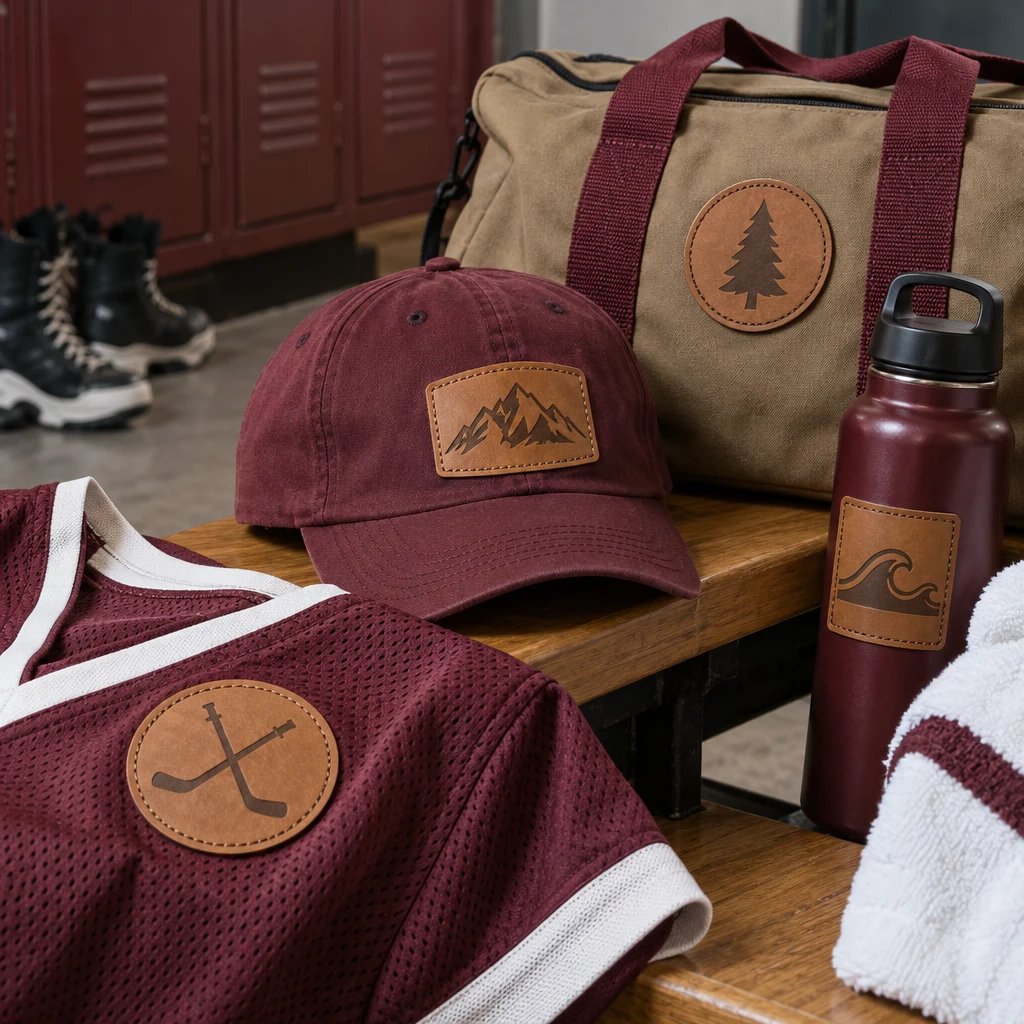
The leather itself supplies a visible color before any artwork is added. There is no universal leather patch color limit: engraving generally gives tonal contrast, while compatible printing or color-fill methods can add separate colors. The useful limit depends on the leather surface, the decoration process, and the finished patch size.
That distinction causes more confusion than it should. A brown patch with a dark engraved logo and cream attachment stitching can look like a three-color object, but it isn't necessarily a three-color decoration job. The base material, the mark, and the stitching are separate production decisions. Count them separately before comparing quotes.
What sets the leather patch color limit?
The decoration method sets the practical color limit, not the word leather. A quote needs to identify how the logo will be made before a color count means much.
Engraving is a surface-marking process that removes or alters material to create a visible design. It doesn't lay down a different ink for every color in the artwork. Debossing is a pressure-forming process that presses artwork into the surface. Without added pigment or another finish, it produces relief and shadow rather than a separately colored logo.
Printing is different. It places color on a compatible surface, subject to the printing system, adhesion requirements, and available material. Color fill puts pigment into selected recessed areas where the construction supports it. Neither method should be assumed just because the artwork file contains red, white, and blue.
In our production experience, the first useful question is not how many colors are allowed. It's which colors must survive the move from the original logo to the patch. Some logos remain recognizable as one mark. Others depend on a specific color arrangement. Those are different jobs.
Count the base, the artwork, and the attachment thread separately
A complete color specification separates the leather base from the decoration and any visible attachment thread. This keeps an attractive mockup from becoming an ambiguous production instruction.
Base color is the color of the patch material before decoration. Artwork color is any separate color applied to form the logo. Attachment thread is the thread used to sew the finished patch onto a garment, if sewing is part of the order. A stitch line pictured around the edge does not automatically mean garment attachment is included.
For example, consider a tan leather patch with dark engraved lettering and black perimeter stitching on a work jacket. The tan belongs to the material specification. The dark lettering is the result of the selected engraving process and material. The black belongs to the sewing specification. Asking for a three-color patch leaves too much open.
I'd write those three decisions out, even for a small club run. It takes little space on an approval sheet and prevents someone from treating a decorative mockup line as an instruction to add a printed border.
Choose the decoration method before counting logo colors
Use engraving or debossing when material and shape matter more than exact logo colors. Consider compatible printed construction when the colors carry information that cannot be removed.
| Method or component | Where the visible color comes from | What the artwork review checks | Main trade-off |
|---|---|---|---|
| Engraving | The leather base and the surface response to engraving | Open spaces, line weight, and contrast on the chosen material | Does not reproduce a multicolor file as separate colored marks |
| Debossing without added color | The base material, recessed areas, and shadows | Stroke strength, spacing, and depth suitability | A restrained mark that may be less readable at a distance |
| Compatible surface printing | Applied inks plus any exposed leather | Surface compatibility, underbase needs, fine detail, and handling requirements | More color freedom, but performance depends on the complete material and ink system |
| Compatible recessed color fill | Pigment placed in selected recessed areas | Separation between filled areas and enough room to contain the pigment | Small adjacent details can become difficult to fill cleanly |
| Contrasting attachment stitching | Thread around the patch perimeter | Stitch placement, edge clearance, and garment construction | Adds an accent but does not restore missing colors inside the logo |
These are process categories, not a promise that every treatment works on every leather option. The available construction needs confirmation before approval. The leather patch options are the right starting point for the material discussion, but the order specification still needs to identify the actual decoration method.
Check the leather surface before promising a color match
Leather color, surface finish, and grain affect how the finished artwork looks. A color approved on a white screen is not automatically the same color on a textured brown patch.
Natural leather can show variation in grain and shade. Coatings and finishes also affect how the surface accepts a mark. Synthetic leather alternatives may offer a different level of surface consistency, but their suitability for engraving, printing, or heat application must still be checked. They are not interchangeable materials.
Dark bases deserve particular attention. A dark mark on dark leather can disappear under ordinary indoor lighting even when the enlarged artwork looks clear. Some engineered engraving materials reveal a contrasting layer, but that behavior belongs to that specific material. Don't assume all black leather engraves to a light color.
For printed artwork, an opaque underbase may be needed to keep the leather color from influencing lighter inks. An underbase is a supporting ink layer that helps the visible artwork cover the substrate. It is a production consideration, even if the buyer doesn't count it as a logo color.
If brand matching matters, provide the brand color reference and ask what the selected construction can reasonably reproduce. A digital mockup communicates intent. It does not measure finished color, and it cannot show every change caused by grain, gloss, or lighting.
Reduce color only after checking what the logo needs
Remove colors that are decorative before removing colors that distinguish parts of the logo. A good single-color conversion preserves the identity rather than merely turning the file black.
For example, a landscaping company logo might contain a green tree, a brown trunk, and gray lettering. On an engraved leather patch, the tree and trunk may need to become one silhouette with open spaces defining the branches. Simply converting every colored shape to a solid mark could turn the center into a block.
See your artwork as a custom USA patch before you buy. Free digital mockup in 12 hours — 5-piece minimum per design. We do not produce until you approve.
GET A FREE MOCKUPA different example is a team badge whose red and blue halves identify separate groups. Removing those colors may remove the point of the badge. I'd keep the color requirement and reconsider the patch construction rather than force that design into engraving.
Outlines need judgment too. A colored outline that separates two shapes on screen may become another dark line in engraving, closing a gap that should stay open. Sometimes deleting the outline improves the patch. Sometimes the two shapes need more space. This is artwork adaptation, not a file-format conversion.
A useful review asks what must remain readable from normal viewing distance: the team name, the main symbol, or both. Tiny supporting text can be dropped with approval. The main name cannot quietly disappear because the original file was crowded.
Review the artwork at the actual patch size
Color separation only helps when the finished patch has room to show it. Review the artwork at its specified width and height in inches, not only in a zoomed-in proof.
For example, a 2.5-inch-wide cap patch might hold a bold symbol and a short name comfortably, while a version with a surrounding motto, fine outline, and small colored accents needs simplification. That is an example layout, not a universal size rule. Letter shape, patch height, and the available decoration process all matter.
The artwork preparer checks the spaces inside letters, the gaps between adjacent elements, and the distance from the artwork to the cut edge. These checks matter for engraving and printing alike, although the specific constraints differ. More colors won't rescue letters that are too crowded.
Not every leather order needs an embroidery digitizer. An engraved logo needs artwork prepared for its marking process. If the design changes to embroidery, a digitizer then translates shapes into stitch directions, stitch types, and a sewing sequence. Treating these as the same file-preparation step hides important differences.
Print the proof at actual size if you can. Put it on the intended cap front or jacket panel. The paper won't reproduce leather texture, but it will quickly tell you if the small lettering is doing any useful work.
Keep edge color and backing out of the logo count
The cut edge and backing are construction details, not extra artwork colors. They can still change the visible result and should be shown or described in the approval.
A leather edge may expose a different tone from the face. Cutting and finishing methods can also affect its appearance. On a light cap, a dark edge may read as a thin outline; on a dark jacket, it may disappear. Don't promise a matching edge color unless an edge treatment is actually included.
A merrowed border is a wrapped thread edge commonly associated with fabric patches. It should not be assumed for a leather patch. A visible stitch line near the perimeter is a different construction detail, and the placement needs enough room to avoid crowding the logo or weakening the edge.
Backing decisions depend on the garment. Sew-on construction is often the practical choice for a leather jacket or a canvas work vest when a suitable sewing method is available. Hook-and-loop backing makes sense for a removable patch on an existing loop panel. Heat-seal backing requires confirmed compatibility with both the patch and the garment.
I'd skip an assumed iron-on solution for coated outerwear or a heat-sensitive cap. A backing that looks convenient in the order form can create a larger problem at application. Check the garment instructions and get process-specific application guidance before anyone applies heat.
Match the color treatment to hats, jackets, and club gear
Choose colors against the actual garment, not against an empty white background. Placement, garment texture, and expected handling affect how much contrast the patch needs.
On a structured twill cap, the patch face curves with the crown, and a center seam may affect placement. A simple engraved mark on a contrasting base can work well here because the cap is already a small display area. Adding tiny printed accents may complicate approval without making the logo easier to recognize.
For a denim jacket, consider the wash and the stitching already on the garment. A light leather base can separate the patch from dark denim. On a brown canvas work coat, the same patch may need a darker mark or a different base shade to avoid blending into the fabric.
Club vests often carry several patches together. A leather badge may intentionally differ from neighboring embroidered pieces, but that also changes the color language of the set. If a club requires a consistent red-and-white identity across names, logos, and event patches, leather may be the accent piece rather than the standard construction.
For bags, handling matters as much as appearance. A patch near a grab handle sees different abrasion from one on a jacket chest. Confirm the intended use when discussing a printed finish. No decoration method should be described as immune to scuffing, flexing, or cleaning.
Switch materials when exact colors matter more than leather
A fabric patch is often the better choice when distinct logo colors are nonnegotiable. Keeping leather is not worth making the team name or emblem harder to recognize.
Ready to spec type, size, backing, and quantity? Open the quote form for a free 12-hour mockup and USA shipping after approval.
GET A FREE MOCKUPEmbroidery gives separate thread colors and a textured surface. It suits bold lettering and clear shapes, although fine details still need adequate space. It doesn't reproduce a smooth photographic gradient, and thread color selection should be reviewed rather than assumed to match every digital value.
For a color-dependent team logo, you can request a free digital mockup through the embroidered patch hub to see whether a stitched version is the clearer choice. Compare it at the same finished dimensions as the leather version, not at a larger display size.
A printed fabric construction may be more suitable for gradients, shaded illustrations, or artwork with many small color transitions. Review the printed patch options when image detail matters more than the grain and feel of leather. Printing still has limits, but it avoids pretending that tonal engraving can reproduce a full-color image.
I'd keep an engraved leather version for a restrained brand mark and use a different construction for a detailed commemorative design. The patches can belong to the same organization without using the same material. Forcing every application into one construction usually creates unnecessary compromises.
What changes the quote when more colors are requested?
More colors can add cost when they require a different process, additional preparation, or more finishing work. The number of visible colors alone is not enough to price a leather patch.
A larger patch uses more material. A complicated outline can require more attention at cutting and finishing. Separate filled areas may create work that a simple engraved mark does not. With some printing methods, adding another artwork color may matter less than changing the surface preparation or coverage.
Ask for the quote in dollars against a defined specification: material, finished dimensions, quantity, decoration method, backing, and any attachment work. Two totals aren't comparable if one includes a printed finish and the other assumes engraving, even when both proofs show the same logo.
The lower-cost option is enough when a plain engraved mark does the job and the buyer wants the leather to remain visible. Spend on additional color when it protects recognition or carries information. Extra color added only because the file has it is not automatically useful.
Move from the artwork file to an approved production specification
The mockup step turns the logo into a defined patch order. Production should follow the approved dimensions, material, decoration method, and construction details rather than an informal description of the colors.
- Send the artwork and intended use. Include the garment type, patch placement, finished width and height in inches, quantity, and any brand colors that must remain distinct.
- Identify the material and marking process. Confirm natural leather or a specified alternative, base shade, engraving or other decoration, and any surface treatment needed for applied color.
- Review the actual-size layout. Check lettering, open spaces, edge clearance, placement of attachment stitches, and which parts of the leather will remain exposed.
- Resolve color expectations. Identify whether the mockup shows tonal engraving, separate inks, filled areas, or thread. Ask about a physical sample if actual surface appearance is critical; a digital proof is not a physical sample.
- Approve the complete specification in writing. Keep the final artwork version with the dimensions, backing, quantity, and shipping details so a later file cannot quietly replace the approved design.
- Allow for production and delivery as separate steps. The finished patches need checking against the approved specification before packing and shipment to the confirmed address.
USA Customized Patches has a 10-piece minimum. A free digital mockup is provided in about 12 hours, and production starts only after written approval. Typical production timing is 7–12 business days; confirm the schedule for the selected construction and keep shipping time separate from production time.
Quotes are available 24 hours a day, 7 days a week. USA Customized Patches ships from Corona, California, to all 50 states across the United States. A shipping origin is not a statement about where every material or manufacturing step originates.
If the color treatment is still undecided, send the artwork and garment details through the patch artwork and quote contact page for a free digital mockup. Note which colors are required and which can become tonal engraving. That gives the review a useful starting point.
What this advice is based on
This advice rests on general patch-production processes, the digital mockup step, and the written order specifications. It is not a test report establishing one color limit for every leather material.
In our production experience, reliable approvals separate appearance from process: what the buyer wants to see, how the selected material can produce it, and what the finisher needs to check. Digital color, an engraved tone, and dyed leather are not the same reference, even when they look similar in a proof.
Before approval, make sure the order sheet names the base shade and decoration method on separate lines. If the only color instruction is “match the logo,” the most important production decision is still unresolved.