
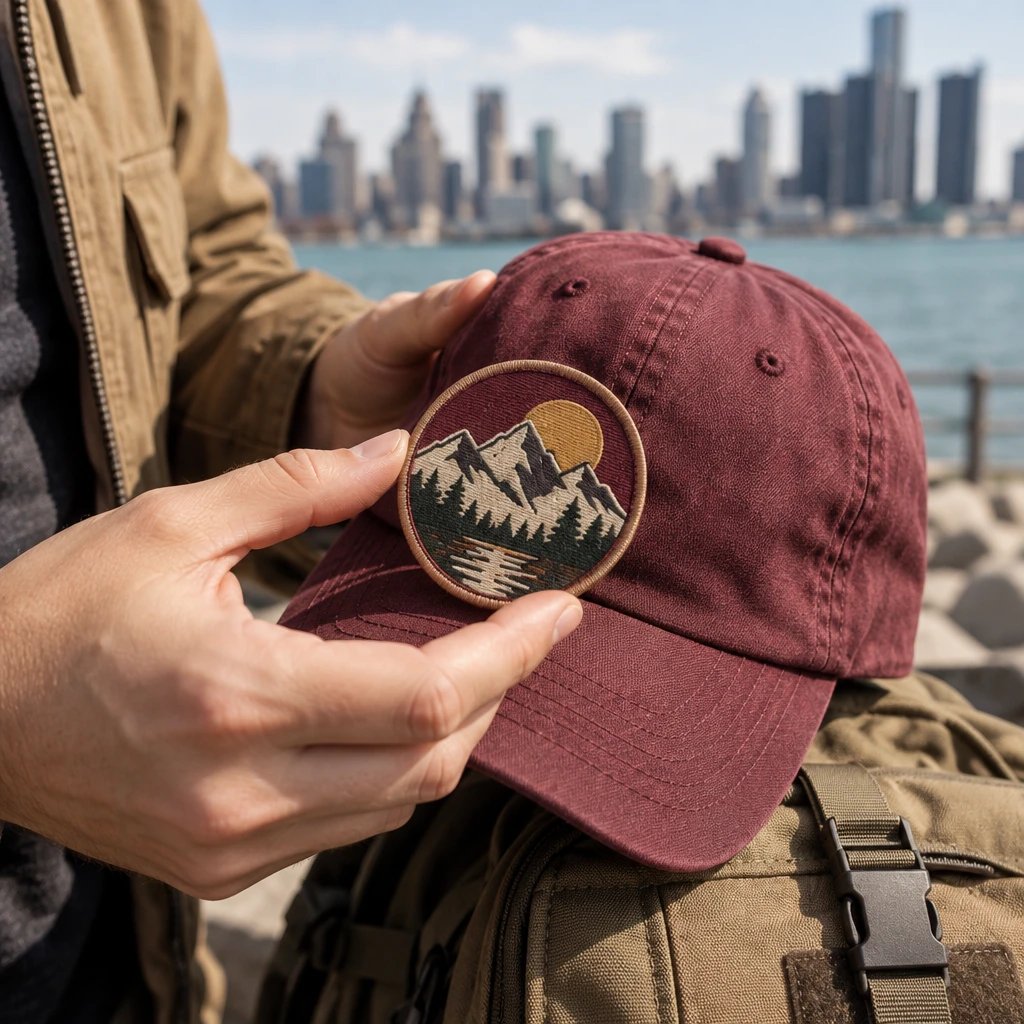
Ordering Detroit custom patches online can be safe, but a convincing front-view mockup can hide a backing that won't work on the intended jacket. Check the supplier, payment terms, finished dimensions, attachment method, and delivery schedule before authorizing production. The artwork matters; the notes beside it matter just as much.
Check Detroit custom patches online orders before payment
A safer order has a verifiable business identity, a written specification, and an approval step that prevents an unfinished design from reaching production. A polished website alone does not establish any of those things.
Start with the quotation. It should identify the seller, the patch construction, the quantity, and what the amount in US dollars covers. If the artwork email names one business and the payment request names another, ask for an explanation before paying. A legitimate billing arrangement should be explainable without a chase through several unrelated messages.
Read the correction and cancellation terms while the order is still changeable. Custom work is not the same as buying a stocked cap. Once artwork has been approved and production has begun, changing the club name or switching the backing may require work to be repeated. Ask how the supplier handles a manufacturing mismatch versus an error that appeared in the approved artwork.
No payment method makes a bad specification good. Still, use a documented payment channel and review the protections offered by the payment provider. Don't send card details in an ordinary artwork email. An unexplained request to move payment to a personal account is a reason to stop and verify the request independently.
- Confirm the business name and contact information before submitting payment.
- Request a written quote that separates the patch specification from delivery assumptions.
- Check when payment is due and what happens if you cancel before or after artwork approval.
- Keep the quotation, payment confirmation, approved proof, and delivery correspondence together.
Put the garment in the order notes first
The garment determines which patch constructions and attachment methods are practical. Specify the actual placement, not just the logo and the word "patch."
A structured cap front, a denim jacket back, and a coated work shell present different problems. Cap curvature can make a wide patch resist sitting flat. Heavy denim generally gives a sew-on patch a more forgiving foundation. A coated shell may be sensitive to heat, and sewing through it creates needle holes that can affect its weather resistance.
For example, a Detroit running club might order a patch for both knit beanies and nylon windbreakers. I'd avoid assuming one attachment method suits both. The beanie stretches and may distort under a stiff patch; the windbreaker may not tolerate the heat needed for a heat-activated backing. The garment label and a test on the actual material should decide the attachment, not the convenience of ordering everything alike.
Placement needs measurements. For example, a 3-inch patch that looks restrained on a jacket chest can dominate the front of a shallow cap. Measure the usable area between seams and other obstructions. A flat photograph helps, but a ruler beside the placement area is more useful than a close-up with no scale.
Include the use case by name: mechanic work shirt, motorcycle club vest, school team cap, retail hoodie, or removable equipment identifier. Those few words tell the production desk what the patch will have to put up with.
Choose a construction the artwork can survive
Choose the patch material by its smallest necessary detail and its intended use. Embroidery is the right call for visible thread texture, but it is not automatically the right call for dense lettering or photographic artwork.
Embroidered patches are fabric-based patches that build a design with stitched thread. The digitizer must turn lines and filled areas into stitch instructions, not simply reproduce every pixel. Tiny open spaces can close as thread accumulates. Narrow lettering can become crowded, especially when an outline surrounds it.
A woven patch is a textile patch that forms its design with interlaced threads rather than embroidery stitched over a base. It often handles finer lettering more cleanly while keeping a fabric surface. Printed patches are useful when the design depends on gradients or image detail that would be altered substantially by converting it to thread.
| Construction | Good reason to choose it | Production limitation to check |
|---|---|---|
| Embroidered fabric | Raised thread texture for team emblems, workwear logos, and club badges | Small letters, narrow gaps, and close outlines may need simplification |
| Woven fabric | Fine lettering and compact artwork with a flatter textile surface | The result will not have the raised stitch texture of embroidery |
| Printed fabric | Gradients, illustrations, and detail that should not become stitch shapes | Print appearance and surface wear differ from stitched construction |
| Polyvinyl chloride (PVC) | Molded relief for equipment patches and designs with distinct raised areas | Small features need workable molded spacing; flexibility depends on construction |
I'd skip elaborate embroidery for a small badge whose main purpose is to carry several lines of readable text. Either simplify the copy or consider woven patches for fine lettering. Keeping the original artwork unchanged is not a useful victory if nobody can read the finished patch.
If thread texture suits the design, send the artwork and garment placement for a free digital mockup of custom embroidered patches. Ask for the smallest lettering and the proposed border to be shown clearly.
Read the mockup as a production document
A digital mockup is a visual approval document that shows the proposed design and its specified features before production. It is not a physical sample, and it cannot establish how the finished patch feels, bends, or attaches.
USA Customized Patches provides a free digital mockup in about 12 hours. The minimum order is 10 pieces. Production starts only after written approval, so a question about spelling, dimensions, or backing belongs before that approval, not in a separate message sent afterward.
See your artwork as a custom USA patch before you buy. Free digital mockup in 12 hours — 5-piece minimum per design. We do not produce until you approve.
GET A FREE MOCKUPLook at the design at its intended finished size. Enlarging a proof until every letter looks comfortable defeats the exercise. For example, if the proposed patch is 3 inches wide, view or print it at that width and judge the club name from a normal reading distance. Make sure print settings have not enlarged or reduced the image.
Color needs a separate check. A screen produces light; thread reflects it. The same digital color can appear different across devices, and a mockup cannot promise an exact screen-to-thread match. If a brand color is important, supply the existing reference and ask which available thread color is proposed. Don't approve it with "whatever looks close" unless close is genuinely acceptable.
In our production experience, the useful question is not "Does the proof look nice?" It is "Does this proof settle the choices the production team will otherwise have to interpret?" Missing dimensions and unspecified backing leave room for assumptions even when the artwork is clean.
- Read every name, date, abbreviation, and punctuation mark against the original request.
- Confirm finished width and height in inches, including how the border is counted.
- Check the smallest letters, enclosed spaces, thin lines, and gaps between colors.
- Verify material, thread or print colors, border type, and backing in the written notes.
- Match the quantity and design version to the quotation.
- Approve one identified final version in writing, or list the changes still required.
Leave room for stitches and the border
The digitizer needs enough space to build stable stitches, and the border needs room that does not compete with the design. Reducing a logo without changing its details often creates a patch that cannot reproduce the artwork cleanly.
Digitizing is the process of converting artwork into instructions for stitch placement, direction, sequence, and supporting stitches. Those choices affect more than appearance. Stitch direction changes the way light catches the thread. Dense areas can pull on the fabric, while narrow columns need enough width to hold their shape.
More stitches are not automatically better. Excessive density can make a patch stiff and can contribute to distortion. For a design with a large plain background, exposed base fabric may be enough. Full thread coverage costs more work and changes the hand of the patch; it is worth choosing when that surface is part of the design, not merely because it sounds more substantial.
A merrowed border is an overlocked thread edge that wraps around the patch perimeter. It suits many simple shapes and provides a clearly defined rim. Detailed outlines and tight inward corners may call for a cut edge instead. Confirm how exposed fabric edges will be finished, because a cut silhouette and a wrapped border are different constructions.
Leave breathing room around the lettering. If the last letter nearly touches the border in the proof, finishing will not create extra space. I'd reduce decorative flourishes before shrinking the club name. The name is usually the part people need to recognize.
Match the backing to the attachment job
Choose the backing according to the garment, expected wear, and whether the patch must be removable. Iron-on, sew-on, hook-and-loop, and adhesive options solve different attachment problems.
A sew-on patch is attached with stitches through the patch and the receiving material. For a permanent patch on a denim vest or sturdy work shirt, sewing is usually the straightforward choice. It also avoids depending on heat activation. The trade-off is installation: someone needs access to the placement area without accidentally stitching a pocket shut or catching an unwanted lining layer.
Iron-on backing uses heat-activated adhesive to bond the patch to compatible fabric. Check the garment's heat tolerance and the supplied application instructions. Curved cap panels, seams, textured fabric, and coatings can interfere with consistent contact. A home iron and a controlled press do not necessarily deliver the same heat and pressure across the patch.
Hook-and-loop backing allows removal when the garment or bag has a compatible receiving panel. Confirm which side is supplied and whether a separate receiving piece is included. A hook-backed patch alone does not turn an ordinary jacket into a removable patch system.
Adhesive backing can be enough for temporary identification on a suitable surface. I'd skip it as the default attachment for regularly washed workwear. It is not interchangeable with a sewn installation, and the surface condition matters. Dust, texture, moisture, and repeated flexing all complicate adhesion.
Compare quotes with the same specification
Compare the total quoted amount in US dollars only after the construction, size, backing, and quantity match. A lower price can be perfectly reasonable, but it may also describe a different patch.
Bigger patches and denser stitched areas generally require more material or production work. Complex shapes, specialty constructions, and added attachment components can also change the quote. Ask what changes the price rather than trying to judge value from a front-view image.
For example, a team comparing a flat woven badge with a heavily embroidered badge is comparing different surface treatments, even if both carry the same logo. If the goal is readable identification on a uniform, the simpler option may be enough. There is no production reason to pay for raised texture the wearer does not need.
Check whether the quote includes digitizing or other setup, the selected backing, shipping, applicable taxes, and any requested schedule adjustment. Don't assume an omitted line means the service is free. Also confirm how multiple designs, alternate names, or color variations affect the order. A single total quantity does not tell the production desk how that quantity is divided.
Ready to spec type, size, backing, and quantity? Open the quote form for a free 12-hour mockup and USA shipping after approval.
GET A FREE MOCKUPKeep the quoted specification beside the final proof. If the backing changed during artwork revisions, the quote and order notes should change with it. Otherwise, the front of the patch can be right while the order is still wrong.
Keep approval, production, and transit separate
Delivery planning needs separate allowances for artwork approval, production, and shipping transit. A fast mockup does not mean a finished patch is already on its way to Detroit.
USA Customized Patches has a typical production window of 7–12 business days after written approval. Confirm the schedule for the actual construction and quantity before committing to an event date. Revisions, unusual specifications, and approval delays can change when work is ready to begin.
Orders ship nationwide from Corona, California, to all 50 states. A Detroit delivery therefore needs a shipping allowance separate from production. Shipping origin does not, by itself, establish where a patch was manufactured; buyers with a purchasing requirement for United States manufacture should request written confirmation before ordering.
Use the date the patches must be in your hands, not just the event date. For example, a club may need time to sew patches onto jackets before a weekend gathering. The required arrival date comes before that sewing work, and the production schedule needs to work backward from it.
Review the United States shipping information and confirm the destination ZIP code, delivery address, and receiving arrangements. A business address that cannot accept deliveries on certain days should be identified early. Tracking helps after dispatch; it does not recover time lost waiting for artwork approval.
USA Customized Patches is open 24 hours a day, 7 days a week for quotes. Quote availability is not the same as round-the-clock production or carrier movement. Business-day timing still matters.
Check the finished order before attaching it
Inspect the delivered patches against the approved proof and written specification before sewing, pressing, or distributing them. Attachment can make a correction harder to assess and harder to carry out.
The stitcher watches how thread coverage and registration develop. The finisher checks the cut or wrapped edge, backing application, loose threads, and overall presentation. Those are general production checkpoints, not a reason for the buyer to skip an arrival inspection.
Count the order and compare patches from different parts of the package. Check the wording, finished dimensions, border, and reverse side. Thread changes appearance with lighting and angle, so inspect color under consistent light rather than comparing a patch under a warm lamp to a bright phone screen.
- Confirm the received quantity and any design or color splits.
- Measure finished dimensions and compare them with the approved specification.
- Check lettering, border shape, backing type, and visible finishing.
- Photograph any suspected mismatch, including a ruler where size is involved.
- Contact the supplier with the order reference before attaching affected patches.
- If the order matches, test the intended attachment method before applying it across all garments.
Report the specific issue. "The supplied backing is hook-and-loop, but the approved order specifies sew-on" is actionable. "These feel wrong" needs more investigation. Keep the packaging and order documents until any delivery or production question has been resolved.
What this advice is based on
This advice rests on the general patch-production process, the digital mockup step, and the written order specifications that connect artwork to finished goods. It does not rely on invented customer stories, reviews, or delivery statistics.
In our production experience, small unresolved choices tend to become larger problems after approval. Letter spacing, border clearance, garment compatibility, and backing selection should be settled while they are still notes on a proof. A digital image cannot replace physical testing when exact color, stiffness, or attachment performance is critical.
For a free digital mockup, send the artwork, finished dimensions, garment material, backing preference, quantity, and required arrival date through the patch order contact page. If the garment or backing is undecided, mark it "not yet confirmed" rather than approving a guess.