
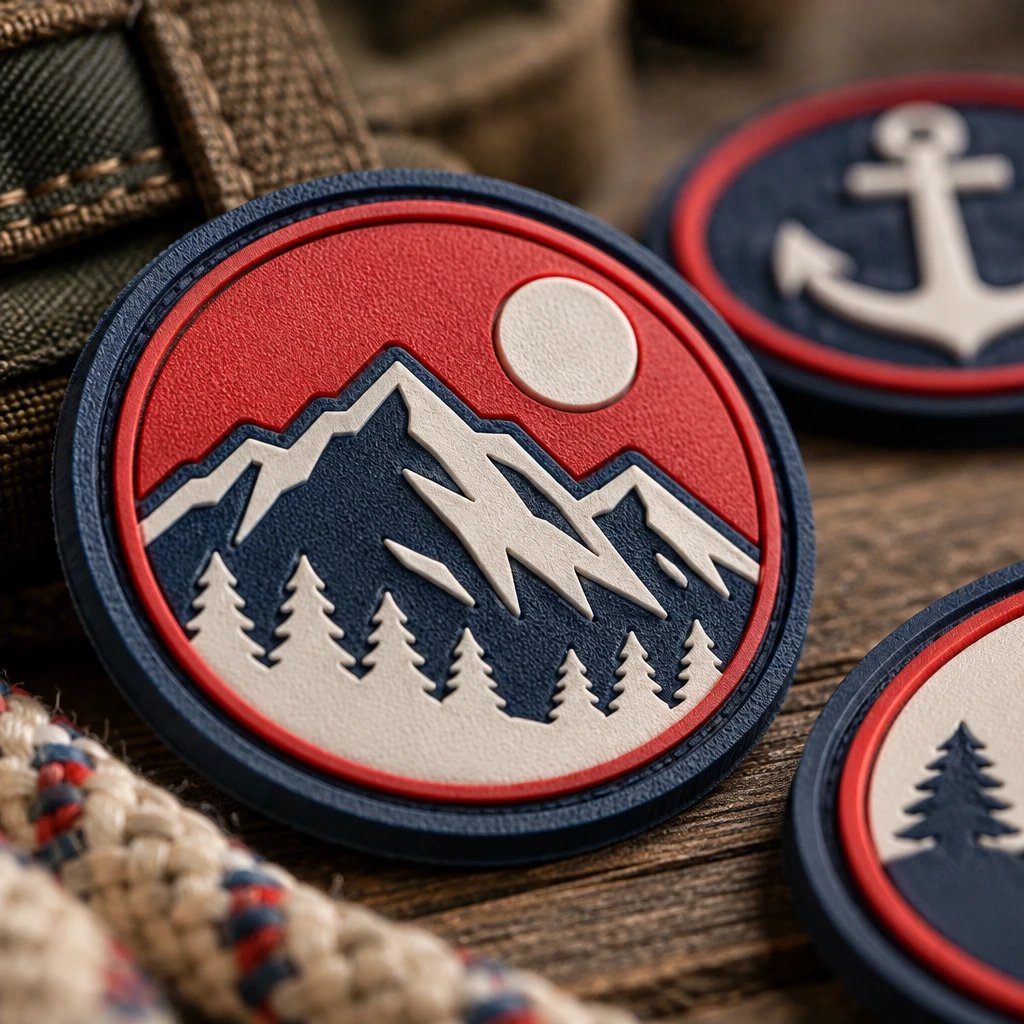
For leather vs pvc patches cost comparisons on small orders, choose leather for a quiet, textured logo and PVC for wet use, bright colors, or raised artwork, then compare matching quotes rather than assuming either costs less. Setup, decoration, and attachment can change the better buy. Here are the reasons, including where a simpler patch is enough.
A patch can look right on a screen and still be wrong for its garment. A thick badge may fight the curve of an unstructured cap. A pale tonal logo may disappear against leather grain. A washable work shirt may need care that the decorative patch cannot tolerate. Those are specification problems, not problems a nicer product photo will solve.
Which material makes the better small-order patch?
Leather wins when the material itself is part of the design. Polyvinyl chloride, usually called PVC, wins when color separation, moisture resistance, and molded relief matter more than a natural surface.
A leather patch is a cut leather badge that carries artwork through a specified process, such as engraving, debossing, or printing. A PVC patch is a flexible molded plastic badge that separates artwork through colored areas, recessed lines, and raised surfaces. Neither definition tells you the backing, thickness, or final cost. Those need their own line items.
Be precise about leather. Genuine leather comes from animal hide; synthetic leather is a manufactured material that imitates its surface. Their grain, consistency, decoration response, and care requirements differ. A quote labeled only “leather-style patch” leaves too much unresolved. Ask which material and finish are included before comparing it with another supplier's price.
For example, a neighborhood coffee business ordering 20 patches for canvas aprons might prefer a simple tonal leather mark because it fits the garment. A paddling club ordering 20 gear-bag badges has a stronger reason to use PVC. Same quantity. Different service conditions. The lower quote means little if the patch fails the actual use case.
| Buying criterion | Leather patches | PVC patches | Small-order decision |
|---|---|---|---|
| Durability | Can wear attractively, but abrasion, moisture, cleaners, and heat may alter the surface or finish. | Resists water and supports wipe-clean use; raised areas can still scuff and attachment can fail. | Choose for the exposure the finished garment will actually receive. |
| Detail level | Engraving or debossing suits bold marks; fine detail depends on grain, finish, process, and contrast. | Distinct color areas and raised shapes read well; narrow gaps and tiny letters can merge during molding. | Review artwork at final size rather than enlarging the screen preview. |
| Cost drivers | Hide or synthetic material, thickness, cutting, engraving, stamping, printing, and finishing affect cost. | Mold setup, dimensions, color layout, relief levels, finishing, and backing affect cost. | Compare total delivered cost for matching specifications, not material names. |
| Typical uses | Canvas aprons, denim jackets, knit beanies, and caps with restrained branding. | Outdoor bags, rain-exposed gear, removable uniform identifiers, and colorful club badges. | Use the garment and cleaning routine to narrow the choice. |
| Color and consistency | Natural leather can vary in grain and tone; a tonal logo may have limited contrast. | Molded colors provide clearer separation, although screen previews are not physical color standards. | Use PVC when distinct color blocks carry essential information. |
| Backing and attachment | Sew-on attachment is often practical; heat-applied systems require material-specific confirmation. | Sew-on and hook-and-loop configurations serve different uses; heat compatibility must be confirmed. | Price the complete attachment system, including any garment-side loop panel. |
| Cleaning | Care depends on the hide, finish, decoration, and garment; repeated machine washing may be unsuitable. | The face can usually be wiped clean, but laundering suitability depends on the entire assembly. | Get care instructions for the patch and backing, not just the face material. |
| Visual character | Grain, tonal decoration, and surface variation create a restrained look. | Smooth color fields and molded relief create a more graphic look. | Do not pay for relief or extra decoration that the logo does not need. |
Which leather vs pvc patches cost drivers matter on a small order?
Setup and specification matter more than a blanket claim that one material is cheaper. On a small run, fixed preparation costs are shared across fewer patches, so a complicated design can outweigh the savings from choosing a less expensive face material.
PVC requires mold preparation for the approved design. Leather may need artwork preparation, cutting setup, an engraving workflow, a stamping die, or a combination of processes. The exact method matters. A laser-decorated leather badge and a custom debossed leather badge do not necessarily carry the same setup structure.
Bigger generally means more material, but size is only part of the bill. A complicated perimeter can add cutting or finishing work. Multiple decoration steps add handling. Hook-and-loop backing adds components and assembly. If patches arrive already attached to hats, that garment work is a different scope from receiving loose patches in a box.
For example, compare a 2.5-inch rectangular tonal leather patch with a PVC version at the same dimensions and quantity. Keep the artwork, intended garment, and attachment requirement equivalent. Comparing that leather rectangle with a larger, multicolor, sculpted PVC badge tells you which specification costs more, not which material is inherently the better value.
- Ask for the total in USD and the effective per-piece cost at the requested quantity.
- Confirm whether artwork preparation, dies or molds, and backing are included or separate.
- Separate loose-patch pricing from garment attachment, blank garments, and garment handling.
- Check shipping and any applicable taxes before comparing delivered totals.
- Ask what changes on a reorder, including whether existing tooling can be reused and under what conditions.
The cheaper option is the right call when it meets the appearance, care, and attachment requirements without compromise that matters to the buyer. I'd skip extra relief for a flat wordmark that already reads clearly. I'd also skip decorative stitching inside a leather patch if a clean engraved mark does the job. Fewer operations can be a useful design decision, not a downgrade.
Choose leather if the texture does useful work
Choose leather if the logo can stay simple and the garment benefits from a tonal, textured badge. It is a strong fit for denim, canvas, and selected headwear, provided the care routine suits the specified leather.
Leather does not need a complicated design to look finished. In our production experience, a clear silhouette and readable lettering usually make better use of the surface than a packed badge with fine rings, small dates, and multiple text arcs. The grain is already visual information. Give it room.
For example, a workwear brand could put a 2-inch-wide tonal patch on a knit beanie cuff. The useful checks are flexibility, corner shape, and how the stitching behaves when the cuff stretches. A thick, stiff patch can pull the knit out of shape even if the logo looks excellent in isolation.
Natural variation can be welcome on a denim jacket. It is less welcome when a brand expects every badge to match a tightly controlled uniform color. Specify genuine or synthetic material, base shade, surface finish, decoration method, and thickness. Browse leather patch options with those questions in mind rather than treating every brown badge as the same product.
When simpler leather is enough
A straightforward shape with one decoration process is enough for many cap and apron logos. Extra printing, layered elements, or ornamental edge work should solve a visual problem before they earn a place on the quote. If the intended result is a quiet maker's mark, adding more can work against it.
See your artwork as a custom USA patch before you buy. Free digital mockup in 12 hours — 5-piece minimum per design. We do not produce until you approve.
GET A FREE MOCKUPI'd avoid choosing natural leather solely to claim a premium material on frequently laundered staff shirts. Unless the specific leather system is confirmed for that cleaning routine, the material can become a maintenance problem. A patch should not force a crew to treat a work shirt like a display garment.
Choose PVC if water, color, or raised detail matters
Choose PVC for gear exposed to rain, dirt, and routine wiping, or for artwork that depends on separate colored areas. Molded relief is useful when it strengthens the design, not simply because another level can be added.
PVC resists water better than leather. That does not make an attached patch waterproof equipment. Stitch holes can affect a weather-resistant garment, adhesives have their own limits, and a hook-backed badge still needs a secure loop field. Treat the face material and the attachment as separate decisions.
For example, a trail club ordering 30 patches for backpack loop panels could use a bright symbol with a raised outer border. The symbol remains the important part. Tiny member text around the perimeter may not survive reduction to the available space, and adding more colors will not rescue lettering that is simply too small.
A flat PVC design can be enough. Extra relief may add bulk without making the mark easier to recognize, particularly on a low-profile cap. Compare custom PVC patch configurations by thickness, edge construction, and backing as well as color. Ask where the sewing line sits before approving a thick raised perimeter.
When PVC is more patch than the job needs
I'd skip molded PVC for a temporary indoor event badge if a simpler construction meets the brief at a lower quoted total. Water resistance and sculpted depth have little value on a badge used briefly and stored afterward. They are worth paying for when the environment or design actually needs them.
If both leather and PVC feel excessive for a straightforward club logo, request a free digital mockup of a simpler embroidered patch alternative alongside the preferred material. Thread texture may suit the garment, and comparing the actual specifications will show whether that route offers useful savings.
Which backing belongs on caps, jackets, and work gear?
Sew-on attachment is a practical starting point for permanent placement; hook-and-loop is the better fit when badges need to come off. Iron-on attachment is not a universal shortcut for leather or PVC.
A sew-on patch is a badge attached with stitches through its edge or designated sewing area. A hook-and-loop patch is a removable badge whose hook backing engages a compatible loop panel. Ordering the hook side alone does not create a place to attach it on a plain jacket.
Caps need special attention. Their front panels curve, seams interrupt the surface, and some crowns lack the stiffness to support a heavy patch. For example, a 3-inch-wide badge may sit comfortably on one structured cap and distort a softer cap with a different panel shape. Use the actual blank style to judge placement.
For denim jackets and canvas overshirts, a sewn edge usually gives a clear, inspectable attachment. Technical shells are different. Sewing can puncture a weather barrier, while heat can damage coatings or distort fabric. Do not assume a household iron is suitable because the backing is described as heat activated.
A merrowed border is a wrapped thread edge commonly used on textile patches; it is not the default edge construction for leather or molded PVC. For leather, confirm the cut edge and stitching allowance. For PVC, confirm the molded border and any sewing channel. These details affect how neatly the patch can be attached.
- Structured caps: check usable front-panel space, center seams, curvature, and patch stiffness.
- Knit beanies: check cuff stretch, patch flexibility, and whether stitching creates puckering.
- Denim and canvas jackets: leave usable room for the sewing line and check access behind the placement.
- Uniforms with loop panels: match the finished patch shape to the existing panel and confirm hook backing.
- Coated outerwear: confirm attachment compatibility before committing to sewing or heat.
What should you check before approving the artwork?
Check the design at its finished dimensions, then check the material and attachment notes separately. A digital mockup confirms the proposed layout, but it cannot physically demonstrate grain, flexibility, adhesion, or wear.
Screen enlargement hides trouble. For example, a 2-inch badge viewed across a laptop screen can make a narrow line of text look easy to read. Print the layout at actual size or measure an on-screen version carefully. If the secondary wording becomes a dark stripe, remove it, enlarge the patch, or revise the lettering.
Ready to spec type, size, backing, and quantity? Open the quote form for a free 12-hour mockup and USA shipping after approval.
GET A FREE MOCKUP- Confirm finished width and height in inches, including the border rather than only the central artwork.
- Identify the face material precisely: genuine leather, a specified synthetic leather, or PVC.
- Review the decoration method, tonal contrast or color assignments, and any raised or recessed areas.
- Check the smallest lettering and narrowest gaps at actual size; approve any necessary simplification explicitly.
- Verify the edge construction, sewing allowance, backing, and whether a garment-side loop panel is included.
- Record the intended garment, placement, care routine, and whether the order covers loose patches or attachment.
- Approve the final artwork and written specifications together so an attractive image does not override an unresolved construction detail.
Color deserves its own conversation. A digital leather texture is illustrative, not a promise that every piece of natural hide will share that exact grain. PVC color on a monitor is also not a physical color standard. If matching an existing uniform is critical, ask what physical reference or sample options are available and how they affect the schedule.
Send the artwork, target size, garment, and preferred backing through the patch specification contact form for a free digital mockup before production. If the choice is still open, note that clearly so the comparison addresses leather and PVC under the same basic requirements.
How do minimums, approval, and delivery affect the decision?
USA Customized Patches has a 10-piece minimum and provides a free digital mockup in about 12 hours. Production starts only after written approval, and orders ship nationwide from Corona, California, to all 50 states.
The typical production window is 7–12 business days. Confirm the schedule for the selected material, construction, quantity, and current order before tying it to an event date. Artwork revisions happen before approval, and transit is a separate part of the calendar. A mockup turnaround is not a delivery promise.
Quotes are available 24 hours a day, 7 days a week. When requesting one, include the delivery ZIP code and the date the patches must be in hand. Shipping across the United States can involve different transit conditions, so use the shipping information as a starting point and confirm the actual shipment plan for the order.
A small order should stay small when that is all you need. Buying unused inventory just to spread setup across more pieces may lower the unit cost while increasing total spending. Ask for the requested quantity first. Consider a larger run only if there is a credible use for the additional patches and the artwork is unlikely to change.
Reorders deserve a written specification too. Keep the approved artwork, dimensions, material description, backing, and decoration notes together. If a future version needs a different club year or sponsor logo, that change may affect setup or tooling. An order that looks similar is not necessarily an unchanged repeat.
What is this comparison based on?
This advice rests on patch construction, the digital mockup step, and the order specifications that control production. It is not a laboratory wear test or a claim that every leather or PVC formulation performs alike.
In our production experience, artwork scale, decoration method, edge construction, and attachment explain many differences buyers initially attribute to material alone. That is why the comparison separates the patch face from its backing and avoids a universal price winner. An actual quote and approved specification are the reliable basis for a particular purchase.
Which option should you put on the purchase order?
Choose leather for a restrained logo whose texture belongs on the garment. Choose PVC when moisture exposure, distinct colors, or molded relief earns its place in the specification; choose the simpler quoted construction when those features add nothing useful.
For example, a tonal badge on a canvas jacket does not automatically need printed accents and elaborate edge work. A removable badge on outdoor gear does not need extra sculpted levels if a clear flat symbol is easier to read. Pay for the property that matters. Leave the rest out.
Before approving the purchase order, make sure it names the material, finished size, decoration, backing, attachment scope, quantity, delivered total in USD, and required arrival date. If any of those fields is blank, resolve it before production starts.