
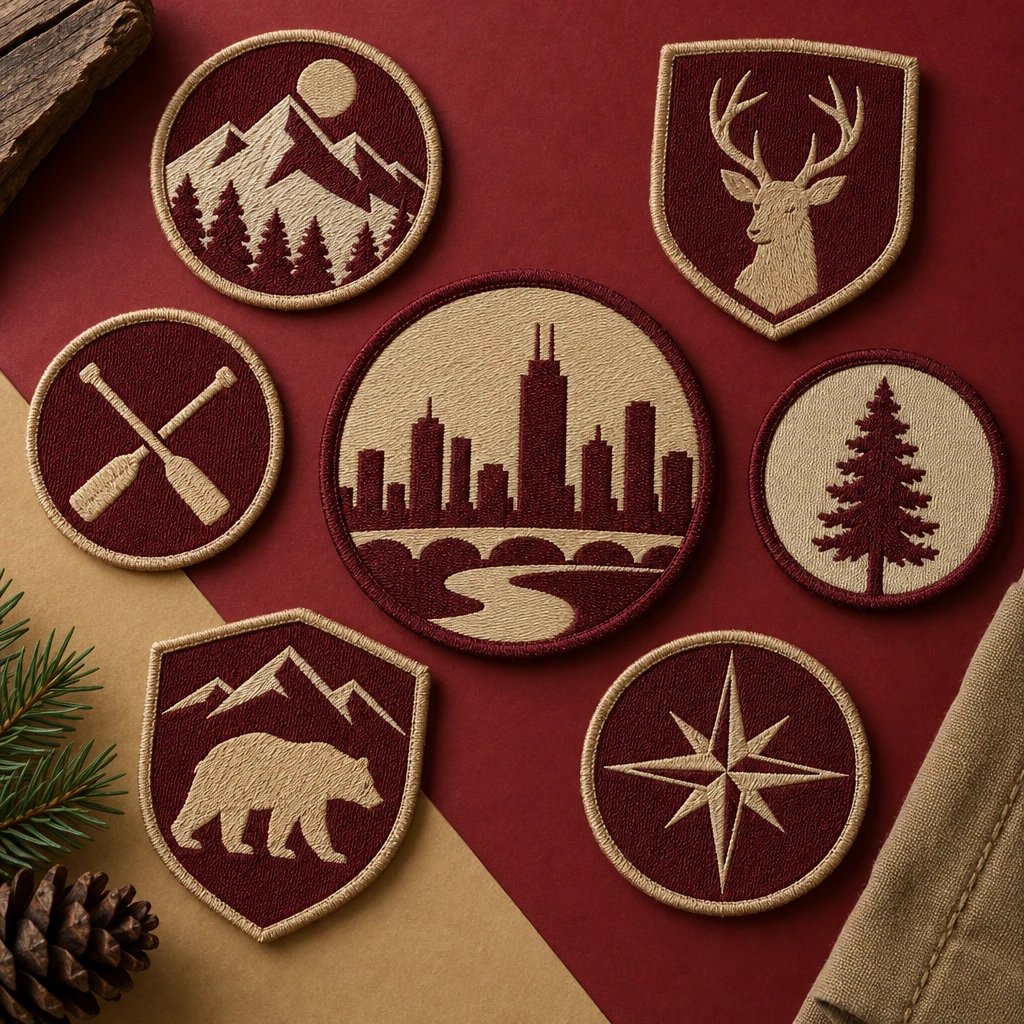
For Indianapolis sports teams and local brands, embroidered patches are the right starting point for bold cap logos and jacket badges; choose woven patches when small lettering or fine artwork matters more than raised texture. If you're searching for “patch ideas indianapolis,” start with the garment and finished size. Here are the design, attachment, and cost reasons behind that choice.
Which patch ideas Indianapolis teams can use will actually read on a garment?
A large initial, a simplified mascot, or a short neighborhood name usually works better than a complete promotional graphic. A patch has to identify the group while someone is wearing it, not just look convincing on an enlarged screen.
Indianapolis gives designers plenty to work with: basketball, racing culture, neighborhood identity, and straightforward Indiana references. The useful move is choosing one of those ideas, not squeezing all of them into the same badge. Original artwork also keeps the design from depending on a professional team's identity or an event mark you haven't been authorized to use.
A basketball club badge built around the initials
Example: a youth basketball club orders 40 patches for warm-up jackets. A roughly 3-inch badge could carry the club initials, one simplified basketball, and the city name. That's enough. Adding the coach's name, a full season schedule, and a slogan would turn the badge into a reading assignment.
I'd use embroidery if the initials are the main feature. Thread gives broad letters some body, and a simple ball remains recognizable without a web of tiny seam lines. Keep the year separate if the club expects to reorder the same badge for future players. A dated patch becomes obsolete even when the rest of the uniform doesn't.
A neighborhood badge for a local business
Example: a Fountain Square coffee shop wants matching patches for canvas aprons and staff caps. Start with the shop's own symbol and a short location line. An illustrated storefront might be useful on a poster, but its windows, brickwork, and sign lettering will compete for space on a cap.
The apron can accommodate a larger badge than the cap. That doesn't mean both versions need different identities. Keep the symbol and color arrangement consistent, then remove secondary text from the cap version. Woven construction is worth comparing if the shop insists on retaining a narrow lettering style, but simplifying the artwork may solve the problem without changing materials.
An original racing-inspired club emblem
Example: an Indianapolis automotive club uses an original wheel silhouette, a short club name, and a broad checkered accent on a work jacket. The reference reads without needing a detailed car drawing. Leave some open space between the wheel and the lettering so their outlines don't merge.
I'd skip a tiny illustrated engine for this application. It may be accurate artwork, yet accuracy means little if the features disappear at the finished size. A narrow strip of small checks can cause the same trouble. Larger checks, fewer elements, and a regular border are usually the more useful production choices.
Embroidered or woven patches: what changes in the finished badge?
Embroidery provides raised thread texture; woven construction provides a flatter surface that accommodates finer detail. Neither material wins every order, and neither has one fixed price advantage.
An embroidered patch is a fabric badge that uses stitched thread to form its design over a base material. A woven patch is a textile badge that forms its design with fine interlaced threads. Both can represent a team or business, but the way they build the artwork changes what remains readable.
| Criterion | Embroidered patch | Woven patch | Practical buying decision |
|---|---|---|---|
| Durability | Suitable for regular garment wear, but raised stitches can snag against rough surfaces. | Its flatter surface offers less raised thread to catch, though edges and attachment still need care. | Consider abrasion, laundering, and attachment rather than declaring either material indestructible. |
| Detail level | Best with broad lettering, bold outlines, and simplified symbols. | Better suited to fine lettering, narrow lines, and closely spaced design elements. | Choose woven when important details cannot be simplified at the requested size. |
| Surface and feel | Raised thread gives visible texture and a traditional team-badge appearance. | Flatter construction keeps the design closer to the fabric surface. | Pick embroidery for texture; pick woven when a flatter badge is more useful. |
| Cost drivers | Finished size, stitch coverage, quantity, backing, and edge construction affect the quote. | Finished size, weave requirements, quantity, backing, and edge construction affect the quote. | Ask for matched specifications. Woven is not automatically cheaper, and embroidery is not automatically more expensive. |
| Typical uses | Team warm-up jackets, bold cap initials, work shirts, and club emblems. | Detailed brand marks, small location lines, compact badges, and finer mascot artwork. | Match the construction to the design that must remain readable. |
| Small cap placement | Works well when the artwork has a clear, simplified center. | Can retain more detail within a compact placement. | Neither construction fixes a patch that is too tall or too wide for the cap panel. |
| Borders and attachment | Can be specified with an appropriate stitched or cut edge and garment-compatible backing. | Also needs a suitable edge finish and attachment method. | Confirm the border and backing separately; the material name does not settle those choices. |
A screen image can't fully communicate the difference in surface texture. In our production experience, a buyer often asks for embroidery because they like its appearance, then supplies artwork with details that need more space than the proposed patch allows. That's a design decision to resolve before approval, not something to leave for production.
Choose embroidered patches if texture and bold shapes do the work
Choose embroidery for readable initials, uncomplicated mascots, and traditional sports or workwear badges. It's the right call when the design benefits from visible stitches rather than depending on very fine lines.
Think of a structured baseball cap with a broad lettermark, a canvas coach's jacket with a shield, or a mechanic's work shirt with a short business name. These garments don't need every part of the patch filled with stitching. Exposed base fabric can provide useful contrast and keep a design from becoming needlessly dense.
- Choose embroidery if the identity still works after removing decorative detail.
- Choose embroidery if raised thread is part of the intended team or brand appearance.
- Choose embroidery if a short name and one strong symbol carry the message.
- Simplify first if the requested design only works when viewed much larger than the actual patch.
This is also where the simpler option can be enough. A plain initial inside a regular border may do a better job on a cap than a densely stitched scene with several secondary elements. If that simpler specification produces the lower quote, there is no production reason to spend more just to make the badge busier.
For a first layout, request a free digital mockup through the embroidered patch options and include the garment, intended width, and the smallest text you need to keep. Those details make the preview useful instead of merely attractive.
Choose woven patches if small lettering must stay in the design
Choose woven construction when fine lines, narrow lettering, or a more detailed symbol must fit inside a compact badge. Expect a flatter appearance rather than embroidery's raised stitch texture.
Example: an Indianapolis running club wants its full club name, a neighborhood reference, and a slim route symbol on a small gear-bag patch. If all three elements genuinely matter, woven construction deserves a comparison. If the route symbol is just decoration, removing it might let a simpler embroidered version work equally well.
See your artwork as a custom USA patch before you buy. Free digital mockup in 12 hours — 5-piece minimum per design. We do not produce until you approve.
GET A FREE MOCKUPFine detail still has limits. A woven patch isn't a miniature poster, and weak color contrast stays weak regardless of how the threads are formed. Dark gray lettering against black fabric needs reconsideration before anyone debates construction.
Use the woven patch construction guide to compare the flatter finish with embroidery. I'd choose woven for a detailed brand mark that cannot be simplified, but not merely because someone described it as more advanced. The useful question is what the wearer and viewer gain.
What patch size fits a cap, warm-up jacket, or apron?
The right size is the largest practical placement that preserves the garment's shape and keeps the required design readable. Measure the actual garment before choosing dimensions; cap panels and jacket fronts vary.
A patch's outer dimensions include its border. That matters because the usable design area is smaller than the total width. A thick border around a small badge can consume the room you thought was available for the team name.
- Cap example: compare a 2.5-inch-wide paper template with the front panel, center seam, and curve above the bill. This is a starting test, not a universal cap limit.
- Warm-up jacket example: test a 3.5-inch badge on the left chest while the jacket is zipped and worn. Check its relationship to the zipper and any existing decoration.
- Apron example: hold a 4-inch-wide template above the pocket and bend forward. Avoid a placement that interferes with the pocket opening or folds constantly.
- Gear-bag example: test the badge on the loaded bag, not only on an empty panel. A flexible surface changes shape when equipment pushes against it.
Paper tells you a lot. Print the design at actual size, cut around it, and photograph it on the garment from normal conversation distance. If the location line already disappears, enlarging the preview on a laptop doesn't solve anything.
For team orders, inspect both the smallest and largest garment sizes. A badge that sits comfortably on an adult jacket may crowd a youth chest panel. Before creating multiple patch sizes, see whether one slightly smaller, simpler design fits the entire group.
Which backing and border suit Indianapolis team gear?
Sew-on attachment is the dependable starting point for many washable jackets, shirts, and aprons. Heat-seal and hook-and-loop backings serve different needs, so choose them by garment compatibility and use rather than convenience alone.
Sew-on for regular wear and laundering
A sew-on patch is a badge that is secured to the garment with stitching. It avoids heat application, which makes it worth considering for fabrics or finishes that may be heat-sensitive. Sewing still requires access behind the panel and care around linings, pockets, and waterproof layers.
I'd start here for a canvas apron or a team jacket expected to stay in rotation. Check who will attach the patches, though. Buying loose patches and hiring a local sewing shop are separate parts of the job unless attachment is specifically included in the quote.
Heat-seal only when the garment can take it
Heat-seal backing is an adhesive layer that bonds under specified heat, pressure, and time. A curved cap, coated shell, or stretch performance shirt is not automatically a good candidate. The garment care label and application instructions both matter.
Don't guess at an iron setting. Ask for the instructions supplied for the actual backing and test compatibility before applying the full order. If permanent attachment is the goal and heat suitability is uncertain, sewing may be the more practical route.
Hook-and-loop for removable identification
Hook-and-loop backing is a removable fastening system that joins a hook surface to a compatible loop surface. It makes sense on bags or outerwear designed for interchangeable badges. Confirm whether the order includes only the hook-backed patch or also a separate loop piece that must be attached to the garment.
A regular border for a straightforward team badge
A merrowed border is an overlocked thread edge that wraps around the patch perimeter. It generally suits regular outlines such as circles, ovals, and rectangles with manageable corners. An intricate mascot silhouette may need a cut edge or another suitable finish instead.
For a basic club badge, I'd keep the regular outline. Tight points and deep notches can complicate the edge without improving recognition. Looking through patch design examples can help you compare border proportions, but approve your own dimensions rather than copying an enlarged photo.
What makes one patch quote cost more than another?
Finished size, quantity, construction, backing, border, and artwork requirements drive the quote. Compare the same specification in US dollars before deciding that embroidery or woven construction is the lower-cost choice.
Embroidery with more stitch coverage generally requires more stitching than a design that leaves some base fabric exposed. Larger patches use more material, and more involved finishing can add work. Woven construction has its own production requirements, so changing the material is not a reliable shortcut to a lower total.
Ready to spec type, size, backing, and quantity? Open the quote form for a free 12-hour mockup and USA shipping after approval.
GET A FREE MOCKUPExample: a club compares a small initials-only badge with a larger crest containing a mascot, city name, year, and motto. That isn't a clean material comparison. The second design asks for more space and more information before the backing or construction has even been selected.
- Set one finished width and height for the comparison.
- Use the same quantity and state whether every patch carries identical artwork.
- Specify the backing and border instead of leaving them open.
- Ask whether the quote includes shipping and any garment attachment.
- Compare the total order cost, not only the unit price.
The cheaper option is the right call when it preserves the useful parts of the design and meets the attachment needs. A plain sew-on badge for a canvas bag doesn't need removable backing if nobody will remove it. A regular circle doesn't need a custom silhouette just because that silhouette is possible.
Don't buy unnecessary pieces to chase a lower unit cost, either. Reusable artwork makes sensible extras easier to justify, especially for new team members. A date-specific sponsor badge has less reorder value, so the lowest total spend may matter more than the lowest price per piece.
What should go into the artwork request and approval?
Send the artwork together with the garment, dimensions, quantity, backing, and required date. Then approve a mockup that shows the exact specification you intend to order, not just the logo.
- Identify the use case. Say “structured baseball cap,” “polyester warm-up jacket,” or “canvas staff apron,” rather than simply “uniform.”
- Provide the best artwork available. Include an editable file if you have one, and identify any text or symbols that must not change.
- Give finished dimensions in inches. State width and height, especially for an irregular outline.
- Separate required content from optional detail. A club name may be essential; a tiny decorative date line may not be.
- Choose the backing and border. Note any garment coating, lining, stretch, or existing loop panel that affects attachment.
- Review spelling, colors, border thickness, dimensions, and small-text treatment on the mockup.
- Give written approval only after the order specifications and delivery expectations are clear.
A free digital mockup is a visual layout that shows the proposed design before production. It helps catch a misspelled neighborhood, a crowded border, or the wrong proportions. It is not a physical stitch sample, a laundering test, or proof that a particular garment can accept heat.
If the material choice is still unsettled, send the artwork and garment details through the patch quote and mockup request and ask for a free digital mockup focused on readability at the intended size. That is the useful comparison to make before approving the order.
What minimum, timing, and shipping should an Indianapolis buyer plan around?
USA Customized Patches has a 10-piece minimum and provides a free digital mockup in about 12 hours before production. Production starts only after written approval.
Typical production timing is 7–12 business days after approval; confirm the schedule for the actual order and allow for shipping separately. Quotes are available 24 hours a day, 7 days a week. Quote availability does not mean production or carrier transit happens continuously.
Orders ship nationwide from Corona, California, to all 50 states across the United States, including Indiana. Shipping origin does not by itself establish where every material or manufacturing step originates. If domestic manufacturing is a purchasing requirement, ask for confirmation of the specific order's origin rather than inferring it from the dispatch address.
For a tournament, staff opening, or club event, provide the date the patches must be in hand. Add time for sewing if a separate shop is attaching them. Check the United States shipping information and confirm the delivery plan before treating a production estimate as an arrival date.
What this advice is based on
These recommendations rest on the patch-production process, the digital mockup step, and the relationship between artwork and order specifications. They are practical selection guidance, not results from a published comparative durability test.
In our production experience, readability problems often come from the combination of small size, crowded content, and weak contrast. Material choice can help, but it cannot repair every layout. The labeled examples here illustrate possible orders; they are not customer case studies, reviews, or claims about completed Indianapolis projects.
Which option should you put on the order?
Choose embroidery for a bold Indianapolis team or business badge; choose woven when essential fine detail needs the flatter construction. If both work, use the simpler specification that fits the garment and the budget.
My first choice for a cap initial, a basketball club shield, or a short work-shirt name is embroidery. My first choice for a compact badge with indispensable fine lettering is woven. I'd skip elaborate artwork on either material when a clean symbol would identify the group faster.
Before signing off, put an actual-size paper version on the smallest garment in the order. Check the lettering, the seams, and the space around the border. If it fails that simple test, change the layout while it's still a file.