
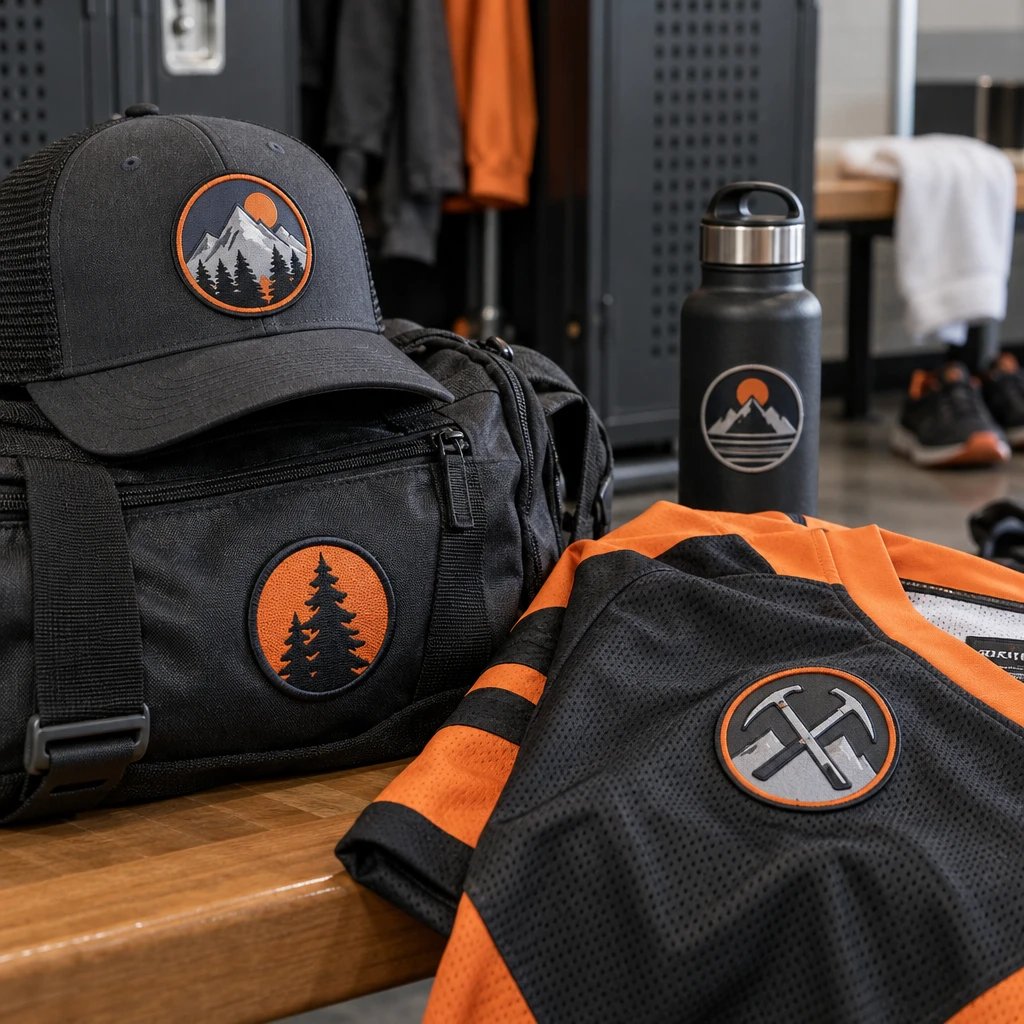
When choosing woven or leather patches for uniforms, I'd pick woven for frequently washed workwear and leather for low-wash garments where its appearance earns the extra care. The reasons come down to washing, surface wear, readable artwork, and attachment, not simply which material feels tougher in your hand.
A uniform patch has to work with the garment underneath it. A badge that looks right on a structured shop jacket can feel stiff on a lightweight housekeeping shirt, and a patch that survives occasional hand cleaning may be the wrong choice for a weekly commercial laundry route. Start with that distinction before comparing colors or requesting a quote.
Which lasts longer: woven or leather patches for uniforms?
Woven usually holds up more predictably on regularly washed uniforms, while leather can be a durable option on garments that receive limited, compatible cleaning. Neither material has a useful universal lifespan without knowing the laundry process, patch construction, and attachment.
There are several ways a patch can fail. The attachment can loosen. The face can become hard to read. An edge can curl or fray while the center still looks fine. Leather may remain physically intact but develop a finish change that makes a uniform look inconsistent. For a business buying matching shirts, appearance can be the replacement trigger long before the material tears.
In our production experience, garment care is a better starting point than a broad claim about toughness. Ask what actually happens after a shift: home washer, tumble dryer, commercial laundry, spot cleaning, or no routine washing at all. Then check the complete patch specification against that process. A material name alone isn't a wash approval.
What are the practical differences between woven and leather?
Woven offers a flatter fabric construction and more flexibility for small lettering, while leather offers a distinctive surface with more restrictive care requirements. The comparison below assumes an ordinary uniform application, not a certified industrial-laundry or protective-clothing specification.
| Buying criterion | Woven patch | Leather patch | Practical uniform decision |
|---|---|---|---|
| Durability in routine washing | Often the more suitable choice when thread, backing, border, and care conditions are compatible. | Repeated soaking, detergent exposure, and drying heat can alter natural leather or its finish; synthetic alternatives vary. | Start with woven for regularly washed work shirts, then confirm the wash conditions. |
| Abrasion and visible wear | Surface threads can fuzz, snag, or wear where straps and equipment rub. | The face may scuff, darken, polish, or lose finish; some changes suit casual wear but not matching uniforms. | Judge acceptable appearance, not just resistance to tearing. |
| Detail level | Interlaced fine threads support compact lettering and multicolor artwork, within production limits. | Fine marks depend on engraving, debossing, surface grain, finish, and contrast. | Choose woven when small department names must remain readable. |
| Cost drivers | Size, quantity, artwork complexity, colors, edge treatment, and backing affect the quote. | Material grade, thickness, marking method, finish, shape, and attachment preparation affect the quote. | Compare equivalent sizes and quantities before calling either option less expensive. |
| Typical uses | Work shirts, team polos, uniform sleeves, service jackets, and fabric name badges. | Selected caps, work aprons, overshirts, outerwear, and low-wash club garments. | Match the material to the actual garment and cleaning routine. |
| Flexibility and comfort | Usually lies flatter and bends more readily on light fabric. | Can add stiffness or weight, depending on material and thickness. | Use a flexible patch on lightweight shirts and near moving joints. |
| Attachment | Sew-on, hook-and-loop, or a compatible heat-applied backing may be possible. | Sew-on or removable mounting may be suitable; heat application requires material-specific approval. | Don't assume a shared backing name means identical application settings. |
| Color consistency | Thread colors allow a defined palette, although reorders still need specification checks. | Natural grain, dye, and finish can introduce variation; coated synthetics behave differently. | Approve the acceptable appearance range before ordering matching uniforms. |
| Water exposure | The fabric face may dry readily, but the backing and garment still need review. | Natural leather can change after wetting; coated synthetic constructions have separate limitations. | Neither patch type makes a garment or its stitch holes waterproof. |
What materials are you actually comparing?
A woven patch is a fabric badge that forms its design from interlaced threads. A leather patch is a cut badge that carries its design in or on a leather surface, but buyers should confirm whether the quoted material is natural leather or a synthetic leather alternative.
Uniform woven patches commonly use polyester thread. The design is built into the woven face rather than stitched as a raised layer over a separate base fabric. That construction helps with compact lettering and a low profile. It doesn't mean every thin line in a screen file will reproduce cleanly at chest-badge size.
With leather patch options, the word leather needs a follow-up question. Natural hide, split constructions, bonded materials, and polyurethane-coated synthetic fabric are not interchangeable. Their surfaces, flexibility, and response to moisture can differ. A synthetic leather patch may offer a more uniform face, but its coating and substrate introduce their own wear considerations.
Put the exact material on the order specification. Also name the marking method, such as laser engraving or debossing. Debossing is a marking process that presses a design below the surrounding surface. An engraved dark logo and a shallow debossed logo can have very different readability even when their artwork starts from the same file.
Choose woven if your uniforms go through regular washing
Choose woven for washable shirts, flexible sleeve badges, and designs that need readable lettering without much bulk. It's the right starting point when consistent daily use matters more than a leather surface.
Think service polos, maintenance shirts, delivery uniforms, and club volunteer shirts. These garments bend, get sweaty, and return to the wash. A light fabric badge generally works with that routine better than a thicker decorative patch, provided the backing and application match the care instructions.
- Choose woven if employees wash their own uniforms and the approved home-care instructions are straightforward.
- Choose woven if the badge includes a department name, location, and logo within a compact footprint.
- Choose woven if the shirt fabric is light enough that a stiff badge could pull or pucker it.
- Choose woven if patches must sit comfortably on sleeves or under a jacket.
- Choose woven if matching thread colors matter more than grain, patina, or a branded leather appearance.
Example: say a facilities team orders 40 patches for short-sleeve work shirts. The artwork includes a building icon, a company name, and a service designation. I'd use woven, simplify any tiny wording, and specify a sewn perimeter if the garment construction allows it. Leather adds care questions without solving that team's main problem.
The less expensive woven quote can be the right call here. There's no reason to buy a leather finish simply because it sounds more substantial. Spend attention on the size, edge, and attachment instead. Those decisions affect how the patch sits on the shirt every workday.
Choose leather if the garment can support its care requirements
Choose leather for selected low-wash jackets, caps, and aprons when a simple design and surface character are part of the uniform's intended appearance. The garment must tolerate the patch's weight, stiffness, and cleaning restrictions.
A canvas shop apron can carry a leather badge convincingly. So can a structured overshirt or a club jacket worn over everyday clothing. But an apron exposed to food spills and frequent laundering is a different job from an apron used for occasional showroom demonstrations. Same garment name. Different specification.
See your artwork as a custom USA patch before you buy. Free digital mockup in 12 hours — 5-piece minimum per design. We do not produce until you approve.
GET A FREE MOCKUP- Choose leather if the garment is normally spot-cleaned and the proposed leather finish permits that cleaning method.
- Choose leather if the design is a bold wordmark, initials, or a simple symbol rather than dense multicolor artwork.
- Choose leather if slight surface variation is acceptable within the uniform program.
- Choose leather if the garment has enough structure to support the patch without sagging.
- Choose leather if the patch can be removed before incompatible cleaning and the team will actually follow that procedure.
Example: a club orders patches for canvas jackets worn at monthly meetings. A simple leather badge can make sense because it isn't headed through the wash after every shift. I'd still ask how the jackets are cleaned before approving the attachment. Low-wash doesn't mean maintenance-free.
I'd skip leather on lightweight housekeeping polos that need frequent washing. I'd also skip it when the logo depends on several small color distinctions that an engraved face cannot preserve. Material character isn't compensation for a name nobody can read.
How do washing, dryer heat, and commercial laundry change the choice?
The cleaning process can eliminate a patch option before artwork is finalized. Review water temperature, detergent chemistry, drying conditions, and any pressing step for the complete patch-and-garment assembly.
Home laundering and commercial uniform service aren't the same exposure. A commercial route may use processes that ordinary consumer patches weren't specified to withstand. Don't call woven suitable for industrial laundering merely because its face uses polyester thread. Adhesive, border stitching, hook-and-loop components, and garment fabric all remain part of the decision.
Natural leather can stiffen, change shape, or lose its intended finish after unsuitable wetting and drying. Coated synthetic leather avoids some natural-hide behavior but can develop coating wear or separation under incompatible conditions. Neither should be approved on the assumption that it behaves like the surrounding cotton or polyester shirt.
For a managed uniform program, get the laundry specification first. Then ask for material compatibility information and arrange evaluation of the proposed assembly under the actual process when failure would be costly. A digital rendering can show where a patch goes. It cannot establish a wash-cycle rating.
Which attachment and border should a uniform patch use?
Sew-on attachment is usually the more dependable starting point for permanent uniform patches, while hook-and-loop is useful when removal is intentional. Heat-applied attachment needs approval for both the patch construction and the garment.
Sew-on for a permanent badge
Sew-on backing is a patch configuration intended for attachment with stitching rather than relying on a heat-activated adhesive. Perimeter sewing provides mechanical attachment, but it won't protect an unsuitable face material from detergent or dryer heat. The sewing contractor also needs to avoid pocket openings, waterproof barriers, and concealed garment components.
A merrowed border is an overlocked thread edge that wraps around a patch perimeter. It works well on many regular woven shapes, although it adds an outline and some thickness. A heat-cut edge can suit detailed contours and a flatter appearance. Leather generally uses its cut edge, sometimes with perimeter stitching, rather than the same wrapped border construction.
Hook-and-loop for deliberate removal
Hook-and-loop backing is a removable fastening system that joins a hook surface to a matching loop surface. It can let staff remove a patch before laundering, but the garment needs a properly attached loop panel. The panel and its stitching still go through the wash.
Removal creates a staff task. If people won't remove the badges consistently, don't use removability as the entire durability plan. Hook-and-loop also adds thickness, can collect lint, and may catch nearby fabric when exposed.
Iron-on only with compatible materials
Iron-on backing uses heat-activated adhesive to bond a patch to suitable fabric. The required temperature, pressure, and dwell time depend on the adhesive system. Avoid guessing with coated shells, stretch shirts, heat-sensitive synthetics, or leather faces. Follow the supplied application instructions, not a generic household-iron setting.
What size and artwork survive daily use?
Readable artwork starts with the finished dimensions, not the size of the logo on a monitor. Woven usually allows more compact detail than a leather design whose visibility depends on surface contrast or impression depth.
Example: compare the same wordmark at 3 inches wide and 2 inches wide on a shirt pocket. The smaller version may still hold the main name, but a secondary service line can become a thin visual stripe. Enlarging the patch isn't always possible because the pocket seam and usable chest area set the boundary.
I'd remove a tiny tagline before squeezing the main name. On leather, I'd also separate narrow lines and avoid making a subtle tonal difference carry essential information. Wear can reduce already-limited contrast. On woven material, don't assume every fine thread element remains equally distinct after routine abrasion.
Ready to spec type, size, backing, and quantity? Open the quote form for a free 12-hour mockup and USA shipping after approval.
GET A FREE MOCKUPA mockup should show finished width and height, artwork placement, border treatment, and the intended material appearance. Check the attachment specification alongside it. For artwork that may work better with a raised stitched face, request a free digital mockup through the embroidered patch hub and compare the layouts at the intended uniform size.
When is the simpler or less expensive option enough?
A standard-shaped woven badge is enough when the job is clear identification on a washable uniform. Leather is worth considering only when its appearance solves a real design requirement and its care limitations fit the garment.
Don't assume material alone sets the price. A complex woven shape with additional attachment requirements can cost differently from a simple leather rectangle. Size, quantity, material, decoration method, border, and backing belong on the same quote comparison. Ask for pricing in USD with shipping and any attachment work identified.
Separate patch price from installed cost. A badge that requires a new loop panel, special sewing access, or repeated removal can add work after delivery. Conversely, spending more on an ornamental material won't improve a basic uniform if employees need a lighter, more washable badge.
Keep the shape simple when it doesn't carry meaning. A rectangle or oval can provide a clear sewing path and protect the readable area from unnecessary cut-ins. Skip extra wording that nobody needs to identify the employee or organization. Those are useful simplifications, not compromises to hide.
What should you approve before production starts?
Approve the material, dimensions, artwork, edge, attachment, and garment-care assumptions as one specification. Approving only the logo leaves too many practical decisions unresolved.
- Identify the garment. Provide the style, fabric composition, placement, and any coating or performance requirements. A polo chest and a structured cap front need different attachment planning.
- Describe the cleaning routine. Include home washing, commercial service, drying, pressing, or spot cleaning rather than saying only that the patch must be durable.
- Set the finished dimensions in inches. Measure usable space between seams and check that the patch won't close a pocket or interfere with garment movement.
- Name the face material and marking method. For woven, confirm the thread-based design. For leather, identify the exact natural or synthetic construction and proposed decoration.
- Confirm the border and backing. Specify sew-on, approved heat-applied backing, or hook-and-loop, including whether a matching loop panel is required.
- Review the digital mockup at actual size. Check spelling, line breaks, spacing, colors, border allowance, and which details have been simplified.
- Resolve performance questions separately. A mockup approves layout; any required laundering or abrasion evaluation needs its own agreement.
- Provide written approval and confirm the schedule. Keep the approved artwork and order specification available for installation and future reorders.
USA Customized Patches has a 10-piece minimum. A free digital mockup is provided before production, typically in about 12 hours. Production starts only after written approval. Typical production timing is 7–12 business days; confirm the schedule for the approved specification and allow separately for transit.
Quotes are available 24 hours a day, 7 days a week. Orders ship nationwide from Corona, CA, to all 50 states in the United States. Review the United States shipping information when planning a uniform rollout, especially if garments must reach a separate sewing contractor before employees can wear them.
What is this advice based on?
This comparison rests on patch construction, material behavior, the digital mockup step, and the specifications needed to quote and produce a uniform order. It is not a claim that every woven or leather patch has passed the same wash or abrasion test.
In our production experience, problems often begin when a buyer approves an attractive face without settling the garment and cleaning details. The mockup helps resolve visual questions. The order specification records material and attachment decisions. Neither replaces physical evaluation when a uniform program requires documented performance.
Which option should you put on the purchase order?
For everyday washable uniforms, put woven on the shortlist first. Choose leather for a defined low-wash application, not as an automatic upgrade.
A service shirt needs legible identification and compatible care more than it needs an interesting surface. A structured club jacket may justify leather because the badge is part of the garment's character. If the lower-priced woven option meets the actual requirements, use it and keep the specification consistent across reorders.
For a free digital mockup, send the artwork, garment type, placement, intended size, and cleaning method through the patch specification contact form. Include a photo showing the surrounding seams. That gives the production desk something useful to check before the material choice becomes an order.