
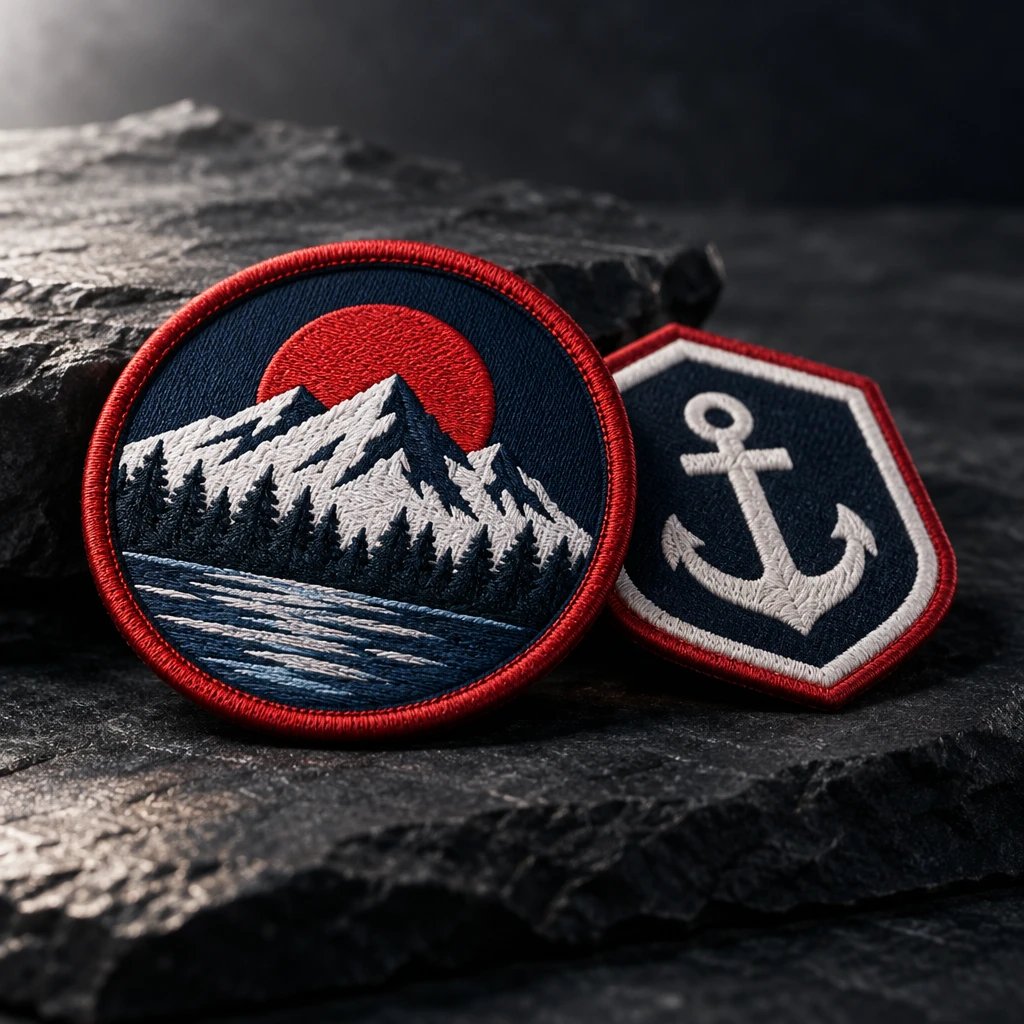
For woven vs leather patches detail, woven is the better choice for small lettering and multicolor logos, while leather is the right call for bold artwork where texture matters more. The reasons come down to how each material forms an image, how it sits on a garment, and what happens when that garment needs washing.
I'd start with the artwork, not the material swatch. A leather patch can look excellent on a structured cap and still be the wrong answer for a club crest packed with names, dates, and separate color fields. Woven isn't automatically better either. If the design is a broad monogram and the cap fabric already has plenty of visual activity, a quieter leather surface may do the job with less fuss.
What is the difference between a woven patch and a leather patch?
A woven patch is a textile patch that forms its design by interlacing colored yarns. A leather patch is a cut material patch that carries a design through a specified process, such as debossing, embossing, engraving, or printing.
Those definitions explain much of the buying decision. With woven construction, the image belongs to the fabric structure. With leather, the material provides a surface for the image. A recessed mark, a raised mark, and printed ink on that surface will not produce the same result, even when the outline is identical.
The word leather also needs checking. Genuine leather and synthetic leather are different materials, with different surface consistency, heat tolerance, and care requirements. Don't approve a quote that leaves that distinction unresolved. The woven patch options and leather patch options are useful starting points, but the order specification should identify the actual construction and finish.
How should you compare woven vs leather patches detail?
Compare the smallest necessary design element first, then color separation, texture, care, and attachment. A patch that loses the club name or requires unsuitable garment care is not a good substitute, even if its material looks more substantial.
| Buying criterion | Woven patches | Leather patches | What to check before approval |
|---|---|---|---|
| Fine detail | Fine yarns can form compact lettering, narrow outlines, and distinct color areas. | Bold shapes usually read best; fine detail depends on the surface and decoration method. | Smallest letters, interior gaps, narrow lines, and finished dimensions. |
| Color | Separate yarn colors create a multicolor design, subject to available thread matches. | Often chosen for a material color plus a contrasting or tone-on-tone mark; printing changes the comparison. | Actual color references and the specified marking process. |
| Texture | Thin textile surface with a visible woven structure at close range. | Grain, finish, thickness, and recessed or raised artwork contribute to the surface feel. | Whether the garment needs flexibility or a firmer badge. |
| Durability | Washing and abrasion performance depend on yarn, edge finishing, backing, and attachment. | Performance depends on genuine or synthetic material, finish, decoration, moisture exposure, and attachment. | The intended wear conditions and care requirements for the complete assembly. |
| Cost drivers | Dimensions, quantity, weave construction, colors, edge finish, and backing. | Material grade, thickness, dimensions, decoration, tooling where applicable, and attachment preparation. | Comparable quotes for the same size, quantity, and garment use. |
| Typical uses | Team uniforms, club crests, name patches, event merchandise, and detailed cap logos. | Bold cap labels, denim branding, jacket badges, bags, and restrained brand marks. | Whether readability or material character does more work. |
| Edges and attachment | Can use a merrowed border or a suitable cut edge, depending on the shape and construction. | Usually uses a cut perimeter; sewing layout must suit the material and design. | Border width, stitch placement, and clearance from artwork. |
| Routine garment care | Often the more practical starting point for frequently washed garments, with an appropriate backing. | May need care that differs from the garment; synthetic leather is not automatically wash-safe. | Written care guidance for the specific patch and attachment. |
The table is a direction, not a promise that every woven patch outlasts every leather patch. In our production experience, the useful comparison is the finished assembly: artwork, material, edge, backing, garment, and care. Leaving out any one of those can make a reasonable material choice fail in use.
Which material keeps small lettering readable?
Woven is generally the safer choice for small lettering and closely spaced color details. Leather can hold fine marks, but reproducing a line is not the same as making that line easy to read.
Contrast matters. Dark woven letters on a light woven field have a clear visual boundary. A shallow mark on brown leather may be physically present yet hard to distinguish when the cap turns away from the light. Surface grain can also interrupt the apparent edge of a tiny character.
Example: a club wants a 3-inch patch with its name around the outside, a central emblem, and a founding date below. I'd start with woven if all of those elements must remain. For a leather version, I'd test a larger central emblem and remove secondary wording before trying to squeeze the whole crest onto the surface.
There isn't one honest minimum letter size for every font and process. An open block letter behaves differently from a narrow script letter. Check the counters inside letters, the spaces between strokes, and the gap between the text and border at actual finished size. Zooming in on a screen can hide a readability problem.
If the small text is essential, you can request a free digital mockup showing the proposed dimensions and artwork spacing before choosing the material. Use that review to resolve legibility, not just to approve the general appearance.
How do color matching and contrast differ?
Woven patches are usually the more straightforward option when several distinct brand colors must remain visible. Leather is a stronger fit when the design can work through material color, tonal contrast, and surface depth.
For woven work, each important color area needs enough room to read as its own shape. A narrow outline that separates two similar colors may matter more than another decorative accent. Available yarn colors also limit matching, so a screen color should not be treated as a promise of an exact physical thread match.
Leather needs a different conversation. Ask whether the design will be debossed, embossed, engraved, or printed. Engraving does not create the same appearance on every material. A printed leather patch can carry colors that a simple recessed mark cannot, but that adds another finish whose appearance and wear need checking.
I'd skip an untested tone-on-tone leather treatment for a sponsor logo that needs to be recognized quickly across a busy event space. For a small brand label on a canvas bag, the same restrained treatment may be exactly right. Visibility is a requirement, not always a virtue.
How will each patch feel on a cap, jacket, or shirt?
Woven usually feels thinner and more flexible, while leather gives a more substantial surface whose stiffness varies by material and thickness. The garment underneath determines whether that extra body is useful or awkward.
See your artwork as a custom USA patch before you buy. Free digital mockup in 12 hours — 5-piece minimum per design. We do not produce until you approve.
GET A FREE MOCKUPOn a structured cotton twill cap, a leather badge can suit the supported front panel. On a soft, unstructured cap, a broad or stiff patch may resist the crown's curve. Woven generally follows that curve more easily, although a firm backing can make a textile patch stiffer than expected.
Example: a 2.5-inch-wide badge on an unstructured cap needs to be considered against the panel shape and center seam. The same badge on the flat chest area of a denim jacket presents a different attachment problem. Width alone doesn't tell you whether it will sit neatly.
For a lightweight polo or performance shirt, I'd avoid choosing a heavy patch simply because it feels substantial in the hand. It can pull the fabric or make the chest area hang differently. For a canvas work jacket, denim vest, or sturdy tote, that concern is often less important than the desired appearance.
Which patch handles washing and daily wear better?
For frequently laundered garments, woven is usually the more practical starting point. Neither material should be called universally washable or more durable without checking its finish, backing, attachment, and care instructions.
Durability has several meanings. A patch can stay attached while its artwork becomes less readable. A leather surface can remain intact while its color or finish changes. A woven patch can keep its colors yet develop wear at an exposed edge. Ask what failure would actually matter for the garment.
Genuine leather can react to moisture, heat, oils, and cleaning products, with the result depending on the material and finish. Synthetic leather has its own limitations; coatings can change or deteriorate under unsuitable care. Calling it synthetic does not settle the washing question.
For a staff shirt going through routine washing, I'd favor a woven patch with a suitable sewn attachment unless the leather option has clearly compatible care guidance. On an occasionally cleaned cap, leather may be entirely appropriate. Commercial laundering is a separate requirement and should be stated before quoting, not discovered after delivery.
Which backing and border should you use?
Choose attachment around the garment and its care requirements, not around convenience alone. Sewing is often a sensible starting point for lasting attachment, while iron-on and hook-and-loop backings require their own compatibility checks.
A merrowed border is an overlocked thread edge that finishes the perimeter of a patch. It can give woven artwork a distinct frame, but it also occupies space. Intricate outlines may need a different edge treatment. Leather typically uses a cut perimeter, so the cut shape and sewing margin become especially visible.
- Sew-on: Check needle access, garment lining, stitch placement, and the space between the seam and artwork. Sewing a finished cap is not the same operation as sewing a flat jacket panel.
- Iron-on: Confirm that both the patch and garment tolerate the required heat and pressure. Do not assume a leather finish, coated fabric, mesh panel, or performance garment can be pressed safely.
- Hook-and-loop: Confirm which side is supplied and whether the garment already has a receiving panel. The attachment adds thickness and changes how the patch sits.
- Adhesive: Clarify whether it is intended for temporary placement or a specific supported use. Do not treat an unspecified adhesive backing as a substitute for a permanent garment attachment.
Backings can reverse a material preference. A flexible woven face with a stiff backing may not behave the way you expected. A leather patch that looks right on the proof may still need a sewing layout that avoids an existing cap seam. That is why backing belongs on the approval sheet.
What drives the price, and when is the simpler option enough?
Price depends on the complete specification, not just the words woven or leather. Compare quotes in US dollars using the same dimensions, quantity, artwork requirements, edge finish, backing, and delivery needs.
Larger dimensions generally use more material. More complicated construction or finishing can add work. Leather grade, decoration method, and tooling where required can affect the quote; woven construction, color requirements, and edge finishing can affect it too. Order quantity also changes how setup work is spread across the run.
A straightforward woven patch is often the sensible budget choice when the job is identification: a readable club name, a recognizable emblem, and an attachment that suits the garment. If that specification meets the brief, paying more for material texture doesn't improve the function.
Example: a run club orders 40 patches for lightweight gear bags and wants its multicolor crest intact. I'd keep the woven version if it meets the quoted budget rather than add leather printing solely to imitate the same image. For a bold mark on denim, a simple leather treatment may be enough without additional colors or decorative finishing.
Don't assume simplifying artwork always lowers the price. It may improve production reliability without changing the quote. Ask which specification changes actually affect cost, and keep the changes that preserve the patch's purpose.
Choose woven if the artwork needs to stay intact
Choose woven if small lettering, separate color fields, or a flexible textile finish are central to the design. It is also the better starting point when a team or business needs recognizable artwork across several kinds of garments.
Ready to spec type, size, backing, and quantity? Open the quote form for a free 12-hour mockup and USA shipping after approval.
GET A FREE MOCKUP- Your logo includes wording that cannot be removed or enlarged independently.
- A club crest needs several clearly separated colors rather than a tonal interpretation.
- The patch will sit on a soft cap, lightweight bag, or garment where unnecessary stiffness would be noticeable.
- Routine garment care makes a leather surface harder to specify confidently.
- The simpler woven quote meets the need without adding a material finish that buyers will barely notice.
The trade-off is texture. Woven will not provide leather grain, and its surface will not feel like a thick stitched embroidery field either. If physical depth is the whole point of the product, choosing woven only for detail may solve the wrong problem. Keep the priority clear.
Choose leather if the material is part of the design
Choose leather if the artwork is bold and the surface character contributes to the finished garment. A broad monogram, simple wordmark, or clear silhouette gives the material room to work.
- The design remains recognizable without small supporting text or many separate colors.
- The garment has enough body to support the proposed patch thickness and size.
- A restrained mark is preferable to a bright, high-contrast badge.
- The specific genuine or synthetic material has care requirements that fit the intended use.
- You are willing to judge the finish as a physical material, not only as a flat digital rendering.
I'd skip leather for a crowded crest unless the buyer is comfortable editing the design. Removing details is not a defect when it is intentional. It becomes a problem when a detailed multicolor logo is quietly reduced to a low-contrast mark and everyone assumes the original identity has been preserved.
What should you check on the digital mockup?
Check the mockup against the finished dimensions and written order specifications, not just the enlarged image. A digital mockup can confirm layout and intended colors, but it cannot fully reproduce leather grain, tactile stiffness, or the way light catches a recessed mark.
- Confirm the finished width and height in inches. Make sure the measurements refer to the complete patch, including its edge treatment.
- Inspect the smallest necessary lettering at actual size. Check interior spaces, narrow strokes, and separation from nearby artwork.
- Verify material and decoration. For leather, identify genuine or synthetic material and the intended marking process rather than approving the word leather alone.
- Check color references. Separate the intended visual color from the available yarn or material match.
- Approve the border and sewing area. Keep critical artwork away from the planned attachment line.
- Match the backing to the garment. Name the actual cap, jacket, shirt, or bag construction where possible.
- Resolve care requirements and record any artwork changes before giving written approval.
A useful proof is specific enough that production does not have to guess. If the texture or tonal contrast is the deciding factor, ask what physical material references or sampling options are available and whether they affect cost or timing. A free digital mockup is not the same thing as a physical sample.
What is this comparison based on?
This advice rests on the production process, the digital mockup review, and the written order specifications. It is not based on a universal laboratory test that declares one patch material more durable than another.
In our production experience, artwork density, contrast, patch size, garment structure, and attachment are the useful checks before approval. The recommendations here describe those production realities. Any claim about a particular material's washing performance, heat tolerance, or finish needs confirmation for the actual material being quoted.
How do minimums, approval, and United States shipping work?
USA Customized Patches has a 10-piece minimum and provides a free digital mockup in about 12 hours, before production. Production starts only after written approval, and orders ship from Corona, CA, to all 50 states in the United States.
Typical production timing is 7–12 business days. Confirm the schedule for the actual specification and keep shipping transit separate from production when planning an event date. Quotes are available 24 hours a day, 7 days a week. The United States shipping information is the place to check delivery details before committing to a deadline.
The verdict is straightforward: keep woven when readability and color separation are doing the work; choose leather when a bold mark and the material surface are the point. If the lower-cost, simpler woven specification already solves the job, I'd keep it.
If you are also considering a traditional stitched finish, you can request a free digital mockup through the embroidered patch hub. Include the artwork, intended dimensions in inches, quantity, garment type, and required delivery date so the comparison starts with a usable specification.