
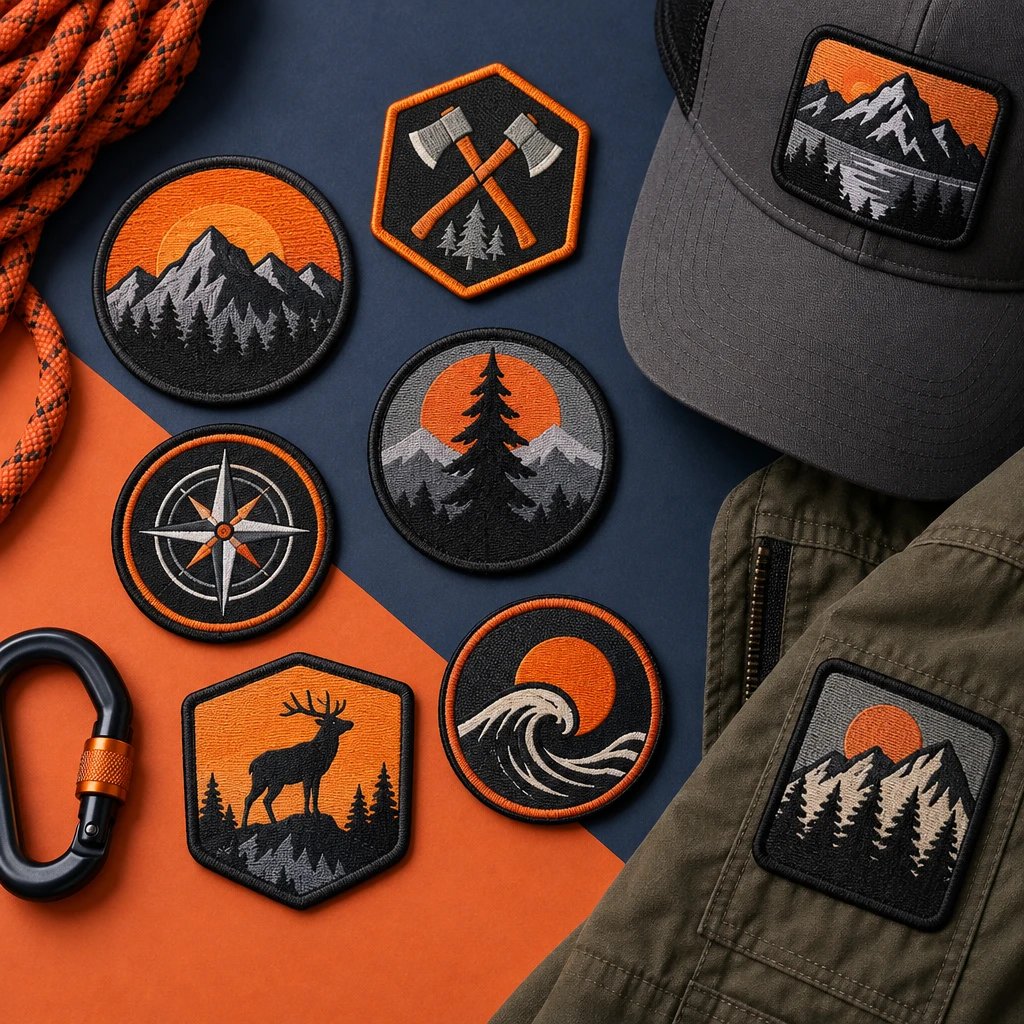
For woven vs PVC patches on hats and jackets, I'd choose woven for fine lettering and soft garments, and PVC for bold outdoor logos that need a wipe-clean surface. The reasons come down to readable detail, how the patch sits on the garment, attachment, and whether molded depth is worth the added setup.
The material alone won't settle the order. A flexible badge can still look awkward if it's too wide for a cap panel, and a weather-resistant patch can still fail if the attachment is wrong. Start with the actual hat or jacket, not a flat logo file.
What changes when comparing woven vs PVC patches on hats?
Woven gives you a flatter, lighter patch; PVC gives you molded depth and a surface that's easier to wipe clean. On a hat, that difference affects both the artwork and the way the front panel bends.
A woven patch is a textile badge that forms its design by interlacing fine yarns, commonly polyester. Unlike embroidery, which stitches a design into a base fabric, weaving builds the image into the textile structure. That construction is useful for narrow lines, compact lettering, and logos that shouldn't feel bulky.
A polyvinyl chloride (PVC) patch is a flexible molded plastic badge that forms its design from colored material and raised or recessed areas. People often call it a rubber patch, although PVC isn't rubber. Its appeal is physical separation: a raised club name, a recessed background, or a border you can feel.
| Buying criterion | Woven patches | PVC patches | Practical implication |
|---|---|---|---|
| Detail level | Fine yarns suit small lettering and closely spaced lines, within weaving limits. | Raised details need enough width and separation to mold clearly. | Choose woven when reading the full name matters more than dimensional texture. |
| Durability | Can hold up well with suitable yarn, edge finishing, and attachment; exposed textile can snag or abrade. | The molded face handles moisture and dirt well, but thin projections and stressed stitch areas can still fail. | Match the construction to the wear point rather than treating either material as indestructible. |
| Weight and flexibility | Usually thinner and lighter, although backing and borders add stiffness. | Often thicker and heavier; flexibility depends on the specified construction. | Woven is generally easier to accommodate on an unstructured cap or lightweight jacket. |
| Cleaning | Dirt can work into the textile; cleaning must respect both patch and garment. | Surface mud usually wipes away with a damp cloth. | PVC is useful for trail and work gear, but the complete garment still controls care instructions. |
| Cost drivers | Size, quantity, yarn colors, edge treatment, backing, and design complexity affect the quote. | Mold setup, size, thickness, color separation, relief levels, quantity, and backing affect the quote. | A straightforward woven design is often the simpler budget choice, especially for a small run. |
| Typical uses | Club caps, lightweight jackets, detailed brand labels, and uniform identification. | Outdoor caps, equipment jackets, removable club badges, and bold workwear branding. | Choose around the garment and use case, not just the appearance of a loose patch. |
| Attachment | Can be specified for sewing or compatible adhesive and removable backing systems. | Often sewn through a designated channel or attached with a specified removable backing. | Confirm the complete attachment method before approving either construction. |
| Border treatment | A merrowed border adds a wrapped thread edge; a suitable cut edge can keep the profile flatter. | A molded perimeter can frame the design and accommodate a sewing channel. | Reserve border and stitch space before deciding how much artwork will fit. |
The comparison assumes a sensible design in each material. Backing can change the result substantially. A heavily backed woven patch may feel stiffer than expected, while a carefully specified PVC badge can be more flexible than its raised appearance suggests.
Choose woven if readable detail and a soft fit matter most
Choose woven when the logo contains fine lettering, the garment needs to flex, or molded depth doesn't serve a practical purpose. It's also the right call when a simpler construction meets the brief and keeps setup under control.
Consider an example: a running club orders 40 patches for cotton twill caps, and the artwork includes a long club name around a narrow skyline. I'd start with woven. The club needs people to read the name, not feel several raised levels, and the cap shouldn't gain a rigid plate across its front.
Small lettering still needs restraint. Weaving doesn't turn a crowded seal into readable artwork automatically. Open the letter spacing, remove decorative hairlines, and keep the smallest words away from the border. Sometimes deleting a secondary phrase does more for the finished patch than changing materials.
For a lightweight coach jacket, a flat woven badge also tends to move with the shell more comfortably. That matters at a chest placement where the wearer bends or folds their arms. On a heavy canvas jacket, the difference in drape may barely matter.
- Choose woven for a detailed club crest that must stay readable at a modest finished size.
- Choose woven for an unstructured cap when keeping the front panel flexible is a priority.
- Choose woven for a jacket label that should sit close to the fabric rather than project from it.
- Choose the simpler woven option when raised depth is only a styling preference and the budget is tight.
Review woven patch construction options with the final logo, not just a material swatch. The important question is whether your narrowest lines, smallest words, and intended border work together at the actual size.
Choose PVC if the patch needs depth and easy surface cleaning
Choose PVC for bold logos, deliberate raised detail, and garments exposed to dirt or splashes. It makes the most sense when those properties solve a real use problem rather than merely making the badge thicker.
For example, a trail crew might specify a broad mountain symbol and a short organization name for a canvas work jacket. A molded face is useful here because surface dirt can be wiped away, and the design has enough open space for clear relief. Tiny contour lines wouldn't improve that badge.
PVC rewards simpler artwork. Separate the lettering from the background, give the outside shape a practical perimeter, and decide which elements actually need to stand higher. Adding another raised level isn't automatically an upgrade. It can complicate the mold without making the logo easier to recognize.
I'd skip PVC for a dense commemorative seal on a soft cap unless the artwork can be edited. Keeping every ribbon, date, and decorative line often means increasing the patch size or flattening the design's hierarchy. Neither helps if the hat has limited front-panel space.
- Choose PVC for a short wordmark or broad icon that benefits from raised and recessed areas.
- Choose PVC for outdoor gear where wiping mud from the patch face is useful.
- Choose PVC for a removable badge when the garment already has an appropriate receiving panel.
- Avoid unnecessary thickness when the patch must bend around a hat crown.
The available PVC patch design options should be evaluated alongside the sewing channel, finished thickness, and backing. A good-looking face doesn't excuse an attachment detail that fights the garment.
Check hat fit before choosing patch dimensions
A hat patch needs to fit the usable front panel without bridging awkwardly across seams or forcing the crown flat. Measure the intended hat blank before settling the patch width and height.
See your artwork as a custom USA patch before you buy. Free digital mockup in 12 hours — 5-piece minimum per design. We do not produce until you approve.
GET A FREE MOCKUPStructured trucker caps, unstructured dad caps, and knit beanies behave differently. A structured crown can support a more substantial badge, but its center seam can still interfere with contact. A soft cotton cap may pucker around a stiff perimeter. A beanie stretches, while the patch generally stretches much less.
As a fit-check example, cut a paper rectangle 3 inches wide by 2 inches tall and hold it against the intended cap. Those dimensions aren't a recommendation for every hat. They're a quick way to see whether the design reaches too close to the bill seam, crosses a strong curve, or crowds the panel edges.
- Identify the exact hat style and photograph its front while the crown is supported in its normal shape.
- Measure the usable area between seams and above the bill, rather than measuring the whole front panel.
- Place a full-size paper outline on the crown and check it from the front and side.
- Account for the border, sewing channel, and blank space before sizing the lettering.
- Confirm how the patch will be attached, including access behind the front panel and sweatband.
A flat digital rendering can't prove that a thick badge will follow a curved crown. In our production experience, that is a fit question separate from artwork approval. If the cap construction or patch thickness is unfamiliar, discuss a physical fit check before committing to the full application run.
If the fit is uncertain, request a free digital mockup with the hat style and proposed dimensions included. Use it to check the artwork scale and placement first, then resolve any curvature or attachment questions before approval.
Match the backing and border to the jacket
For many denim and canvas jackets, sewing is a practical permanent attachment method. Lightweight shells, insulated jackets, and waterproof garments need more care because heat, needle holes, and access to the lining can create separate problems.
Denim and canvas: plan the stitch path
These fabrics generally provide a stable foundation for either material. A woven patch can use a suitable finished edge, including a merrowed border on compatible shapes. A PVC patch should have a planned sewing channel so stitches don't run randomly through raised lettering or too close to the outside edge.
Check pockets before choosing placement. Sewing a chest badge through the entire jacket front can close a pocket or catch its lining. The patch may look correct from the outside while making the garment less useful.
Nylon shells and rainwear: protect the garment first
Don't assume iron-on backing is safe just because a patch can be supplied with it. The required heat may conflict with a shell fabric, coating, insulation, or care label. Sewing avoids that heat but creates needle holes, which can compromise a waterproof barrier.
A PVC face resists water; it doesn't make the jacket waterproof. For technical rainwear, use a garment-approved attachment approach and discuss any required seam treatment with the garment maker or qualified decorator. I'd rather change the placement than damage an expensive shell.
Removable badges: specify both mating surfaces
Hook-and-loop backing is a removable fastening system that joins a hook surface to a matching loop surface. A hook-backed patch needs a receiving loop panel on the garment. Confirm whether that panel is already present, must be supplied, or needs installation.
Removable construction can work for either material. It also adds thickness, and exposed hooks can catch nearby fabric when the patch is removed. For a casual jacket that will never change badges, permanent sewing may be simpler and less bulky.
Compare total cost, not just the patch quote
A straightforward woven patch is often the lower-cost starting point, while PVC adds mold-related setup and construction choices. The accurate comparison is two quotes for the same finished size, quantity, artwork requirements, and attachment plan.
In our production experience, extra complexity costs money when it creates more work in setup or manufacturing. For PVC, that may mean several relief levels or difficult color separation. For woven, the artwork may need more careful preparation, a different edge treatment, or a larger size to preserve legibility.
Ask for the quote in US dollars and confirm what it includes. Loose patches and patches installed on garments are different scopes. Shipping, garment handling, receiving panels, and any sampling or setup charges should be clear before you compare totals.
Ready to spec type, size, backing, and quantity? Open the quote form for a free 12-hour mockup and USA shipping after approval.
GET A FREE MOCKUP- Keep the finished dimensions and order quantity identical when requesting a material comparison.
- Ask whether setup is included and what changes would require new setup on a reorder.
- Specify the same attachment goal, such as permanent sewing, rather than comparing unrelated backing packages.
- Separate patch production from garment application so a lower piece price doesn't hide more installation work.
- Remove unnecessary relief, intricate outlines, or secondary text before reducing useful logo size.
The simpler option is enough surprisingly often. For an indoor staff cap with a detailed company name, woven can do the job without molded depth. Spending more on PVC won't fix poor contrast, crowded lettering, or a patch that's too large for the crown.
If neither flat weaving nor molded plastic gives the texture you want, embroidered patches with visible thread texture are another construction to consider. That isn't a reason to restart a sound order, just a useful alternative when visible stitching is part of the brand's look.
What should the proof and order specifications include?
The proof should show the artwork at a defined size, and the order specifications should identify the construction that the drawing cannot fully communicate. Approving only the logo leaves too many production decisions open.
A digital mockup is a visual proof that shows the proposed design before production. It is useful for checking spelling, layout, colors, dimensions, and placement references. It isn't a physical test of flexibility, molded depth, exact screen-to-material color, or adhesion to a particular jacket.
- Confirm width and height in inches, including the finished outer border rather than only the central artwork.
- Check every word, abbreviation, date, and small interior opening at the intended viewing size.
- Specify woven yarn colors or PVC color areas, using appropriate physical color references when matching is important.
- Identify the edge finish for woven construction or the perimeter and sewing channel for PVC.
- Record the backing, attachment method, and any receiving panel needed for removable patches.
- For PVC, confirm the intended thickness and which design elements are raised or recessed.
- Record quantity, delivery address, needed-by date, and whether garment application is part of the quoted work.
- Approve the final proof and specifications in writing only after any conflicting notes have been corrected.
USA Customized Patches has a 10-piece minimum. We provide a free digital mockup before production, typically in about 12 hours. Production starts only after written approval.
Typical production is 7–12 business days after approval; confirm the schedule for the specified construction and quantity when ordering. Treat production and transit as separate parts of the deadline. Quote requests are open 24 hours a day, 7 days a week.
We ship from Corona, California, to all 50 states in the United States. Review the nationwide shipping information and provide the complete destination when discussing an event date. An approval delay can move the production start even when the artwork changes seem minor.
What is this advice based on?
These recommendations rest on the production process, the digital mockup step, and the written order specifications. They are not claims from a controlled wear test or promises that one material always outlasts the other.
In our production experience, useful comparisons start by separating artwork limits from garment limits. Weaving can solve a detail problem without solving an attachment problem. Molding can create a wipe-clean face without solving hat curvature. The proof and construction notes need to address both.
No universal price or service-life figure applies across these orders. Size, backing, edge construction, thickness, placement, cleaning, and use all change the result. For a demanding application, a physical sample or application test can answer questions a screen proof cannot.
Which material should you approve?
Approve woven for a detailed logo on a soft cap or lightweight jacket unless you have a specific reason to need molded depth. Approve PVC for a bold design on suitable outdoor gear when easy surface cleaning and raised construction justify the added setup and bulk.
That's the verdict. I'd skip the more complicated option if its only benefit is that it looks substantial in a close-up photo. The badge still has to sit correctly, read at normal viewing distance, and stay attached without damaging the garment.
For the next step, request a free digital mockup with your logo, garment style, finished dimensions, quantity, and intended attachment. Include a photo of the exact placement area; a visible center seam, pocket opening, or lining can change the recommendation before anything reaches production.